


Each Monday, I pick out North America’s celestial highlights for the week ahead (which also apply to mid-northern latitudes in the northern hemisphere), but be sure to check my main feed for more in-depth articles on stargazing, astronomy, eclipses and more.
The Night Sky This Week: February 26-March 3, 2024
As the moon wanes from last week’s full ‘Snow Moon,’ the night skies get dark in the early evening. It’s the best time to go stargazing, though this month, Jupiter can still be seen in the west when the moon rendezvous with Spica, the brightest star in the constellation Virgo. If you can find a very dark place, try to spot the Zodiacal Light. If you’re anywhere near artificial light, you’ll fail; as light pollution continues to increase, it’s becoming more crucial to find the right spot to enjoy these cosmic wonders.
Here’s everything you need to know about stargazing and astronomy this week:
Monday, February 26: Saturn And Mercury Meet The Sun
Today, both Saturn and tiny Mercury are lost in the sun’s glare, from our perspective on Earth, as it reaches what astronomers call superior conjunction.
Wednesday, February 28: Moon And Spica
Look to the south before sunrise this morning to see an 87%-lit waning gibbous moon just a degree and a half from Spica, the brightest star in the constellation Virgo.
Thursday, February 29: Leap Day
Today only occurs every four years. It’s February 29 because 2024 is a leap year, which we need every four years to account for the extra quarter day in the Earth’s orbit around the sun.
Sunday, March 3: Last Quarter Moon Meets Antares
Look to the south an hour before sunrise this morning, and you’ll see a half-lit Last Quarter Moon shining less than a degree from Antares, a red supergiant star in the constellation Scorpius.
As well as being a lovely conjunction, a Last Quarter Moon is an excellent time to use a telescope to get a close-up of the lunar surface as sharp shadows are thrown across the landscape.
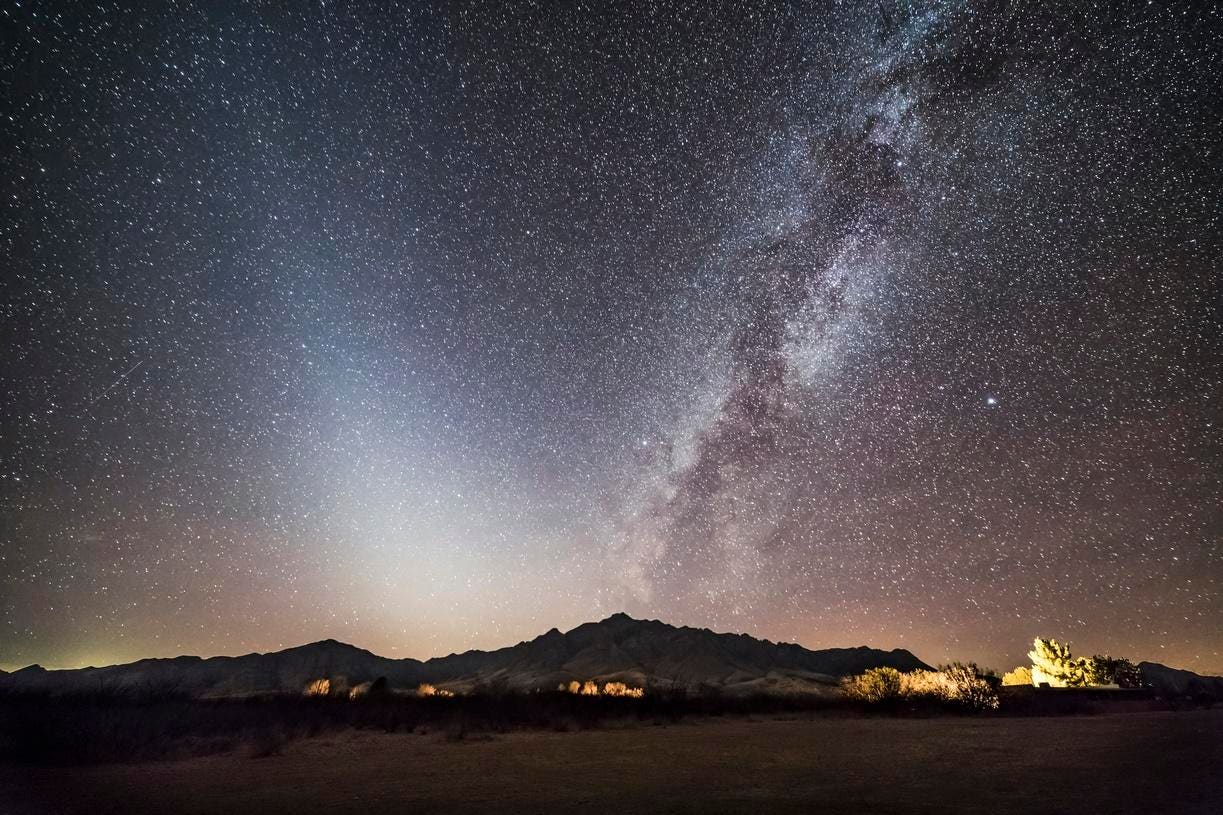
Object Of The Month: Zodiacal Light
This week is the ideal time to see something subtle yet spectacular, but you’ll need to be somewhere truly dark in the northern hemisphere. Look to the western sky about an hour after sunset—just above where the sun has recently set—and see a triangular glow. Known as a “false dusk,” this so-called zodiacal light is sunlight reflecting off cosmic dust left in the solar system. Some of it may be from passing asteroids and comets; it could also be the leftovers of the planets’ formation, or perhaps it’s “Mars Light.”
Either way, it’s the biggest thing in the solar system.
Stargazing Tip Of The Week: Light Pollution
If you live in an urban area, then you’ll know that stars are becoming more challenging to see. A landmark study published last year found that between 2011 and 2022, the night sky got brighter by 6.5% in Europe and 10.4% in North America. “The rate at which stars are becoming invisible to people in urban environments is dramatic,” said Christopher Kyba, lead author and researcher at the GFZ German Research Centre for Geosciences and the Ruhr-Universität Bochum, Germany. “If the development were to continue at that rate, a child born in a place where 250 stars are visible will only be able to see 100 stars there on his 18th birthday.”
The times and dates given apply to mid-northern latitudes. For the most accurate location-specific information, consult online planetariums like Stellarium and The Sky Live. Check planet-rise/planet-set, sunrise/sunset and moonrise/moonset times for where you are.
I’m an expert on the night sky and author of Stargazing In 2024: 50 Easy Things To See In The Night Sky From North America. For the very latest on sky events and the total solar eclipse please subscribe or check my main feed regularly for new articles.
Wishing you clear skies and wide eyes.
Read the full article here