


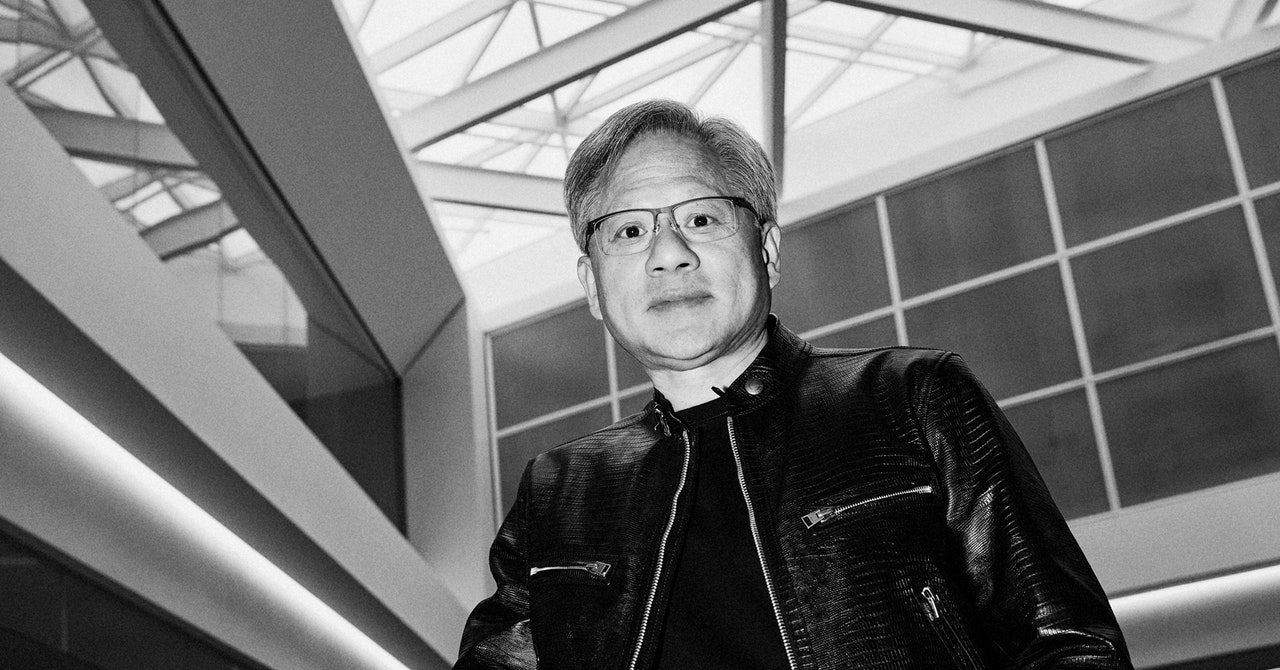
Talking to Jensen Huang should come with a warning label. The Nvidia CEO is so invested in where AI is headed that, after nearly 90 minutes of spirited conversation, I came away convinced the future will be a neural net nirvana. I could see it all: a robot renaissance, medical godsends, self-driving cars, chatbots that remember. The buildings on the company’s Santa Clara campus weren’t helping. Wherever my eyes landed I saw triangles within triangles, the shape that helped make Nvidia its first fortunes. No wonder I got sucked into a fractal vortex. I had been Jensen-pilled.
Huang is the man of the hour. The year. Maybe even the decade. Tech companies literally can’t get enough of Nvidia’s supercomputing GPUs. This is not the Nvidia of old, the supplier of Gen X video game graphics cards that made images come to life by efficiently rendering zillions of triangles. This is the Nvidia whose hardware has ushered in a world where we talk to computers, they talk back to us, and eventually, depending on which technologist you talk to, they overtake us.
For our meeting, Huang, who is now 61, showed up in his trademark leather jacket and minimalist black sneakers. He told me on that Monday morning that he hates Monday mornings, because he works all day Sunday and starts the official work week already tired. Not that you’d know it. Two days later, I attended a health care investment symposium—so many biotech nerds, so many blazers—and there onstage was Huang, energetic as ever.
“This is not my normal crowd. Biologists and scientists, it’s such an angry crowd,” Huang said into a microphone, eliciting laughter. “We use words like creation and improve and accelerate, and you use words like target and inhibit.” He worked his way up to his pitch: “If you want to do your drug design, your drug discovery, in silicon, it is very likely that you’ll have to process an enormous amount of data. If you’re having a hard time with computation of artificial intelligence, you know, just send us an email.”
Huang has made a pattern of positioning Nvidia in front of every big tech trend. In 2012 a small group of researchers released a groundbreaking image recognition system, called AlexNet, that used GPUs, instead of CPUs, to crunch its code and launched a new era of deep learning. Huang promptly directed the company to chase AI full-steam. When, in 2017, Google released the novel neural network architecture known as a transformer—the T in ChatGPT—and ignited the current AI gold rush, Nvidia was in a perfect position to start selling its AI-focused GPUs to hungry tech companies.
Nvidia now accounts for more than 70 percent of sales in the AI chip market and is approaching a $2 trillion valuation. Its revenue for the last quarter of 2023 was $22 billion—up 265 percent from the year prior. And its stock price has risen 231 percent in the last year. Huang is either uncannily good at what he does or ridiculously lucky—or both!—and everyone wants to know how he does it.
Read the full article here





