


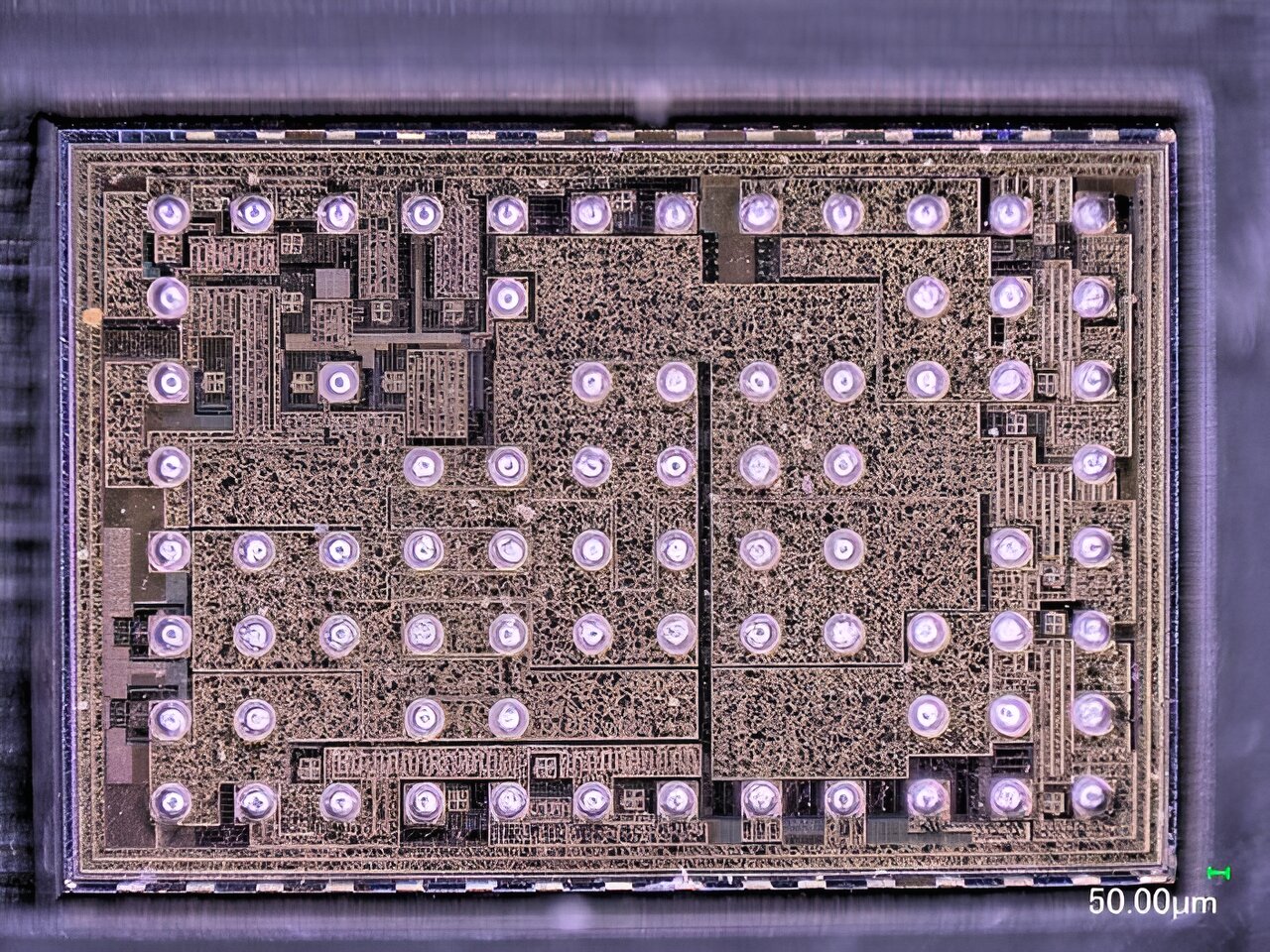
University of California San Diego and CEA-Leti scientists have developed a ground-breaking piezoelectric-based DC-DC converter that unifies all power switches onto a single chip to increase power density. This new power topology, which extends beyond existing topologies, blends the advantages of piezoelectric converters with capacitive-based DC-DC converters.
The power converters the team developed are much smaller than the huge, bulky inductors currently used for this role. The devices could eventually be used for any type of DC-DC conversation, in everything from smart phones, to computers, to server farms and AR/VR headsets.
The results were presented in the paper, “An Integrated Dual-side Series/Parallel Piezoelectric Resonator-based 20-to-2.2V DC-DC Converter Achieving a 310% Loss Reduction,” Feb. 20 at ISSCC 2024 in San Francisco.
“The Dual-side Series/Parallel Piezoelectric Resonator (DSPPR) is the first IC used for PR-based power conversion, and achieves up to 310% loss reduction over prior-art published and co-designed discrete designs for VCRs<0.125,” the paper reports.
“This innovative approach enhances performance, especially at low voltage conversion ratios—an area where prior works struggled to sustain both high efficiency and optimal utilization of piezoelectric materials,” said Patrick Mercier, a professor in the Department of Electrical and Computer Engineering at UC San Diego and a senior author of the paper.
The paper explains that a hybrid DSPPR converter exploits integrated circuits’ ability to offer sophisticated power stages in a small area compared to discrete designs, and enables efficient device operation at voltage conversion ratios (VCR) of less than 0.1.
“The IC provides a distinct opportunity to consolidate all power switches onto a single chip, significantly diminishing the PCB footprint and enhancing phase-control precision,” said Gael Pillonnet, scientific director of CEA-Leti’s Silicon Component Division.
In addition, incorporating additional capacitive-based converter stages, both pre- and post- the piezoelectric DC-DC converter, contributes to performance improvement.
“This strategic integration reduces the demand on piezoelectric material, resulting in a more compact converter with a notably smaller total volume. The marginal increase in additional capacitors, which is less than 10 percent, pales in comparison to the substantial gains facilitated by the proposed topology,” Pillonnet said.
“The DC-DC converter, particularly in the low VCR range, which was a focus of our work, has widespread applications in various sectors, such as high-power computing servers, automotive systems, USB chargers, and battery-powered devices,” said Wen-Chin Brian Liu, a Ph.D. student in Mercier’s research group and the lead author of the paper.
University of California – San Diego
Read the full article here


