


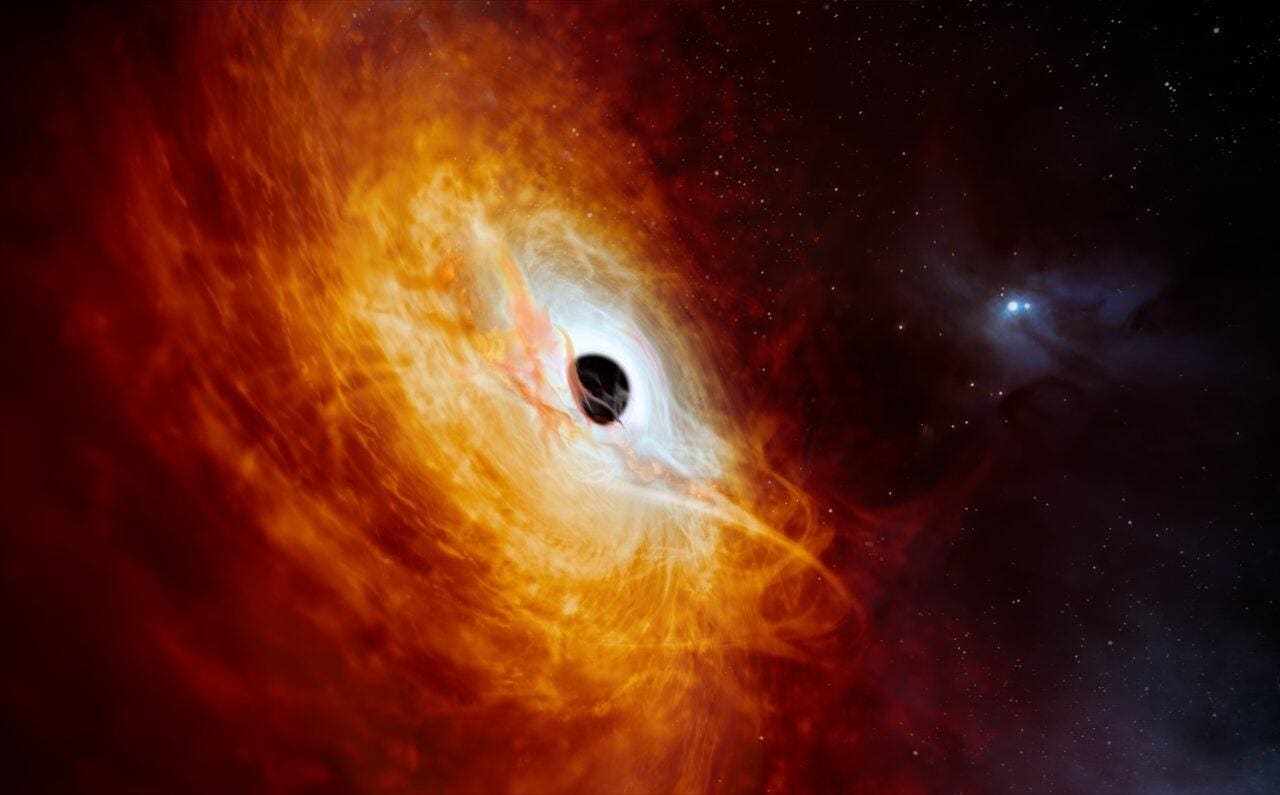
The most luminous object in the universe ever detected has been discovered by astronomers using the European Southern Observatory’s Very Large Telescope in Chile.
Detected 12 billion light-years distant in the early universe, the object is a quasar that’s 500 trillion times more luminous than the sun. “It is a surprise that it has remained unknown until today, when we already know about a million less impressive quasars,” said Christopher Onken, an astronomer at ANU and co-author of the study published today in Nature Astronomy. “It has literally been staring us in the face until now.”
Quasars Explained
A quasar is an object from the dawn of the universe powered by a supermassive black hole. These exceedingly bright sources of light across the sky are the most powerful objects in the universe. The black hole in this quasar is growing in mass by the equivalent of one sun per day, making it the fastest-growing black hole to date.
Recent research revealed quasars to be the consequence of galaxies colliding.
Black Hole
The quasar, named J0529-4351, is so far away from Earth that its light took over 12 billion years to reach us. “We have discovered the fastest-growing black hole known to date,” said Christian Wolf, an astronomer at the Australian National University (ANU) and lead author. “It has a mass of 17 billion suns and eats just over a sun per day—this makes it the most luminous object in the known universe.”
Accretion Disc
The incredible light from this quasar comes from what astronomers call its accretion disk, a hot, thin disk of matter slowly spiraling toward its black hole. “All this light comes from a hot accretion disc that measures seven light-years in diameter—this must be the largest accretion disc in the universe,” said ANU PhD student and co-author Samuel Lai.
In 2019, NASA and the European Space Agency reported that the Hubble Space Telescope had discovered a quasar as bright as 600 trillion suns. However, that quasar’s brightness was magnified by a ‘lensing’ galaxy, reducing its actual luminosity to about 11 trillion suns.
Wishing you clear skies and wide eyes.
Read the full article here