


Each Monday, I pick out North America’s celestial highlights for the week ahead (which also apply to mid-northern latitudes in the northern hemisphere), but be sure to check my main feed for more in-depth articles on stargazing, astronomy, eclipses and more.
The Night Sky This Week: February 19-25, 2024
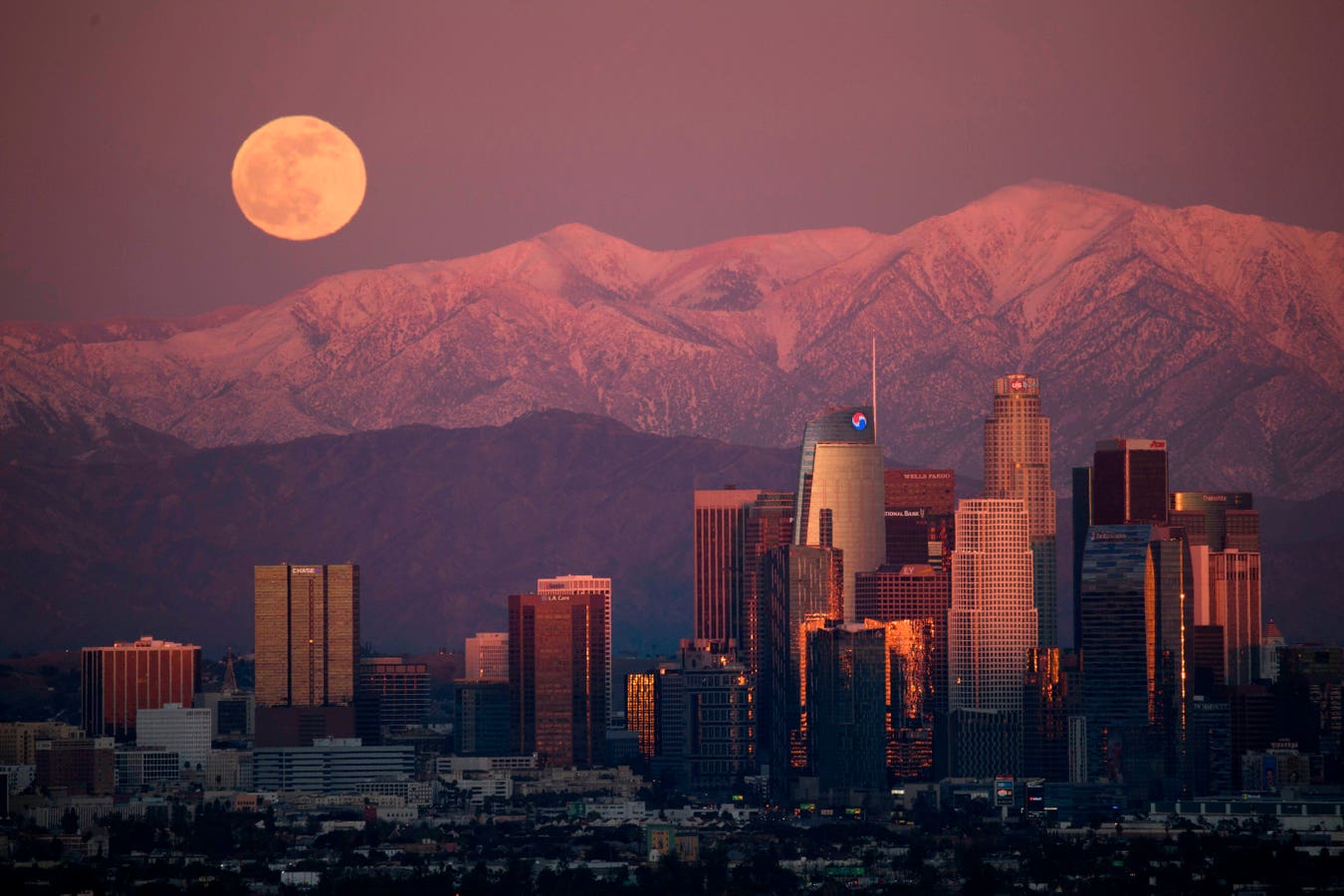
The highlight for sky-watchers this week is undoubtedly the rise of the full “Snow Moon,” which just happens to be the smallest full moon of the year—the opposite of a supermoon. In practice, it will still look large particularly if you view it as it rises on the east during dusk on Saturday.
There are few other interesting celestial events to watch out for, including a waxing crescent moon in Gemini, and Venus and Mars appearing to pass close to each other.
Here’s everything you need to know about stargazing and astronomy this week:
Tuesday, February 20: Moon In Gemini
Look to the eastern night sky after the sun goes down, and you’ll see a 90%-lit waxing crescent moon hanging just a degree or so underneath Pollux, the brightest star in the constellation Gemini. Above will be Castor, the other of the “twins” of Gemini. Pollux and Castor are 52 and 34 light-years from the solar system, respectively, and the 46th and 17th brightest stars in the night sky.
Thursday, February 22: Venus And Mars
There are few more beautiful celestial sights than two big, bright planets appearing to pass close to one another. Sadly, that’s not really the case this morning, as a brilliant Venus appears next to a very dim Mars. However, it’s close—just 0.6 of a degree—and with a pair of binoculars, you should be able to see the sight in the southeastern pre-dawn sky if you have binoculars. Venus will be straightforward to find and you can use it as a guide to find Mars, to its lower right.
Friday, February 23: Moon And Regulus
A waxing gibbous moon, 99% illuminated, will shine a few degrees from Regulus, the brightest star in the constellation Leo, “the lion,” after dark in the eastern night sky. Regulus, “star of the Lion’s breast,” is 77 light-years distant and the 21st brightest star in the night sky.
Saturday, February 24: Full ‘Snow Moon’
Best seen at moonrise where you are tonight, the second full moon of 2024 and the third of winter in the northern hemisphere, the “Snow Moon”—also known as the “Hungry Moon” and the “Storm Moon”—will be the farthest from Earth in 2024 (apogee). Therefore, it will be the smallest—the opposite of a “supermoon.”
Stargazing Tip Of The Week: The Best Time To Stargaze
You can stargaze any time of year but you do need a clear sky. It helps to avoid light pollution, but the moon’s phase is more critical. The main thing to avoid is a full moon, which bleaches the night sky. The week before a full moon is also difficult.
The best time is from the Third Quarter to the New Moon, when there’s no moonlight before midnight. With no moon and a clear sky, you’ll see a few thousand stars, the Milky Way (in summer), meteors, and satellites—all with your naked eyes. It’s accessible to anyone who takes the time to look.
Stargazing Dates For Your Diary: Planetary Conjunctions
The apparent close pass (conjunction) of Venus and Mars this week is difficult to see, but there will be more in 2024 that will be easier to see:
- April 20: Jupiter and Uranus (separated by just half a degree)
- July 16: Mars and Uranus (separated by just a degree—an outstretched finger)
- August 15: Mars and Jupiter (separated by just a third of a degree)
The times and dates given apply to mid-northern latitudes. For the most accurate location-specific information, consult online planetariums like Stellarium and The Sky Live. Check planet-rise/planet-set, sunrise/sunset and moonrise/moonset times for where you are.
I’m an expert on the night sky and author of Stargazing In 2024: 50 Easy Things To See In The Night Sky From North America. For the very latest on sky events and the total solar eclipse please subscribe or check my main feed regularly for new articles.
Wishing you clear skies and wide eyes.
Read the full article here