

Close Menu
  • Home
  • News
  • Startups
  • Innovation
  • Industry
  • Business
  • Green Innovations
  • Venture Capital
  • Market Data
    • Economic Calendar
    • Stocks
    • Commodities
    • Crypto
    • Forex
Facebook X (Twitter) Instagram
[gtranslate]
Facebook X (Twitter) Instagram YouTube
Innovation & Industry
Banner
  • Home
  • News
  • Startups
  • Innovation
  • Industry
  • Business
  • Green Innovations
  • Venture Capital
  • Market Data
    • Economic Calendar
    • Stocks
    • Commodities
    • Crypto
    • Forex
Login
Innovation & Industry
Green Innovations

Perovskite solar cell technology goes greener with antinomy

News RoomNews RoomFebruary 14, 2024No Comments2 Mins Read
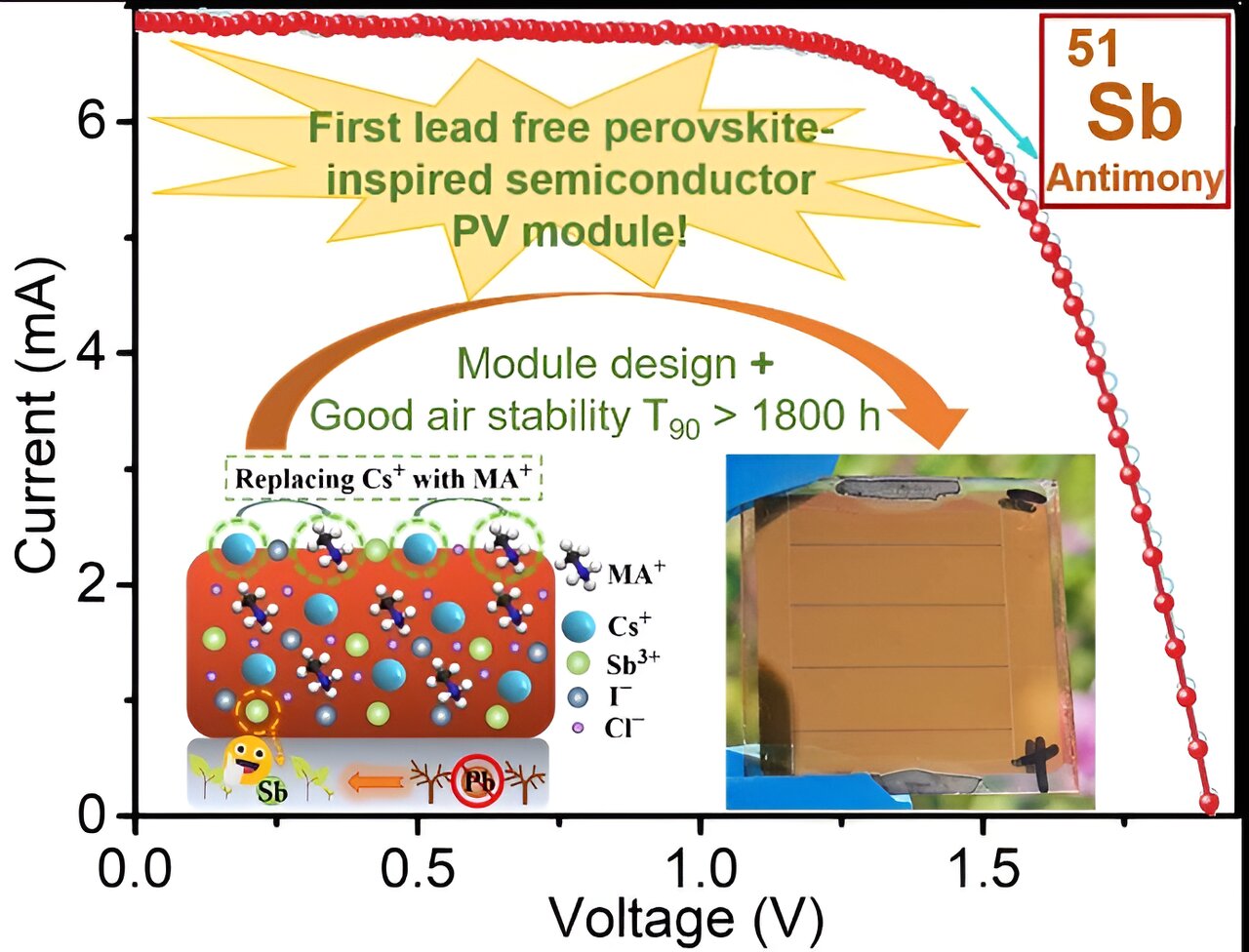
Current density−voltage (J−V) curves for the MA1.5Cs1.5Sb2I3Cl6 module (active area: 3 × 0.84 cm2), measured under standard test conditions (AM1.5G, 1,000 W/m2). Insets are schematic of antimony (Sb)-based perovskite-inspired material composition (left) and front-view photo of the fabricated module (right). Credit: ACS Energy Letters (2024). DOI: 10.1021/acsenergylett.3c02409

A team of researchers led by Center for Hybrid and Organic Solar Energy (CHOSE), Electronic Engineering Department at Tor Vergata University of Rome has developed the first air-stable lead (Pb) and tin (Sn)-free perovskite solar modules, fabricated with an antimony (Sb)-based perovskite-inspired material (PIM) as the light absorber. The results are published in the journal ACS Energy Letters.

“The Sb-based perovskite-inspired material photovoltaic cells we developed aim to solve a main issue with perovskite technology, that of the potential toxicity of Pb, as well as offer alternatives to Sn-based perovskites, which are unstable, and thus difficult to process in air,” the research group said.

Two cations in the precursor mixture were introduced that not only improved power conversion efficiencies (PCE = 1.5%) of Sb-based MA1.5Cs1.5Sb2I3Cl6 solar cells by 81% compared to conventional Cs-only counterparts, but also boosted long-term stability by 60%, with a loss of only 10% after ∼1,800 h of aging in air.

Such a positive stability behavior in air, accompanied by a thermal durability of hundreds of hours at high temperatures of 85°C in air, also enabled the researchers to carry out all three scalable P1, P2, and P3 laser patterning steps in air, which is required to manufacture a PV module. This enables laser equipment used for module patterning and manufacturing to be placed outside the glovebox simplifying the process as well as its cost.

Future studies will be focused on increasing efficiencies of these types of cells. “This study reveals new potentialities for large-scale production of potentially greener photovoltaics,” the research group said.

More information:
Jie Xu et al, Air-Stable Lead-Free Antimony-Based Perovskite Inspired Solar Cells and Modules, ACS Energy Letters (2024). DOI: 10.1021/acsenergylett.3c02409

Provided by
Tor Vergata University of Rome


Read the full article here

Related Articles

Neutron scattering study points the way to more powerful lithium batteries

Green Innovations April 16, 2024

Researchers can help shipowners achieve ambitious climate targets

Green Innovations April 16, 2024

Solar energy can uplift rural Ethiopians, but is hard to come by

Green Innovations April 16, 2024

A timer can shorten your shower even when you have no incentive to save water

Green Innovations April 16, 2024

High electric bills threaten California’s clean future: This plan could help

Green Innovations April 16, 2024

New insight about the working principles of bipolar membranes could guide future fuel cell design

Green Innovations April 16, 2024
Add A Comment
Leave A Reply Cancel Reply

Copyright © 2026. Innovation & Industry. All Rights Reserved.
  • Privacy Policy
  • Terms of use
  • Press Release
  • Advertise
  • Contact

Type above and press Enter to search. Press Esc to cancel.

Sign In or Register

Welcome Back!

Login to your account below.

Lost password?