


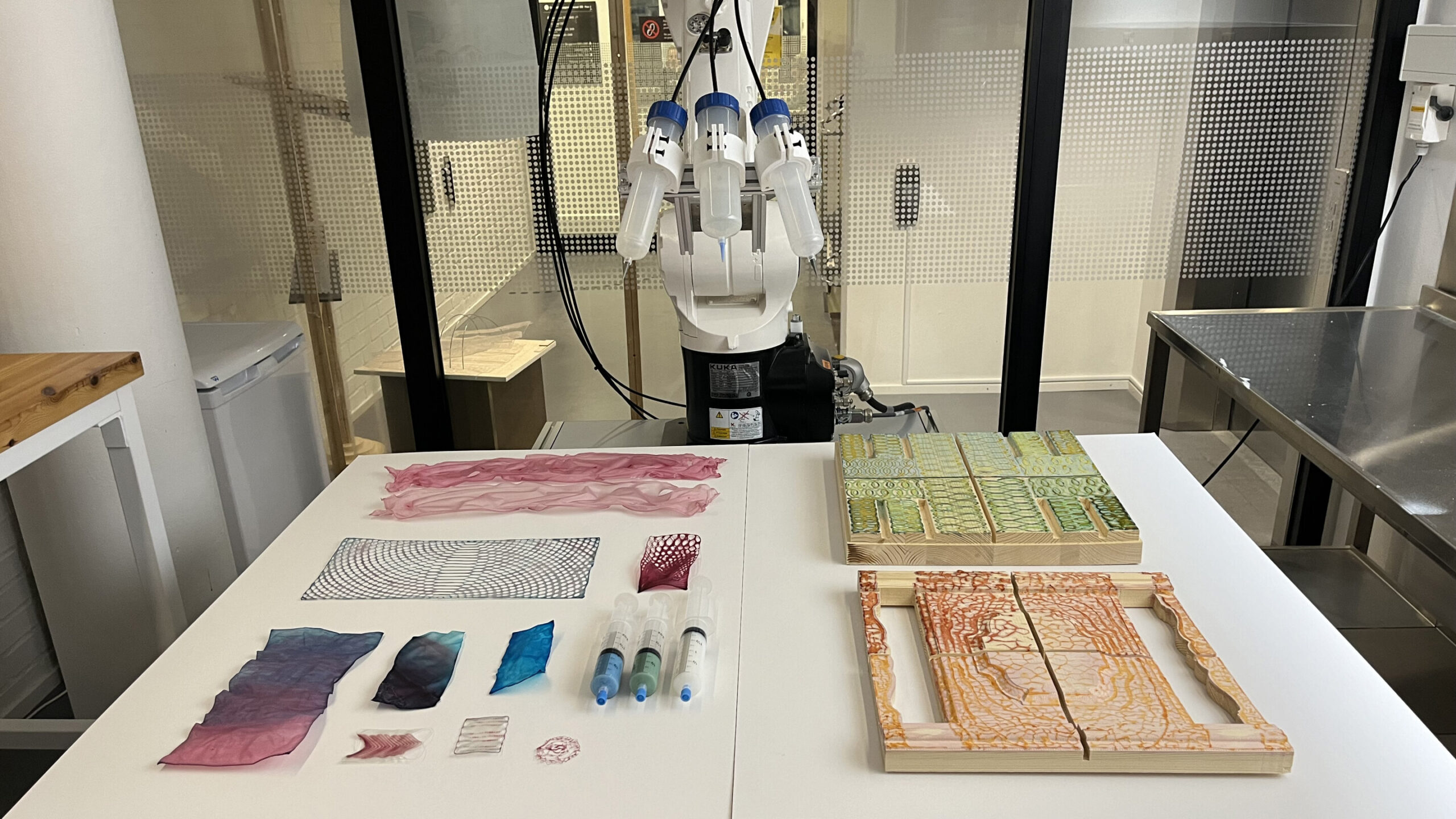
For the first time, a hydrogel material made of nanocellulose and algae has been tested as an alternative, greener architectural material. The study, from Chalmers University of Technology in Sweden and the Wallenberg Wood Science Center, shows how the abundant sustainable material can be 3D printed into a wide array of architectural components, using much less energy than conventional construction methods.
The research is presented in a paper titled “Robotically 3D printed architectural membranes from ambient dried cellulose nanofibril-alginate hydrogel” published in the journal Materials and Design.
The construction industry today consumes 50% of the world’s fossil resources, generates 40% of global waste and causes 39% of global carbon dioxide emissions. There is a growing line of research into biomaterials and their applications, in order to transition to a greener future in line with, for example, the European Green Deal.
Nanocellulose is not a new biomaterial, and its properties as a hydrogel are known within the field of biomedicine, where it can be 3D printed into scaffolds for tissue and cell growth, due to its biocompatibility and wetness. But it has never been dried and used as an architectural material before.
“For the first time we have explored an architectural application of nanocellulose hydrogel. Specifically, we provided the so far missing knowledge on its design-related features, and showcased, with the help of our samples and prototypes, the tuneability of these features through custom digital design and robotic 3D printing,” says Malgorzata Zboinska, lead author of the study from Chalmers University of Technology.
The team used nanocellulose fibers and water, with the addition of an algae-based material called alginate. The alginate allowed the researchers to produce a 3D printable material, since the alginate added an extra flexibility to the material when it dried.
Cellulose is coined as the most abundant eco-friendly alternative to plastic, as it is one of the byproducts of the world’s largest industries. “The nanocellulose used in this study can be acquired from forestry, agriculture, paper mills and straw residues from agriculture. It is a very abundant material in that sense,” says Zboinska.
3D printing and nanocellulose: A resource efficient technique
The architectural industry is today surrounded by access to digital technologies which allows for a wider range of new techniques to be used, but there is a gap in the knowledge of how these techniques can be applied.
According to the European Green Deal, as of 2030, buildings in Europe must be more resource-efficient, and this can be achieved through elevated reuse and recycling of materials, such as with nanocellulose, an upcycled, byproduct from industry. At the same time as buildings are to become more circular, cutting-edge digital techniques are highlighted as important leverages for achieving these goals.
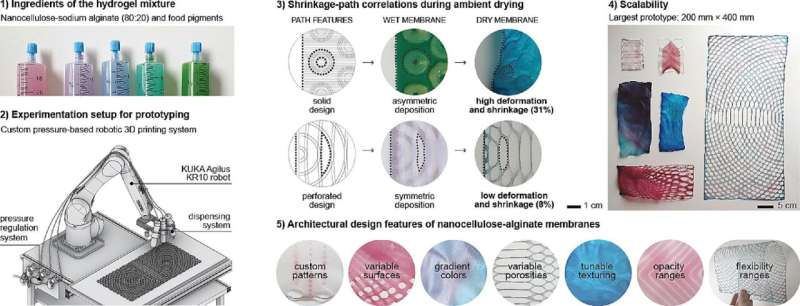
“3D printing is a very resource efficient technique. It allows us to make products without other things such as dies and casting forms, so there is less waste material. It is also very energy efficient. The robotic 3D printing system we employ does not use heat, just air pressure. This saves a lot of energy as we are only working at room temperature,” says Zboinska.
The energy efficient process relies on the shear thinning properties of the nanocellulose hydrogel. When you apply pressure it liquifies allowing it to be 3D printed, but when you take away the pressure it maintains its shape. This allows the researchers to work without the energy intensive processes that are commonplace in the construction industry.
Zboinska and her team designed many different toolpaths to be used in the robotic 3D printing process to see how the nanocellulose hydrogel would behave when it dried in different shapes and patterns. These dried shapes could then be applied as a basis to design a wide array of architectural standalone components, such as lightweight room dividers, blinds, and wall panel systems. They could also form the basis for coatings of existing building components, such as tiles to clad walls, acoustic elements for damping sound, and combined with other materials to clad skeleton walls.
The future of greener building materials
“Traditional building materials are designed to last for hundreds of years. Usually, they have predictable behaviors and homogenous properties. We have concrete, glass and all kinds of hard materials that endure and we know how they will age over time. Contrary to this, biobased materials contain organic matter, that is from the outset designed to biodegrade and cycle back into nature.
“We, therefore, need to acquire completely new knowledge on how we could apply them in architecture, and how we could embrace their shorter life cycle loops and heterogenous behavior patterns, resembling more those found in nature rather than in an artificial and fully controlled environment. Design researchers and architects are now intensely searching for ways of designing products made from these materials, both for function and for aesthetics,” says Zboinska.
This study provides the first steps to demonstrate the upscaling potentials of ambient-dried, 3D-printed nanocellulose membrane constructs, as well as a new understanding of the relationship between the design of the material’s deposition pathways via 3D printing, and the dimensional, textural, and geometric effects in the final constructs.
This knowledge is a necessary stepping stone that will allow Zboinska and her team to develop, through further research, applications of nanocellulose in architectural products that need to meet specific functional and aesthetic user requirements.
“The yet not fully known properties of novel biobased materials prompt architectural researchers to establish alternative approaches to designing these new products, not only in terms of the functional qualities, but also the acceptance from the users. The aesthetics of biobased materials are an important part of this.
“If we are to propose these biobased materials to society and people, we need to work with the design as well. This becomes a very strong element for the acceptance of these materials. If people do not accept them, we will not reach the goals of a circular economy and sustainable built environment.”
More information:
Malgorzata A. Zboinska et al, Robotically 3D printed architectural membranes from ambient dried cellulose nanofibril-alginate hydrogel, Materials & Design (2023). DOI: 10.1016/j.matdes.2023.112472
Chalmers University of Technology
Read the full article here


