


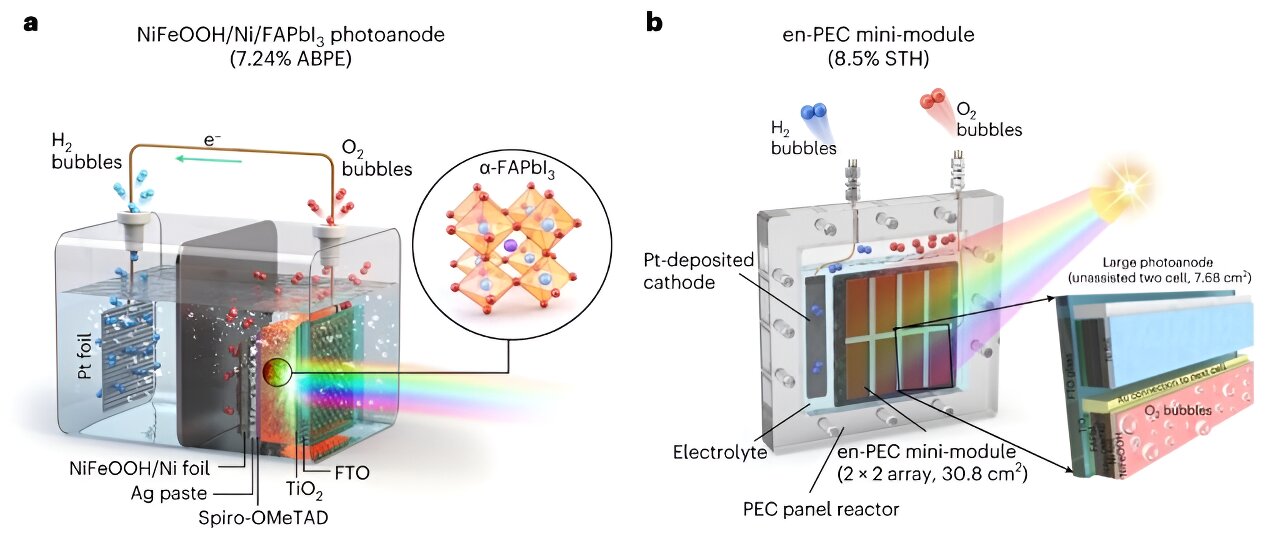
In a development toward practical photoelectrochemical water splitting, a research team has achieved a technological breakthrough in the production of green hydrogen. Through their innovative approach, the team has overcome the challenges of efficiency, stability, and scalability in photoelectrodes, paving the way for practical implementation. The study is published in the journal Nature Energy.
The team includes researchers from the School of Energy and Chemical Engineering at UNIST, led by Professors Jae Sung Lee, Ji-Wook Jang, and Sang Il Seok, in collaboration with Professor Hankwon Lim from the Graduate School of Carbon Neutrality at UNIST.
One of the key aspects of this breakthrough lies in the team’s ability to address the limitations of perovskite solar cells (PSCs) and significantly increase the size of photoelectrodes by a staggering 10,000 times. By doing so, they have achieved unprecedented efficiency, durability, and scalability in the production of green hydrogen using solar energy.
“Solar hydrogen technology, which harnesses the abundant renewable energy of the sun to decompose water and obtain hydrogen, is an ideal approach for green hydrogen production,” explained Professor Jae Sung Lee. “Through scaling up the photoelectrodes and overcoming the efficiency limitations of perovskite solar cells (PSCs), we have made significant strides towards practical implementation.”
The research team utilized perovskite as the photoelectrode material due to its efficiency and relative affordability. However, PSCs have been known for their vulnerability to ultraviolet rays and moisture, which pose significant challenges. To overcome these limitations, the team introduced formamide, rather than methylammonium, as a cation of perovskite. This modification greatly enhanced the stability of the photoelectrodes against ultraviolet rays.
Additionally, the team sealed the contact surface with water using a nickel foil, ensuring stability even in water. This groundbreaking achievement is a testament to the leadership of UNIST researchers, including Professor Sang Il Seok, who also contributed to this study.

The research team’s module-based design approach, connecting small photoelectrodes and arranging them in specific sizes, has paved the way for large-scale practical applications. With a solar hydrogen conversion efficiency exceeding 10% in this module-based design, the team has met the minimum condition for commercialization, achieving the world’s highest efficiency in large-area photoelectrodes.
Dr. Dharmesh Hansora, the first author of the study, emphasized the significance of this achievement, stating, “The photoelectrode developed in this study maintained high efficiency even in large areas. With our focus on field demonstration for the commercialization of green hydrogen production in the future, it is expected that solar-powered green hydrogen technology will be commercialized before 2030.”
More information:
Dharmesh Hansora et al, All-perovskite-based unassisted photoelectrochemical water splitting system for efficient, stable and scalable solar hydrogen production, Nature Energy (2024). DOI: 10.1038/s41560-023-01438-x
Ulsan National Institute of Science and Technology
Read the full article here


