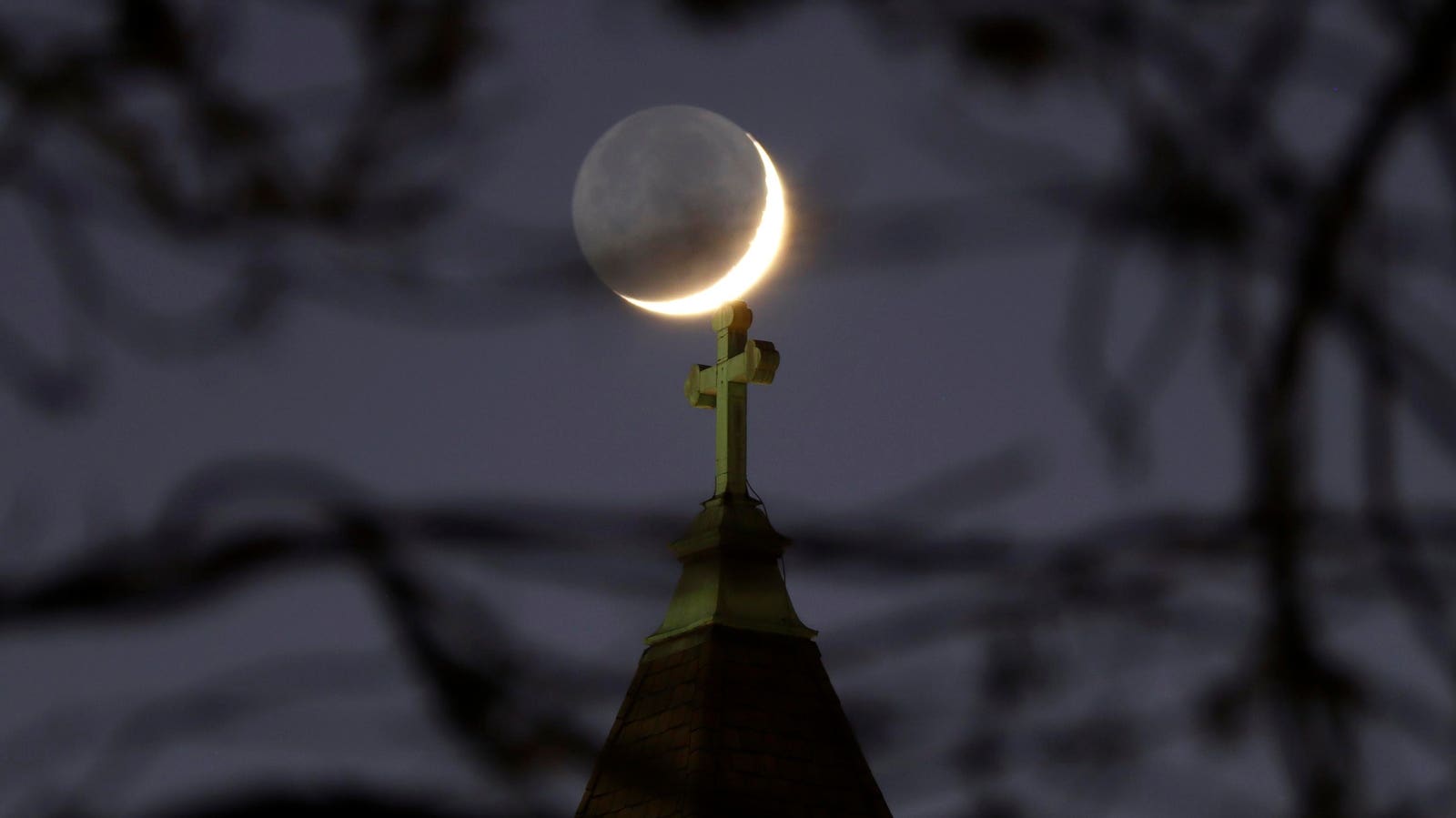
Each Monday, I pick out North America’s celestial highlights for the week ahead (which also apply to mid-northern latitudes in the northern hemisphere), but be sure to check my main feed for more in-depth articles on stargazing, astronomy, eclipses and more.
The Night Sky This Week: February 5-11, 2024
If you’ve been trying to find a time to stargaze for the first time in 2024, make it this week. With a crescent moon shrinking to a new moon midweek, the skies are dark and ideal for picking out constellations. It’s a great week to find the likes of Taurus, Orion, Gemini, and the Andromeda Galaxy.
This week also offers a timely reminder to start planning your trip to experience totality during the upcoming total solar eclipse in the U.S. If you don’t, all you’ll see is an unimpressive partial solar eclipse through solar eclipse glasses.
Here’s everything you need to know about stargazing and astronomy this week:
Monday, February 5: Crescent Moon And Antares
Look to the southeast an hour before sunrise this morning and you’ll see a 25%-lit waning crescent moon shining less than a degree from Antares, a red supergiant star in the constellation Scorpius. To the left of the pair will be a bright Venus.
Wednesday, February 7: Old Moon
Look to the southeast an hour before sunrise this morning to see a 9%-lit waning crescent moon shining below Venus.
Thursday, February 8: Eclipse Countdown
Today, it’s just two months until the “Great American Eclipse,” a total solar eclipse in North America for the last time until 2033 (Alaska) and 2044 (Montana and the Dakotas). The 115-mile-wide path of totality will pass across parts of five states in northwest Mexico, 15 U.S. States from Texas through Maine, and six Canadian provinces.
It will be possible to view the sun’s corona naked-eye for up to 4 minutes 28 seconds, only from this path—from everywhere else in North America, a partial solar eclipse will be seen.
Friday, February 9: New ‘Snow Moon’ Begins ‘Year of the Dragon’
Today, there’s a new moon roughly between Earth and the sun, and so lost in the latter’s glare. A new moon is, therefore, invisible to us on Earth—the exception being a solar eclipse when the disk of the new moon can be seen moving across the sun’s disk. This particular new moon signals Chinese New Year—the “Year of the Dragon.”
Sunday, February 11: Young Crescent Moon And Mercury
Tonight you can be among the first to see the youngest, most slender waxing crescent moon this month, but it won’t be easy. A 6%-lit slim crescent moon will be visible in the southwestern sky just after sunset but will sink soon after. You’ll need a low western horizon and a pair of binoculars to scan the still-bright twilight sky to find it. You may also see dim Saturn below it.
A crescent moon also means completely dark, moonless skies during the night. That makes this week an excellent time to go stargazing.
Object Of The Week: The ‘Seven Sisters’ Stars
The Pleiades is a group of stars also known as the “Seven Sisters.” It’s located in the Taurus constellation and can be seen with the naked eye as a small, bright cluster. The Pleiades group contains seven main bright stars—Alcyone, Atlas, Electra, Maia, Merope, Taygeta and Pleione. These stars are around 100 million years old, which is very young compared to most stars. They’re surrounded by a cloud of gas and dust that lights up with the radiation from the stars, making them look even more beautiful.
However, there is a special way to observe these stars. When you look at the Pleiades, you see stars, but if you look slightly to one side, you’ll see a bright and dazzling sight in the corner of your eyes unlike anything else in the night sky.
The times and dates given apply to mid-northern latitudes. For the most accurate location-specific information, consult online planetariums like Stellarium and The Sky Live. Check planet-rise/planet-set, sunrise/sunset and moonrise/moonset times for where you are.
I’m an expert on the night sky and author of Stargazing In 2024: 50 Easy Things To See In The Night Sky From North America. For the very latest on sky events and the total solar eclipse please subscribe or check my main feed regularly for new articles.
Wishing you clear skies and wide eyes.
Read the full article here