


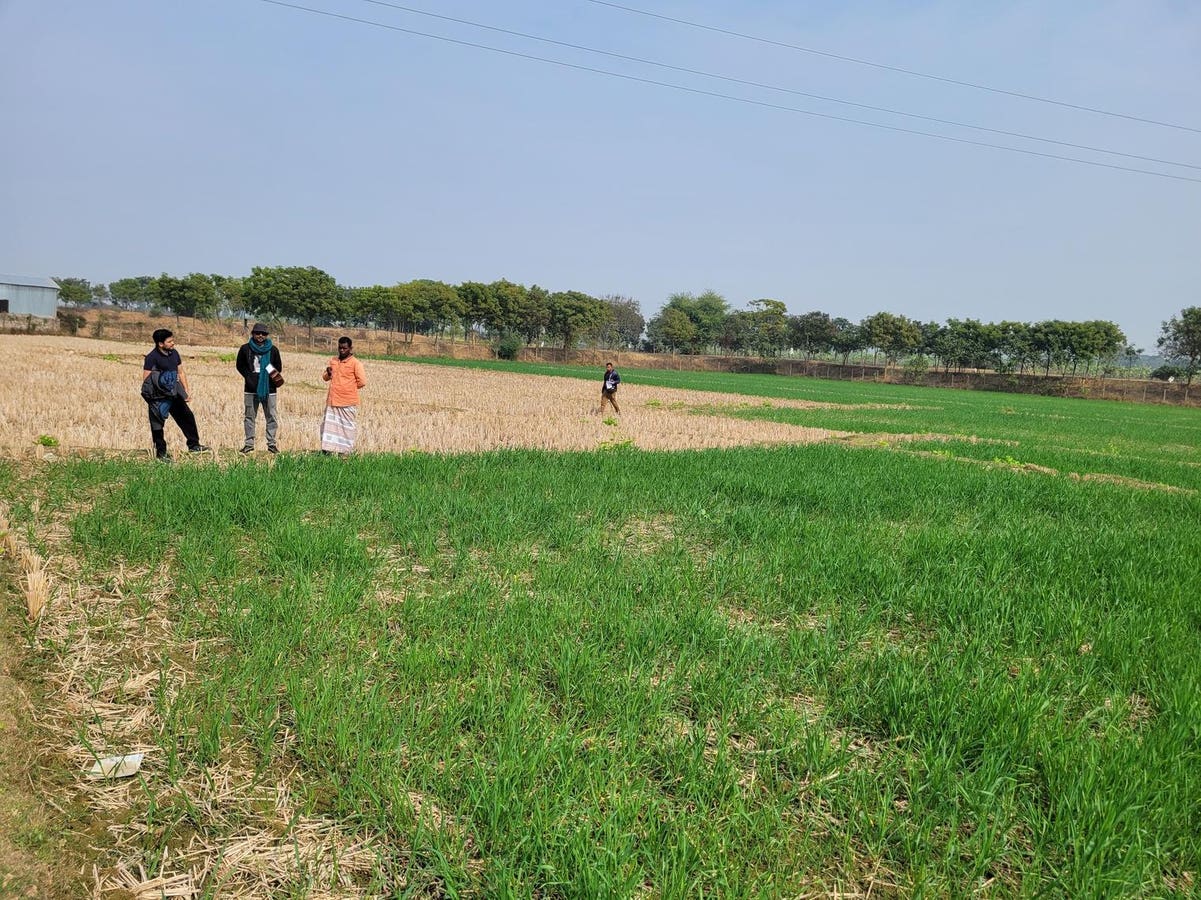
A researcher originally from Bangladesh has been looking at farms in South Asia to determine why agricultural practices aimed at reducing carbon emissions haven’t been adopted.
The agricultural sector is estimated to make up about a third of greenhouse gas emissions, according to the World Bank and the number of people suffering acute food insecurity increased from 135 million in 2019 to 345 million in 82 countries by June 2022.
Asif Ishtiaque, an Assistant professor at Missouri State University, says that climate-smart agriculture is a suite of agricultural practices and technologies designed to address the challenges posed by climate change in the agricultural sector, while also promoting sustainability and resilience.
“I observed majority of the farmers are not adopting most climate-smart agriculture practices and technologies, even nologies were highly recommended by government and non-government agricultural organizations,” he says.
Despite the promise of climate-smart agriculture (CSA) to improve food security in South Asia, most CSA practices and technologies have not been widely adopted.
In a study published in January 2024 in Nature Climate Change, Ishtiaque and his coauthors identified the key barriers to climate-smart agriculture adoption in South Asia: Weak organizational capacities; inadequate targeted incentives and limited post-adoption follow-up.
“Previous studies on the adoption of climate-smart agriculture practices and technologies were mostly case-study focused and limited to a specific location, whereas it was important to view this problem as a regional issue,” he says, adding that large-scale interventions may not be possible if studies are conducted on a case-by-case basis.
Ishtiaque explains that the adoption of these practices not only aids farmers in adapting to climate change impacts but also involves conservation of soil, water, and energy. and that many of the practices and technologies have been shown to lead to increased yields.
“This is particularly useful to regions where arable lands are scarce,” he says, “It has been found by agricultural researchers that if farmers do not till their lands between the time of harvesting one crop and sowing the next (zero-tillage), then crop yield increases and can generate greater revenue.”
Ishtiaque says that the biggest challenge of this project was the widely-varied nature of South Asian agriculture.
“For example, in Bangladesh, Nepal, and the eastern part of India, agricultural farms are smaller in size and farmers are relatively less wealthy, whereas in the western part of India and some part in Pakistan, farmers are more wealthy and have larger farms. Similarly, soil types, soil nutrients vary across South Asia,” he says, “These biophysical and socioeconomic factors play important role in determining the adoption of climate-smart agriculture practices and technologies.”
Bangladesh: First-hand Climate Impacts
Ishtiaque grew up in Bangladesh, a country in South Asia with numerous rivers and channels.
“In my childhood, my mother used to tell me stories of different countries and we had a large world map at home hanging on the wall,” he says, adding that this spurred his interest in geography.
Ishtiaque would go on to complete undergraduate studies in geography and environment at the University of Dhaka, including a project on disaster-induced migration.
“While working in urban slums, I realized that many of these migrants were involved in agriculture before they left their rural origins: because agriculture is heavily nature-dependent, it is an extremely climate-sensitive sector,” he says, adding that realization led him to pursue higher education training in climate change impacts on agricultural systems and effective adaptations to minimize those impacts.
“I think enabling scientists from the global south to take the lead in addressing global challenges is imperative for ethical, inclusive, and effective research,” Ishtiaque says, adding that a deep-rooted understanding of local contexts, cultural nuances, and community dynamics provides a unique lens for interpreting research outcomes.
“This cultural competency is crucial for developing context-specific solutions that resonate with the communities involved,” he says, “Additionally, my firsthand experience with the impacts of global challenges in South Asian region enhances the authenticity and relevance of my work.”
Better Rice Varieties
In India, another researcher working on improving agricultural outcomes for farmers is Jauhar Ali, head of the Hybrid Rice Development Consortium (HRDC), at the International Rice Research Institute (IRRI).
Ali has led a team that developed a rice variety that takes up less arsenic and they’re now working on one that will generate less greenhouse gas emissions.
According to the World Health Organization, an estimated 140 million people in over 70 countries drink water containing the toxic element arsenic at levels above WHO guidelines and in the Indian subcontinent, contaminated water from the Himalayas flow down across multiple countries into farmlands and irrigation reservoirs, which are then absorbed by food crops like rice, the dominant dietary staple in the region.
Ali says that in 2012, he and his team identified that arsenic toxicity was a key rice production constraint in India and Bangladesh.
“We initiated strategic research to develop arsenic protocols for screening and identifying the donors and advancing breeding lines,” he says, “By 2019, we had already released arsenic-safe rice varieties like PR126 and BRRI dhan 69 in India and Bangladesh, and they are currently occupying more than a million hectares.”
Read the full article here



