


High-performance batteries are required for a wide range of applications, and demand for them is growing rapidly. This is why the research and development of electrochemical energy storage systems, including those for electromobility, is one of the most important areas of work in materials science worldwide. The focus is not only on the charging capacities and charging speeds of the batteries, but also on the life span, safety, availability of raw materials and the CO2 balance.
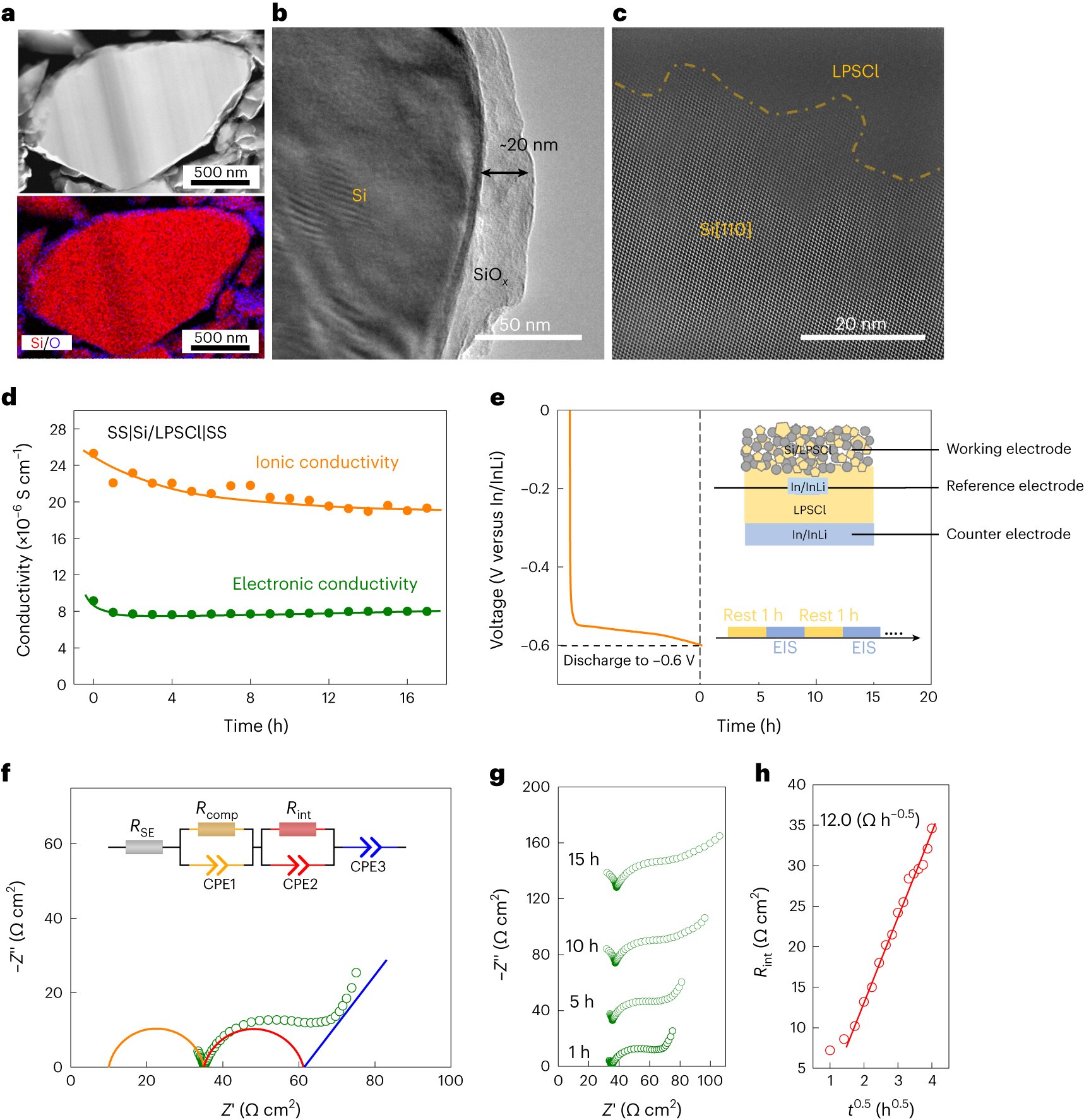
Chemists Dr. Hanyu Huo and Prof. Dr. Jürgen Janek (both Justus Liebig University Giessen), physicist Prof. Dr. Kerstin Volz (University of Marburg), materials scientist Dierk Raabe (Max Planck Institute for Iron Research, Düsseldorf) and theoretical material scientist Prof. Dr. Chandra Veer Singh (University of Toronto, Canada) and their teams have investigated the properties of silicon anodes in solid-state batteries.
They have come to the conclusion that these anodes have great potential to improve the performance of these batteries. Their findings on the stability, chemomechanics and aging behavior of silicon electrodes have now been published in the journal Nature Materials.
For the investigations, the research team combined various experimental and theoretical methods to quantitatively evaluate the transport of lithium in the electrode, the strong mechanical volume change of silicon during the charging and discharging processes and the reaction with the solid electrolyte.
“This comprehensive and fundamental analysis is an important step towards the possible use of silicon as an electrode material in solid-state batteries, which is currently the focus of intensive international research,” says Prof. Janek, one of the authors of the study.
The solid-state battery is an advanced concept of the lithium-ion battery, which currently functions with a liquid, organic electrolyte. The ultimate target is to use a solid electrolyte, which promises even better storage properties, longer service life and increased safety. The development of solid-state batteries has been the subject of intensive research worldwide for about 10 years, and the Giessen team led by Prof. Janek is one of the leading academic groups in this field.
During the charging process of a battery, lithium is absorbed in the negative electrode, the anode. “This causes the silicon at the anode of the battery to expand by several hundred percent, which leads to considerable mechanical problems in a solid-state battery,” explains Prof. Janek.
“In addition, the favored solid electrolytes react with the stored lithium, which also leads to capacity losses. Our recently published work evaluates these aspects quantitatively in detail for the first time.”
In the development of more powerful solid-state batteries that can compete with conventional lithium-ion batteries, the anode should be formed by a material with a particularly high storage capacity—ideally a lithium metal. However, this carries the risk of internal short circuits under operating conditions, so silicon is being investigated as an alternative with a similarly high storage capacity.
“Our results show that the silicon anode has considerable potential for use in solid-state batteries, which could be exploited by cleverly adapting the interfaces in the battery,” says Prof. Janek.
Additional material concepts are required to overcome the chemical and chemomechanical aging of silicon anodes. One part of this solution could be a polymer interlayer, as the research team from Germany and Canada has already been able to demonstrate.
More information:
Hanyu Huo et al, Chemo-mechanical failure mechanisms of the silicon anode in solid-state batteries, Nature Materials (2024). DOI: 10.1038/s41563-023-01792-x
University of Giessen
Read the full article here


