


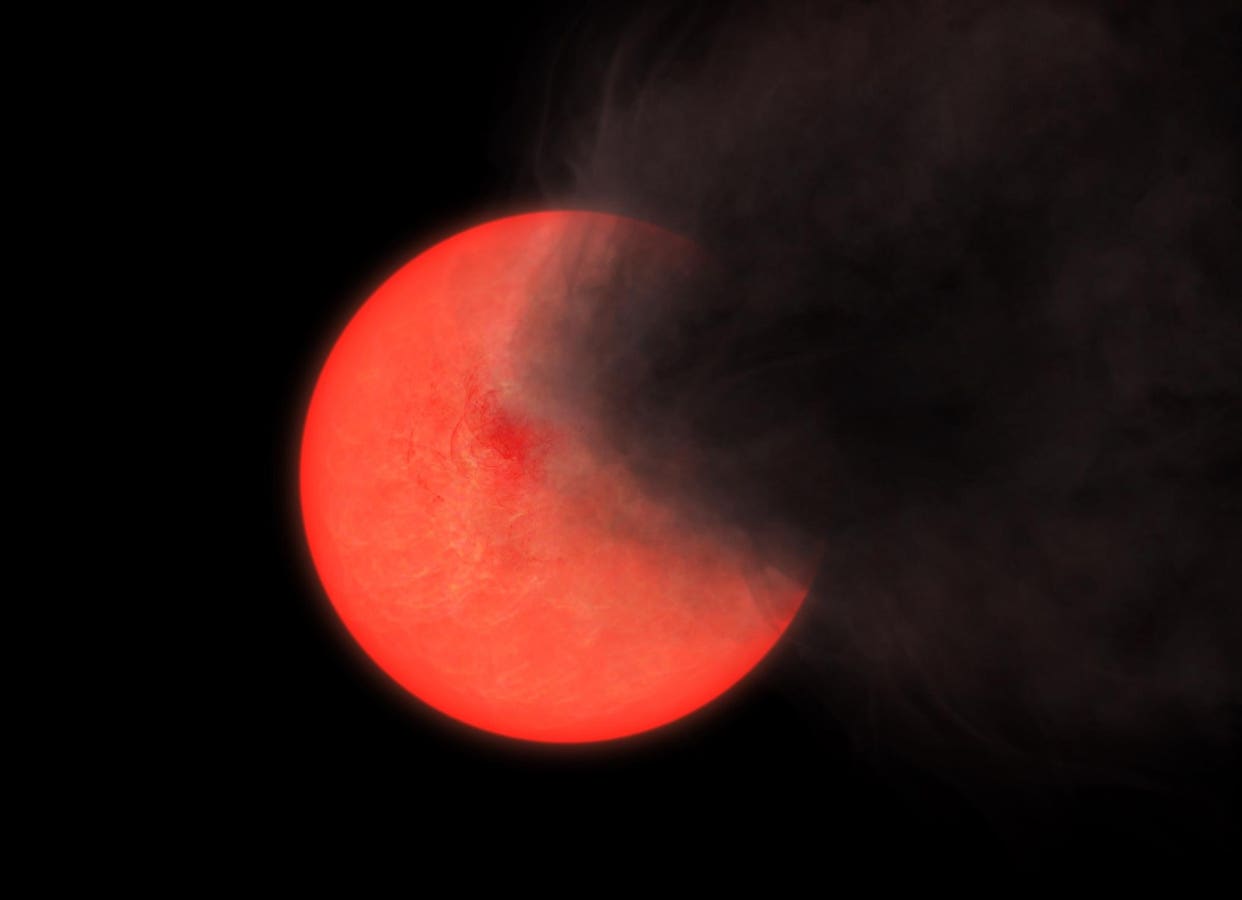
Astronomers have discovered a completely new type of star near the center of our galaxy that have the weird habit of seeming to fade away before suddenly coming to life to blow big bursts of smoke across space.
The scientists gave these shy stars the appropriate nickname “old smokers.”
“These elderly stars sit quietly for years or decades and then puff out clouds of smoke in a totally unexpected way,” explained Professor Dante Minniti at Andrés Bello University in Chile. “They look very dim and red for several years, to the point that sometimes we can’t see them at all.”
That lack of luminosity is what leads astronomers to consider them “hidden.” But in this case it appears that an entire class of stars has been hiding out from human eyes until now.
The work is published across three papers in the latest issue of Monthly Notices of the Royal Astronomical Society.
At least 21 old smokers were found during a ten-year survey called ‘VISTA Variables in the Via Lactea’, or VVV. The survey was intended to seek out a very different type of star, almost the complete opposite of the elderly exhalers.
“Our main aim was to find rarely-seen newborn stars, also called protostars, while they are undergoing a great outburst that can last for months, years, or even decades,” explained Dr, Zhen Guo from the University of Valparaiso in Chile, who led analysis of the light spectra from the stars.
The team found 32 such erupting protostars, some increasing their brightness at least 40-fold. But the study also revealed the existence of the old smokers, which the astronomers determined to be a new type of red giant star.
“We weren’t sure if these stars were protostars starting an eruption, or recovering from a dip in brightness caused by a disc or shell of dust in front of the star,” recalled University of Hertfordshire Professor Philip Lucas, who led the international team conducting the study. “Or if they were older giant stars throwing off matter in the late stages of their life.”
Lucas says the discovery has implications for our understanding of our galaxy and its composition.
“The discovery of a new type of star that throws off matter could have wider significance for the spread of heavy elements in the Nuclear Disc and metal-rich regions of other galaxies.”
Read the full article here



