


Hyundai Motor and Kia have developed technology to improve EVs’ high-speed cruising range by making them more aerodynamic but the claimed improvement of only 2.8% still leaves a big gap compared with combustion technology.
Test data from 31 EV reviews on WintonsWorld.com shows high but legal speed cruising can slash offered range by between 23% to 60%, with most managing to lose from 30 to 40%.
There are good scientific reasons for this.
Peter Wells, Professor of Business and Sustainability at Cardiff Business School, put the problem this way, in an interview last year.
“Range falls off a cliff at high speed. For an electric car, the extra energy required getting from 60 mph to 75 mph is astonishing and virtually doubles energy consumption to move all that air out of the way,” Wells said.
Hyundai of Korea and its subsidiary Kia said EVs have an inherent problem during high-speed driving. From about 50 mph, aerodynamic resistance starts to build. Their so-called skirt device goes some way to smoothing a path through the air.
Manufacturers have been reluctant to admit this is a problem, which ruins EV’s ability to compete with internal combustion engines as they cruise along Europe’s highway network where the speed limit is often 130 km/h (82 mph), and unlimited in some parts of Germany.
The cheapest diesels can manage at least 400 miles before refuelling, which takes maybe 5 minutes.
Hyundai said its Active Air Skirt technology controls the turbulence generated during high-speed driving by operating variably depending on speed.
“Installed between the front bumper (fender) and the front wheels, AAS is hidden during normal operation but operates at speeds over 50 mph when the aerodynamic resistance becomes greater than the air resistance. It is positioned only in front of the tires without completely covering the front end, “ Hyundai said in a statement.
There are other benefits.
“Aerodynamic enhancements of the technology increase downforce, which improves vehicle traction and high-speed stability,” the statement said.
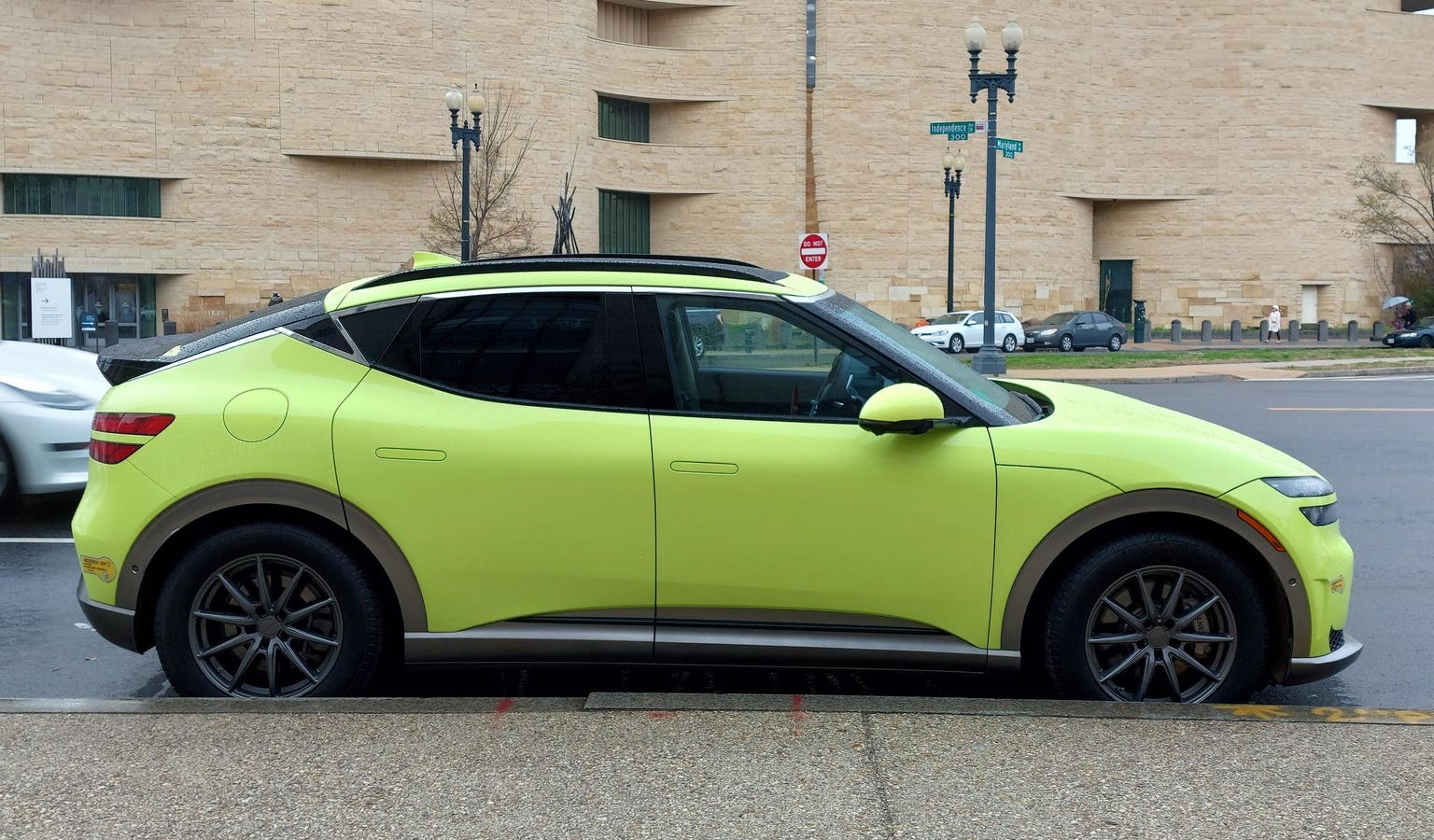
Hyundai said the testing took place on a Genesis GV60, and range was improved by 2.8% or about 3-1/2 miles. Genesis is Hyundai’s premium subsidiary. AAS would be particularly useful in making big bulky SUVs slip through the air more efficiently.
Genesis said in a separate statement that the technology may go into mass production after durability and performance tests.
The Hyundai statement didn’t say how it identified the problem that persuaded it to bring forward this technology, or whether this was an interim path towards making EVs more competitive with ICE vehicles. Hyundai gave no details of the spending involved in developing AAS, or when it would be installed on Hyundai, Kia and Genesis EVs.
Hyundai hasn’t yet responded to emailed questions.
Wintonsworld data shows the Kia Soul high-speed cruising penalty was 23.1%, giving it a theoretical highway range of 205 miles, and 2nd place in the table. Also-rans were the Kia EV6 (31.5%, 157 miles), Genesis GV60 (39.0% 143 miles), and Hyundai Ioniq5 33.3% (135.4 miles). Leading the pack was the Tesla model 3 (30.2%, 239 miles). In third place was the Tesla Model Y (45%, 180 miles).
At the bottom end of the scale, the Mini Electric was last with 32% and 67 miles of highway range, then the Vauxhall Corsa (52.6%, 73.2 miles) and the Fiat 500e (52.5%, 76.5 miles). The Mini Electric is currently being replaced by a new model.
Read the full article here



