


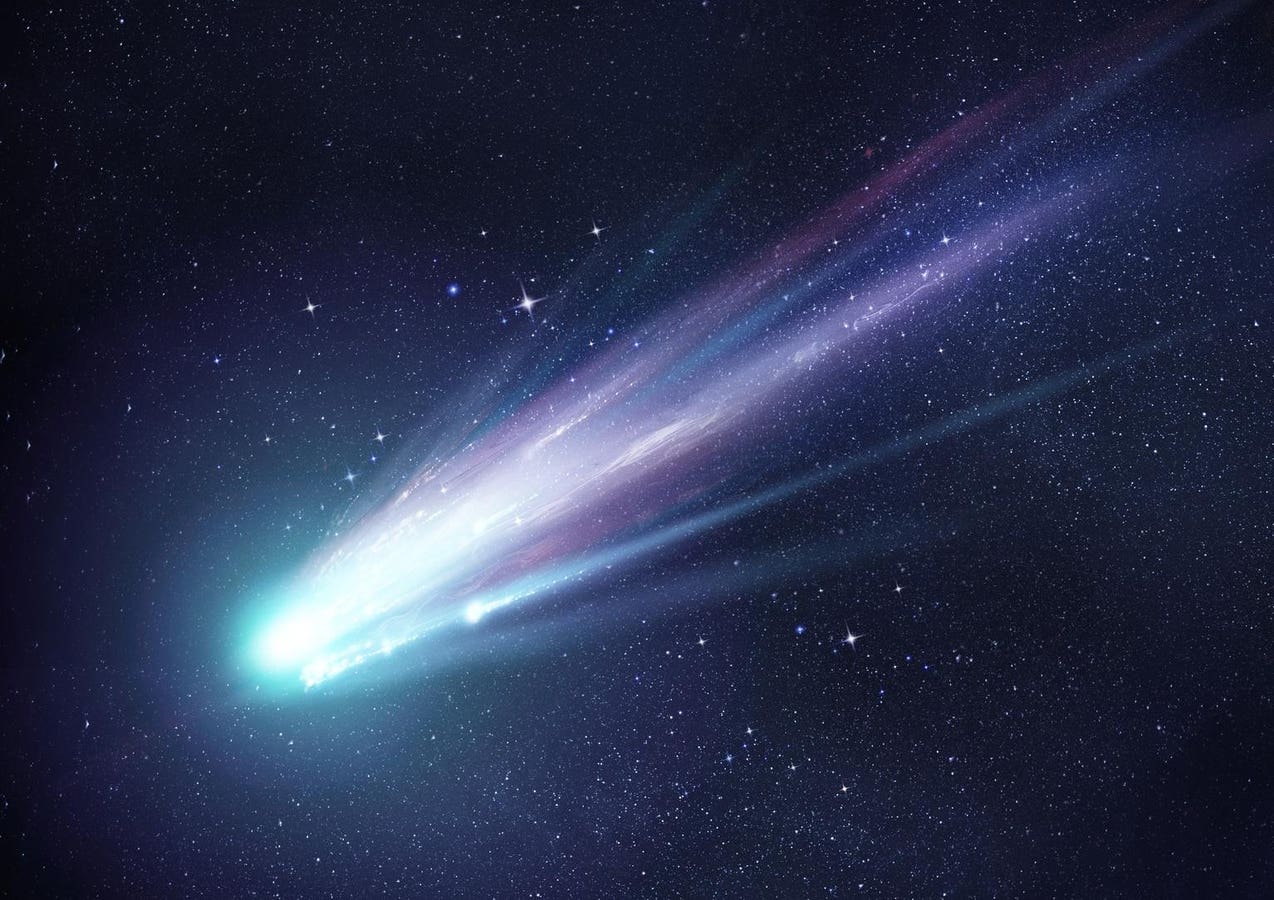
The much-heralded Vera Rubin Observatory —- due to come online early next year in northern Chile —- is most often touted as a better way to get a grip on dark energy, dark matter, and cosmology. But it should also open a new window onto observations of our solar system. In fact, the Rubin’s Legacy Survey of Space and Time (LSST) is expected to discover as many as five million small solar system objects.
Asteroids and comets are believed to be the relics of planet formation, with compositions that reflect their formation region, Carrie Holt, a postdoctoral researcher in astronomy and planetary science at Las Cumbres Observatory in Calif., told me in Puerto Varas, Chile. LSST will discover an order of magnitude more objects across our solar system, she says.
With a larger inventory of objects, we will be able to better understand the formation of our Solar System and its subsequent evolution, Holt told me at the recent ‘Cosmic Streaming in the Era of Rubin’ conference in Puerto Varas.
The LSST widefield survey is expected to totally change the current paradigm of known near-Earth objects, taking us from some 20,000 known NEOs to an estimated 200,000 over its survey lifetime of between five and ten years.
We are excited that we could discover really, small objects coming close to Earth or even impacting Earth, says Holt.
As For Finding Interstellar Objects?
Because of the vast distances between stars, interstellar asteroids and comets are incredibly sparse, even though typical stars may eject trillions of such objects, the Rubin Observatory notes. Such sparseness implies that these objects will be rare and faint (like small Near-Earth Objects) and an efficient way to search for them is through a wide and fast survey like LSST, the observatory notes.
But LSST will also hopefully find comets farther from the Sun than ever before. And it should even discover as many as ten interstellar asteroids and comets that are just entering our solar system.
Right now, especially with distant comets, we don’t have enough of a comet sample size to draw any firm conclusions with our results, says Holt. So, having more objects will help with that, she says.
There are now about 3000 known comets, but the expectation is that the LSST will triple that number to an estimated 10,000 comets, many of which lie in our outermost solar system.
Trying To Find Pristine Comets
Comets spend most of their lifetime relatively unchanged in the outer Solar System as relics of planet formation, says Holt. Dynamically new comets have nearly parabolic orbits, suggesting they are entering the inner Solar System for the first time, she says. Since such comets are thought to have undergone minimal solar heating prior to discovery, so they are useful probes for linking observable cometary features to conditions in the pre-solar nebula, says Holt.
Because it’s so far away, we can’t see the Oort Cloud directly, says Holt. But comets from the Oort Cloud —- a spherical reservoir of comets about halfway to the closest star —- are pushed inward from passing stars and galactic tides, she says. And when they come in towards the inner solar system, we get to observe them, says Holt.
Why Are Oort Cloud Comets Important?
Oort Cloud comets are some of the most pristine objects in our solar system, they’re holding ices from when they were first formed, says Holt. And they’re so far away that they are not really affected by the Sun, she says.
The LSST survey is enabling theorists to garner a better understanding of the earliest epochs of our solar system. Some of these comets likely harbor pristine materials that date from roughly 4.567 billion years ago. They’ve essentially been in a deep freeze at the outer fringes of our solar system for billions of years.
Once they start heading into our inner solar system, their ices sublimate from solids to a gas without passing through a liquid phase. The hope is that the LSST can first identify such a pristine comet and then follow up on such a detection with ground- or space-based spectroscopy. If so, such followup observations could reveal a treasure trove of early solar system astrochemistry.
So, when we observe these comets, we’re essentially observing materials that helped form the solar system, says Holt. This gives us an idea of how the solar system came to be to what it is today, she says.
Read the full article here



