


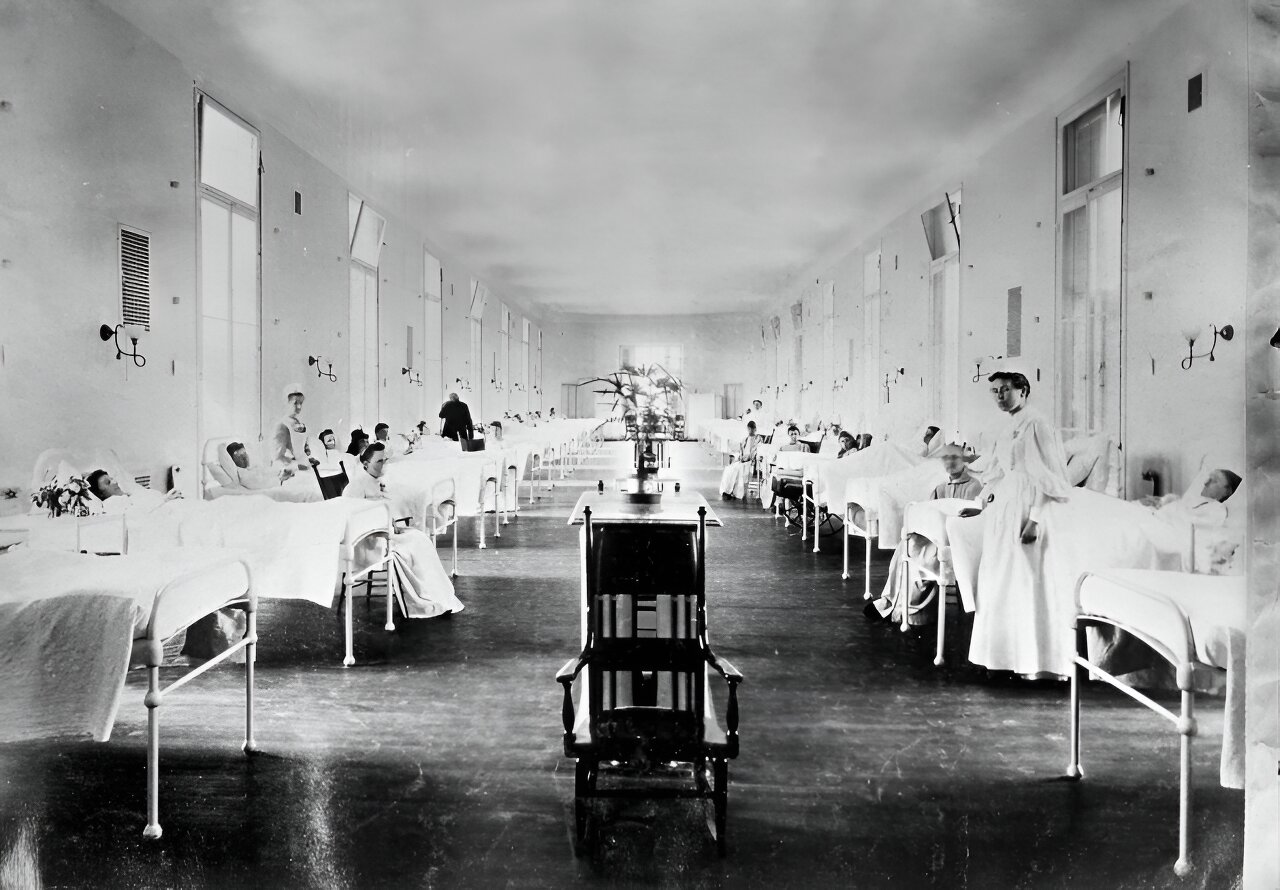
By revamping a forgotten heat recovery technique used in the design of Montreal’s Royal Victoria Hospital, McGill University researchers say modern temperature control and ventilation design could be transformed.
As the COVID-19 pandemic raises questions about efficient ventilation and the climate crisis threatens to exacerbate extreme temperatures, efficient building design is front of mind for today’s architects. But what can we learn from architectural techniques that were developed more than 100 years ago?
A group of researchers at McGill University’s Peter Guo-hua Fu School of Architecture set out to answer this question by examining the original ventilation system in Montreal’s Royal Victoria Hospital.
In findings outlined in an article in iScience, the researchers say that, by revamping the lost technique, modern temperature control and ventilation design could be transformed.
“These historical insights could help us to design less equipment-heavy solutions today with a new approach to energy-sufficient architecture and healthy indoor environments,” said co-author Professor Salmaan Craig.
In the schematics for the Royal Victoria Hospital, first built in 1893, the team found an early precedent for ventilation heat recovery, an efficiency measure that recuperates heat from the exhaust air so that stale, indoor air can be constantly replenished with fresh, outdoor air without needing much extra energy to heat up this incoming flow.
“Ventilation heat recovery is vital for healthy, energy-efficient buildings but needs miles of ductwork. The supporting infrastructure causes substantial emissions during manufacture, maintenance, and disposal,” said Anna Halepaska, Ph.D. candidate and the study’s first author.
Through archival research and lab experiments, the researchers verified the ventilation rate and amount of heat recovery. They found that by revamping the 19th century technique by eliminating ductwork and fans, it was possible to recover heat through partition walls and floors while maintaining a steady ventilation flow.
Shedding new light on 19th-century environmental motivations
By following a historic paper trail of correspondence between clients, consultants, architects and engineers the McGill team found out how and why the system was designed in such a way originally. Many scholars assume that heat recovery is a 20th century invention, but the study shows that engineers experimented with it in the 19th century, before electrification and the widespread use of mechanical fans.
“Fuel economy and clean indoor air were real concerns in the 19th century, especially in hospitals. However, this early heat recovery innovation responded to the harsh Canadian winter on very pragmatic terms. It provided a means to preheat outdoor air, which stopped the pipework in the air heating system from freezing in cold snaps,” said Craig.
By re-reading archival documents, the researchers were also able to clarify the role of British hospital specialist Henry Saxon Snell, who mysteriously backed away from the project after developing its original designs. The board of governors pushed Snell to step down after local consultants argued his ventilation scheme wasn’t fit for the cold winter.
The researchers proved the governors right, finding precisely why Snell’s scheme was unfit while revealing the innovative, heat-recuperating method that replaced it.
“It’s also surprising that much of the ventilation design was inspired by a completely different building type namely the Canadian Parliament building. Architectural historians sometimes think of hospitals as unique, but this work shows those crucial connections,” said Professor Annmarie Adams, co-author and architectural historian.
Uncovering this early history of heat recovery sheds new light on the environmental ideas motivating 19th-century engineers and architects in Canada and abroad.
More information:
Anna Halepaska et al, 19th-century thermosiphon ventilation and its potential for heat recovery in buildings today, iScience (2023). DOI: 10.1016/j.isci.2023.108765
McGill University
Read the full article here


