


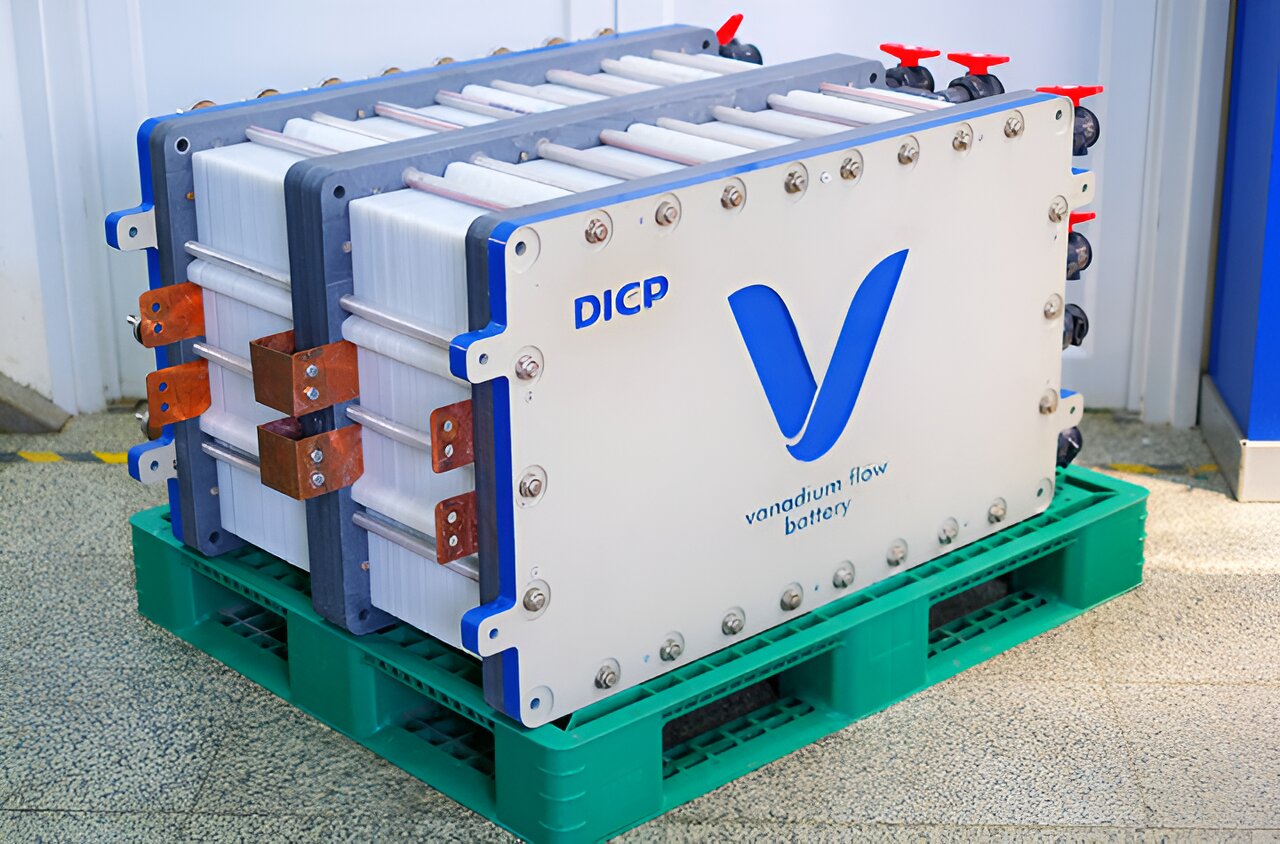
Recently, a research team led by Prof. Li Xianfeng from the Dalian Institute of Chemical Physics (DICP) of the Chinese Academy of Sciences (CAS) developed a 70 kW-level high-power density vanadium flow battery stack. Compared with the current 30kW-level stack, this stack has a volume power density of 130kW/m3, and the cost is reduced by 40%.
Vanadium flow batteries are one of the preferred technologies for large-scale energy storage. At present, the initial investment in vanadium flow batteries is relatively high.
Stack is the core component of a vanadium flow battery. The power density determines the cost of the stack. The higher the power density is, the smaller the stack volume is, resulting in lower cost under the same power output conditions.
Based on self-developed highly selective weldable porous composite membranes and weldable highly conductive bipolar plates, Prof. Li’s team developed a 70kW-level stack using a short flow path, an ultra-thin battery structure, and low flow resistance and high distribution uniformity flow channels.
The energy efficiency of this stack is 81.0% under 70kW rated power charge and discharge conditions, and the energy efficiency is 82.1% under 60kW constant power charge and discharge conditions; in addition, the stack operates stably after more than 1,200 cycles, with only 1.7% energy efficiency decay.
By using this stack, a 20-foot container energy storage unit module can be upgraded from 250kW to 500kW without greatly increasing the size of power units and the cost of system-supporting facilities.
“This 70kW-level stack can promote the commercialization of vanadium flow batteries. We believe that the development of this stack will improve the integration of power units in energy,” said Prof. Li.
Chinese Academy of Sciences
Read the full article here


