


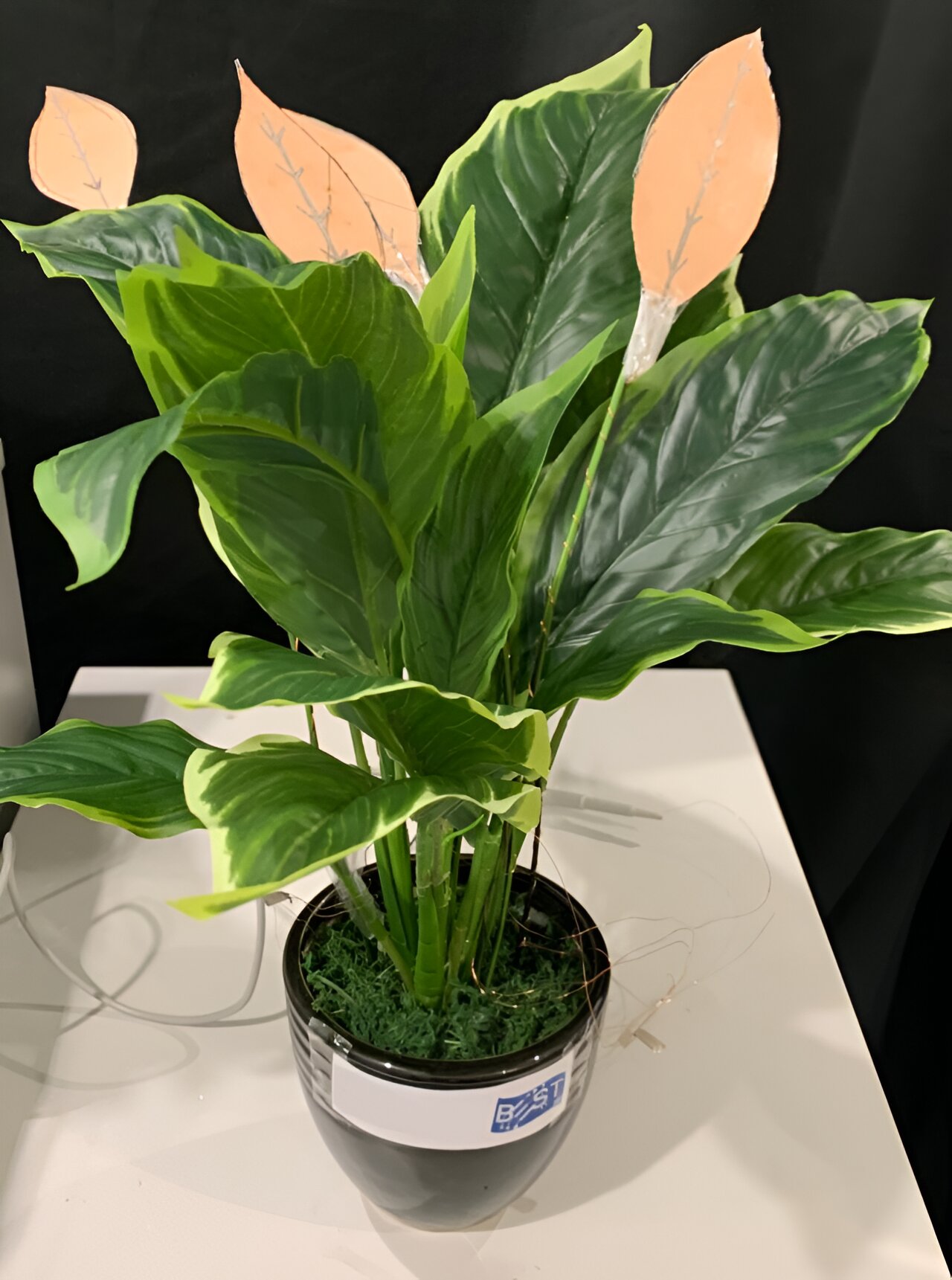
Fake plants are moving into the 21st century. Researchers developed literal “power plants”—tiny, leaf-shaped generators that create electricity from a blowing breeze or falling raindrops—and described them in ACS Sustainable Chemistry & Engineering. The team tested the energy harvesters by incorporating them into artificial plants.
Electrical energy can be produced by nature in several ways. For example, solar panels convert light energy from the sun, and wind turbines transform the kinetic energy of moving air. However, these methods typically rely on a single source and, therefore, are only effective when that source is available. Solar panels don’t work after sunset, for example, and a calm day won’t generate much wind power.
More recently, multi-source energy harvesters have emerged as a method to capture energy from different renewable sources in one device, maximizing potential output. So, Ravinder Dahiya and colleagues wanted to create a multi-source energy harvester that could generate power from both wind and rain.
The team built two different types of energy collectors: a triboelectric nanogenerator (TENG) to capture kinetic energy from the wind and a droplet-based energy generator (DEG) to collect energy from falling raindrops. The TENG consisted of a layer of nylon nanofibers sandwiched between layers of polytetrafluoroethylene, more commonly known as Teflon, and copper electrodes.
Static charges were generated and converted into electricity when the layers pressed into each other. Teflon was also used to make the DEG, which was waterproofed and covered with a conductive fabric to act as the electrodes. As raindrops hit one of the electrodes, it caused an imbalance in charges, generating a current. Under optimal conditions, the TENG produced 252 V of power and the DEG 113 V, but only for short periods of time.
The team mounted the DEG atop the TENG and incorporated leaf-shaped versions into an artificial plant. When the leaf-shaped generators were exposed to conditions mimicking natural wind and rain, they powered 10 LED lights in short flickers. This proof-of-concept “power plant” device could be further developed into larger systems or networks of power plants to produce clean energy from natural sources, the researchers say.
More information:
Guanbo Min et al, Multisource Energy Harvester on Textile and Plants for Clean Energy Generation from Wind and Rainwater Droplets, ACS Sustainable Chemistry & Engineering (2024). DOI: 10.1021/acssuschemeng.3c03620
American Chemical Society
Read the full article here


