


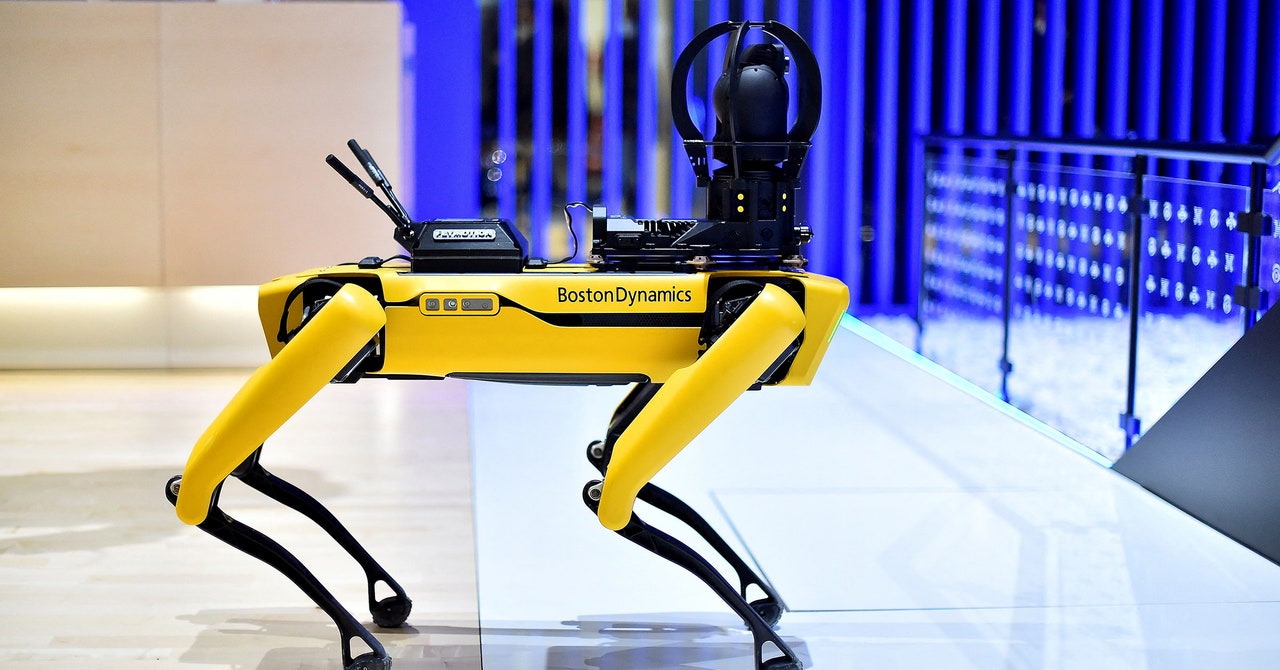
Anyone currently worrying about artificial intelligence taking over the world may want to swing by the Boston Dynamics AI Institute in Cambridge, Massachusetts. While walking around, they’d see that the robots that might lead a future uprising are still trying to tie their shoelaces, metaphorically speaking.
The Institute’s founder and executive director, Marc Raibert, has built some of the world’s most famous robots at his previous venture, Boston Dynamics. The company, acquired by Hyundai in 2020, has developed legged machines capable of running, leaping, and of course dancing with spryness that can veer into the uncanny.
Raibert’s creations include the four-legged, pony-sized Big Dog; its smaller dog-like buddy, Spot; and an acrobatic humanoid called Atlas. They have racked up influencer-levels of YouTube views and likes, found their way into comedy skits, and even inspired dystopian Black Mirror episodes.
The future shock inspired by Boston Dynamics’ robots can obscure the fact that off-camera it is humans providing most of the intelligence needed for their most impressive and daring stunts. Raibert’s AI institute, launched in August 2023 with Hyundai’s support, is working on ways to take humans out of the loop. It will research ways for robots to comprehend and tackle complex and unpredictable situations with little or no human help. Raibert sat down with WIRED at the institute’s headquarters to discuss his new venture.
Will Knight: When did you decide to pivot from focusing on robots’ physical capabilities to working on their intelligence?
Marc Raibert: It’s been a while that I’ve been frustrated, if you want to call it that, with how much work it’s been to get the robot to do each next thing. You need substantial resources, and it’s going to take years to accomplish at the level I’d love to see. The athletic part of robotics is really doing well, but we need the cognitive part.
And the parkour that we see Boston Dynamics robots doing is an example of that painstaking programming and engineering work?
Oh yeah, there’s a lot of work that goes into that.
There have recently been some big leaps in AI thanks to large language models and systems like ChatGPT. Can this technology help your mission?
We have a significant effort here looking at the role they can play in robotics. I’m an enthusiast for using what you know in combination with what you learn. One of the interesting things about language models is that the language comes from humans, who are embodied creatures. It’s not focused on physicality, but it’s also not devoid of embodiment.
Language models became much more powerful thanks to scaling up the training data and computing power involved. Could something similar occur in robotics?
Read the full article here





