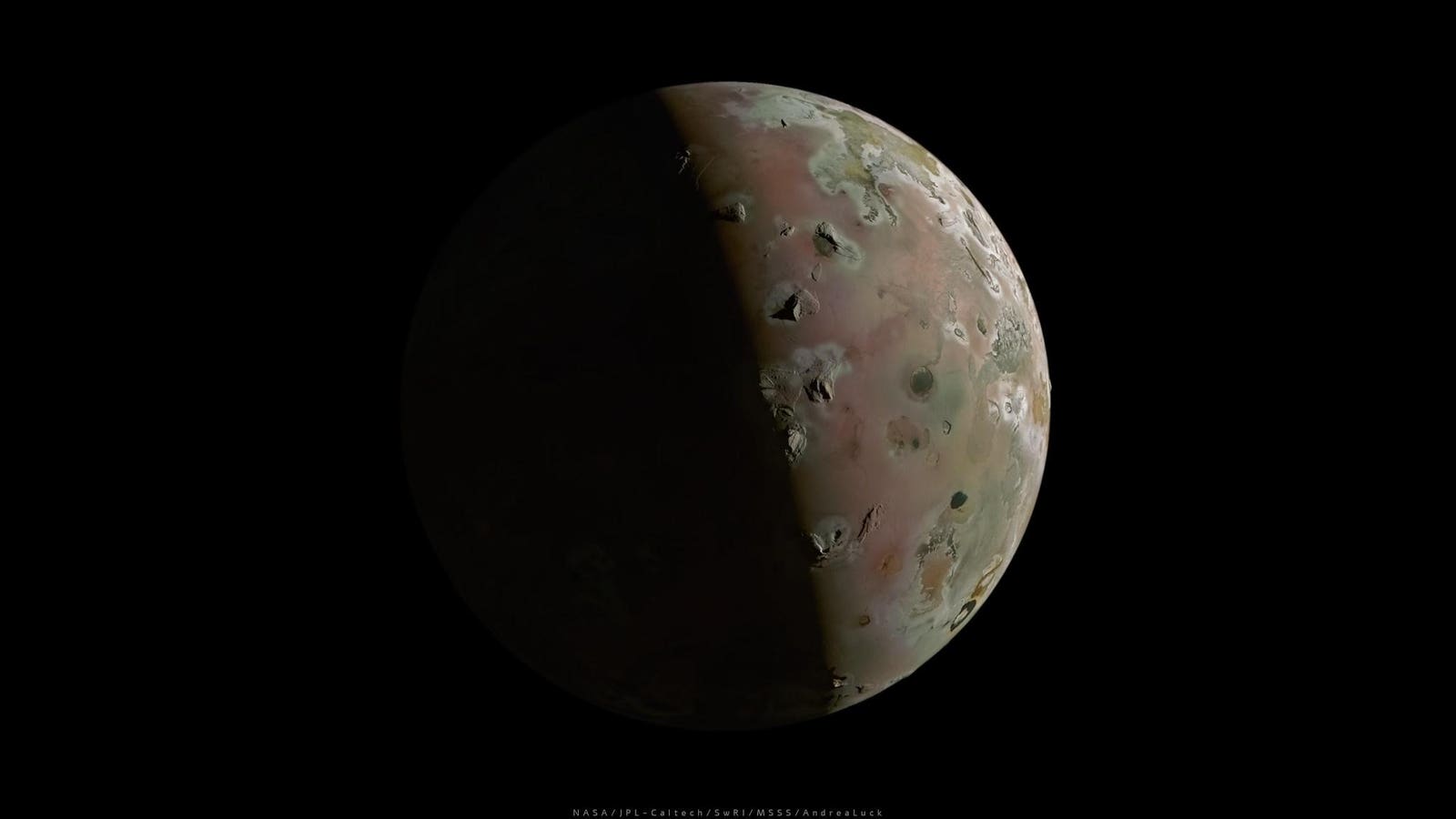
Jupiter’s fiery moon Io appears a violent and chaotic place in the best-ever images ever taken by a NASA spacecraft of the tortured world. In the wake of the first image, NASA has now released five more that together are the best for 22 years of the small moon.
Io is the most volcanic world in the solar system, with eruptions orders of magnitude bigger than anything similar on Earth.
Juno performed its closest pass yet of Io on December 30, reaching within 930 miles (1,500 kilometers) of the moon’s pockmarked surface.
Io is so volcanic, mainly because of the gravitational pull of Jupiter, which causes the moon to be tugged one way and another during its orbit. The added gravitational effects of Jupiter’s three other giant moons, Ganymede, Europa and Callisto, worsen this frictional tidal heating.
The moon’s turbulent 42-day orbit of Jupiter produces immense heat, which scientists think creates an ocean of magma under its rocky surface.
One of its most significant results is Loki Patera, Io’s most extensive volcanic depression and most energetic hotspot, which contains a lake or sea of lava.
Juno’s mission since 2016 has conducted close flybys of three of Jupiter’s giant Galilean moons—Europa, Ganymede, and Io. The fourth, Callisto, will be visited on flybys 21 times by the European Space Agency’s JUpiter ICy moons Explorer between July 2031 and December 2034.
JUICE will also fly by Europa and Ganymede, eventually settling into an orbit of the latter moon. NASA’s Europa Clipper also tours Jupiter’s moons from 2030, focusing on Europa. However, Io is not on the roster of any future space mission.
Several missions to Io have been considered by NASA for its Discovery Program in the past, most recently in 2021 when the Io Volcano Observer (IVO) lost out to two missions to Venus, DAVINCI+ and VERITAS.
Juno orbits Jupiter every 38 days; during 2024, it will make 11 perijoves (close passes of Jupiter’s clouds). The next, its 58th, will occur on February 3, involving a second and final close flyby of Io of an equally close 930 miles.
Wishing you clear skies and wide eyes.
Read the full article here