

When Helsing raised a $223 million Series B round, the tech world saw it as continued confirmation that defense was unquestionably back on the investing agenda.
Further confirmation comes today, in news shared exclusively with TechCrunch, in the form of a $5.5 million seed round for U.K. defense tech startup Labrys Technologies, led by Germany’s Project A Ventures. Also participating were MD One Ventures, Marque VC, Offset Ventures and Expeditions Fund. The funds will be used to expand the development and R&D teams, as well as build out the commercial sales team.
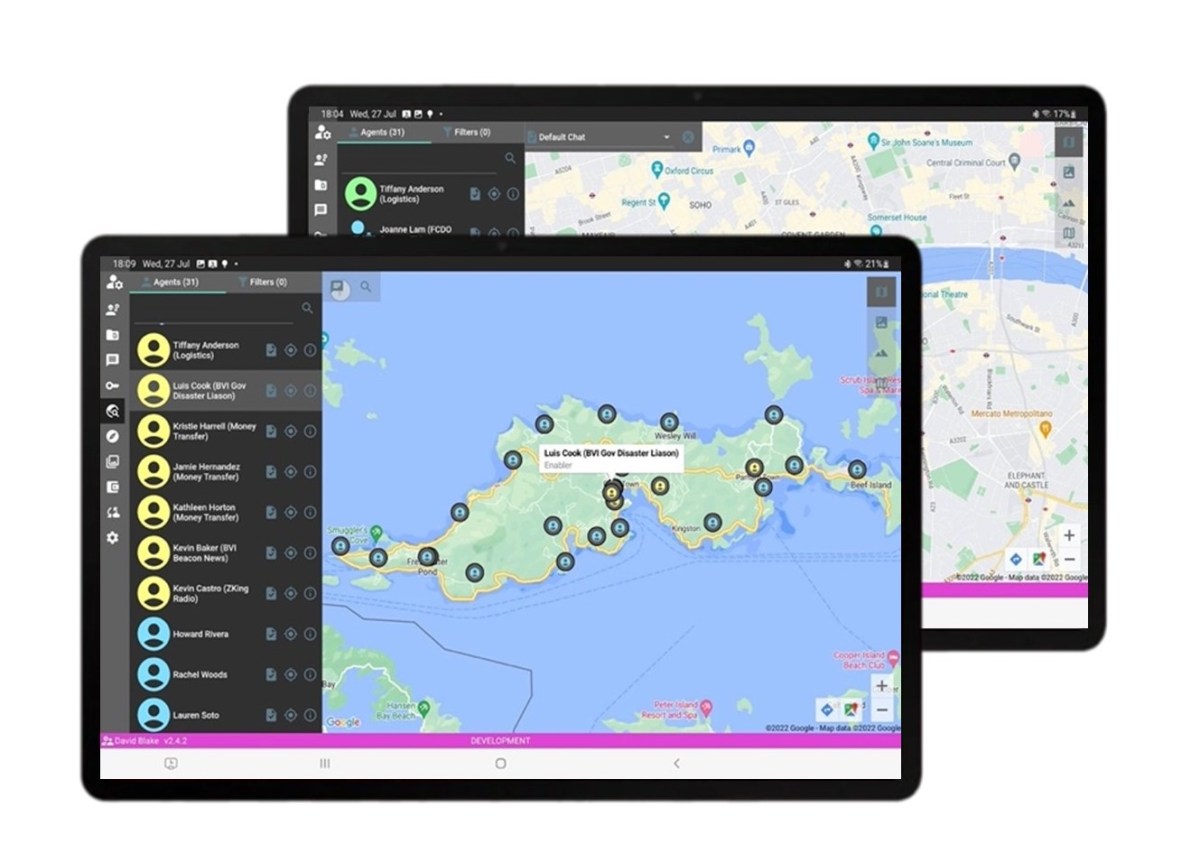
Labrys is perhaps best described as Slack-meets-location-meets-payments for both military and humanitarian scenarios. While that’s a bit of a mouthful, when you look at the problems the product is aimed at solving, it begins to make more sense.
What is commonly used in fast-moving situations like a humanitarian crisis is WhatsApp. And — declaring some interest in the subject — I have personal experience of this. From 2015 onwards, when I founded the Techfugees nonprofit, we found that both refugees and humanitarian workers almost always used WhatsApp to coordinate a response. It was simple, worked over bad networks, was fast and could reveal location. However, its limitations are all too obvious. How do you know you are dealing with a legitimate humanitarian worker? What if they don’t reveal their location? How can you get resources to them, or money? These are important problems to solve.
As co-founder and CEO August Lersten told me in an interview: “WhatsApp is very problematic when it comes to managing large teams worldwide, because the communications are end-to-end encrypted. It can sometimes make it very difficult to actually validate and confirm who you’re actually speaking to on the other end of the line. And you can’t integrate all these different chats into what we describe as a network coordination tree. If I want to speak to 133 people in Indonesia, I don’t necessarily want to have 133 separate individual communications.”
Thus, a Labrys client gets a screen dashboard where a user — like Slack or Microsoft Teams — can message whole teams or individuals and know their live location. And you can pay them (after a fashion).
Labrys Technologies Mobile platform. Image Credits: Labrys Technologies
The veteran-owned startup’s platform effectively “scratched an itch” the founders uncovered through with their own work “in the field.” Lersten is a former Royal Marine Commando who led teams across Africa, the Middle East and Asia. Luke Wattam (co-founder and COO) has worked across the U.K.’s Ministry of Defence, FCDO and U.K. allies.
The Labrys platform, Axiom C2 and Axiom Communicator, allows for KYC/E verification, encrypted communications, task management and where individual users can be geo-located. Lastly, it also wraps in digital payments via Crypto stablecoins. In other words, you can know who you’re dealing with and know where they are, and there’s a method to pay them. This is particularly important when dealing with humanitarian disasters.
As Lersten told me: “I see my people via a geospatial interface. Having that interface is a differentiation as against things like WhatsApp and Slack and other communication channels. The second component is communication with those dots, wherever they are, say, in Afghanistan. And then I want to pay my workforce. I can pay them in U.S. dollar stablecoins all through the same interface.”
Labrys claims the platform has already proven its worth in the field.
It’s been used in Afghanistan, where it has assisted in the evacuation of (the company claims) 5,000 persecuted Afghan minorities, as well as being used by Ukrainian State Emergency Services during the Kakhovka Dam breach.
Mykola Taranenko, commander of the Kherson Regional Rapid Response Team with the Ukrainian Red Cross (and a Labrys client) told TechCrunch via email: “As a commander, I always need to see where my team is when they are on a mission – especially in a high-risk environment like Ukraine. With the help of Axiom, I can securely monitor my team’s location and status… manage donations… quickly convert digital payments into real-world impact… purchase equipment locally [and] donors can see where their money has gone.”
The environment Labrys is operating in is a rarified one, with numerous civilian and military solutions overlapping. For instance, Everbridge is an enterprise software solution, that provides users — often military and NGOs — with an understanding of global flashpoints. But unlike Labrys, it doesn’t have a facility to connect with humans “on the ground,” as it were. Another, TAK, is known as a “Blue Force” tracking system. Meanwhile, Premise Data, which has raised $146 million, has a software platform for humanitarian organizations, and provides analytics about assets on the ground.
This latest funding is amongst the biggest seed rounds for a defense tech startup in Europe to date, and is emblematic of how defense is no longer off limits for investors, as we saw this year during TechCrunch Disrupt.
Plus, “dual use” products that coordinate either civilian or military teams, is a growing market. As of 2022, the global Command and Control Systems market was estimated at $22 billion, and is anticipated to reach $28 billion in 2028.
Meanwhile, Improbable, EclecticIQ, Living Optics and Preligens are all European companies that have raised tens of millions, and often more, in funding in the last year or so.
The news reflects now baked-in trends from last year when VC-backed firms injected $7 billion into aerospace and defense companies in the U.S.
Read the full article here