


Solar technologies are helping to reduce carbon emissions and are set to continue contributing to the mitigation of climate change. One type of solar technology found to be promising for future photovoltaic applications is silicon heterojunction (SHJ) solar cells.
SHJ solar cells have numerous advantageous properties, including high power conversion efficiencies, lean and low-temperature processing, and low temperature coefficients. Nonetheless, most high-efficiency SHJ photovoltaics developed so far rely on expensive and non-scalable fabrication processes, which ultimately limit their large-scale deployment.
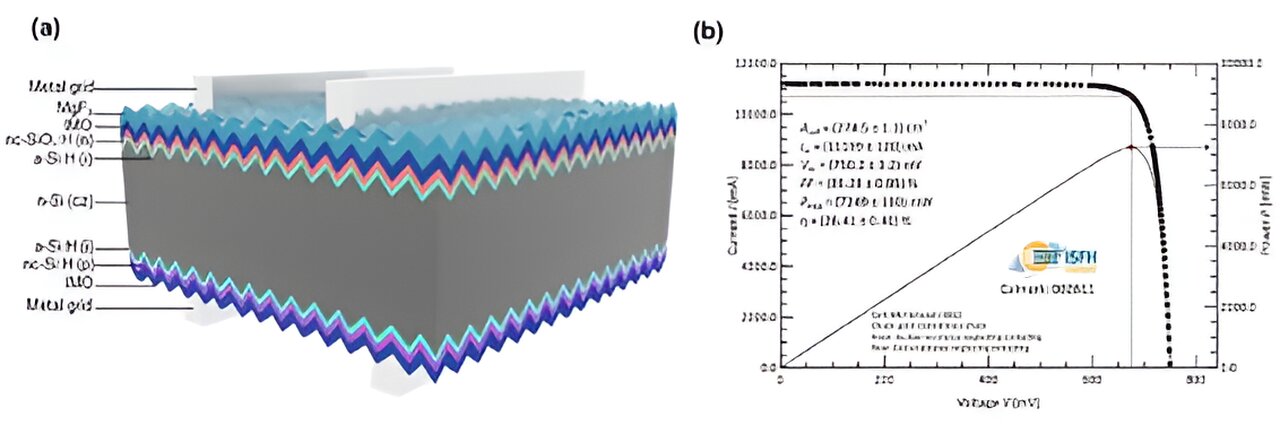
Researchers at Suzhou Maxwell Technologies Co. Ltd., Soochow University, New South Wales University and Dalian University of Technology recently developed new SHJ solar cells using more affordable and scalable fabrication processes. Their proposed solar cells, presented in a paper published in Nature Energy, were found to attain power-conversion efficiencies of up to 26.4%.
“The commercial success of high-efficiency SHJ technology remains impeded by challenges in the cost-effective translation to a production environment of several process steps, especially for a high transparent window-layer deposition and low-cost metallization,” Prof. Xinbo Yang, co-author of the paper, told Tech Xplore.
“For the first challenge, great research efforts have been devoted to replacing conventional doped a-Si:H by doped hydrogenated nanocrystalline silicon (nc-Si:H), or its alloys with oxygen (nc-SiOx:H) and carbon (nc-SiC:H) to reduce parasitic absorption and series resistance.”
Previous studies proposed the use of very high frequency (VHF) plasma-enhanced chemical vapor deposition (PECVD) systems to fabricate SHJ structures, rather than standard radiofrequency systems. This approach can increase the deposition rate and reduce ion bombardment, as VHF promotes SiH4 gas dissociation and decreases the electrical field intensity.
Despite the promising results achieved so far, using VHF PECVD systems also comes with limitations. Most notably, to prevent interelectrode voltage inhomogeneities and poor uniformity in the deposited films, the size of these systems’ reactor chamber should be less than a quarter wavelength than the plasma frequency.
“The second challenge relates to the high-cost metallization process for SHJ solar cells when using low-temperature silver paste, featuring a relatively low conductivity, relatively high shadowing losses and contact resistivity,” Prof. Yang said. “The primary objectives of this work were to improve the large-area uniformity of high quality nc-SiOx:H window layer and to replace the screen-printed silver electrodes with high-quality and low-cost plated copper electrodes.”
To fabricate their SHJ solar cells, the researchers applied wet-chemical processes to commercial M6-size (274.5 cm2) n-type silicon (Cz) wafers. These processes included saw-damage removal, texturing, and cleaning.
Using PECVD, Prof. Yang and his colleagues deposited an intrinsic a-Si:H passivation layer (5 nm) on both sides of the silicon wafer. Subsequently, they deposited nc-SiOx:H(n) layers on the front, serving as the front window layer under the excitation frequency of 27MHz, followed by the rear deposition of a 30 nm nc-Si:H(p) layer.
“All the silicon layers were deposited using the large-size PECVD system designed and produced by Suzhou Maxwell Technologies Co., Ltd.,” Prof. Yang said. “Afterwards, a newly-developed transition metal doped indium oxide (IMO, 80 nm) was sputtered on both sides. For the champion cell, a seed-free plated-copper electrodes was applied using proprietary processes at SunDrive. Compared with conventional low-temperature screen-printed silver electrodes, plated-copper electrodes feature significantly reduced shading loss, minimized bulk resistivity and contact resistivity.”
Prof. Yang and his colleagues evaluated the performance of their SHJ cells in a series of tests and found that they achieved remarkable results. Firstly, they recorded a high efficiency of 25.98% under a PECVD excitation frequency of 27 MHz.
“The large-area nc-SiOx:H(n)-thickness and device-PCE distributions under VHF1 are superior to those of VHF2 (40 MHz) due to minimization of the standing wave effect achieved by reducing the plasma frequency,” Prof. Yang said. “Additionally, VHF1 devices display a lower dark degradation rate than VHF2 ascribed to the denser film that is not easy to be intruded by oxygen and moisture. The current density and fill factor of the device also significantly improve to 40.80 mA/cm2 and 86.28%, respectively by replacing screen-printed Ag with seed-free plated copper electrodes, resulting in a world-record PCE of 26.41% for full-size c-Si solar cells with plated copper electrodes.”
In the future, the SHJ solar cells developed by Prof. Yang and his colleagues could be fabricated on a large scale and deployed in real-world settings. As the deposition techniques used to fabricate these cells are scalable and compatible with existing industrial processes, they could soon also be used by other research teams to develop SHJ cells and other photovoltaic technologies.
“Further systematic studies are needed to determine the effect of PECVD excitation frequency on the microstructure of nc-SiOx:H(n) films and the final device stability,” Prof. Yang added. “The copper plating system for mass-production also required for further optimization, reducing the process complicity and yield.”
More information:
Cao Yu et al, Industrial-scale deposition of nanocrystalline silicon oxide for 26.4%-efficient silicon heterojunction solar cells with copper electrodes, Nature Energy (2023). DOI: 10.1038/s41560-023-01388-4
© 2023 Science X Network
Read the full article here


