


About half of an average American building’s energy consumption is spent on heating and cooling. That’s a lot of money spent, fossil fuel burned and strain on an aging energy infrastructure during times of severe temperatures.
It’s also a problem UC Santa Barbara researchers Charlie Xiao, Elliot Hawkes and Bolin Liao are hoping to make a dent in. In a new paper in the journal Device, the trio presents an adaptive tile, which when deployed in arrays on roofs, can lower heating bills in winter and cooling bills in summer, without the need for electronics.
“It switches between a heating state and a cooling state, depending on the temperature of the tile,” said Xiao, the lead author of the study. “The target temperature is about 65° F—about 18° C.”
At about four inches square, this passive thermoregulating device is a blend of Liao’s expertise in thermal science and Hawkes’s work in mechanism design—a movable surface that can change its thermal properties in response to a range of temperatures. The idea for this project came to them during long drives between Santa Barbara and northern California a few years ago.
“Both our spouses were in Stanford at the time, so we were taking trips and wondering what we could potentially do together,” said Liao, who, like Hawkes, is a professor in UCSB’s Department of Mechanical Engineering. They then began to design mechanically tunable thermal devices.
It wasn’t until Xiao’s idea of using a wax motor that the idea of adaptive roof tiles took its final shape. Based on the change in the volume of wax in response to temperatures to which it is exposed, a wax motor creates pressure that moves mechanical parts, translating thermal energy into mechanical energy. Wax motors are commonly found in various appliances such as dishwashers and washing machines, as well as in more specialized applications, such as in the aerospace industry.
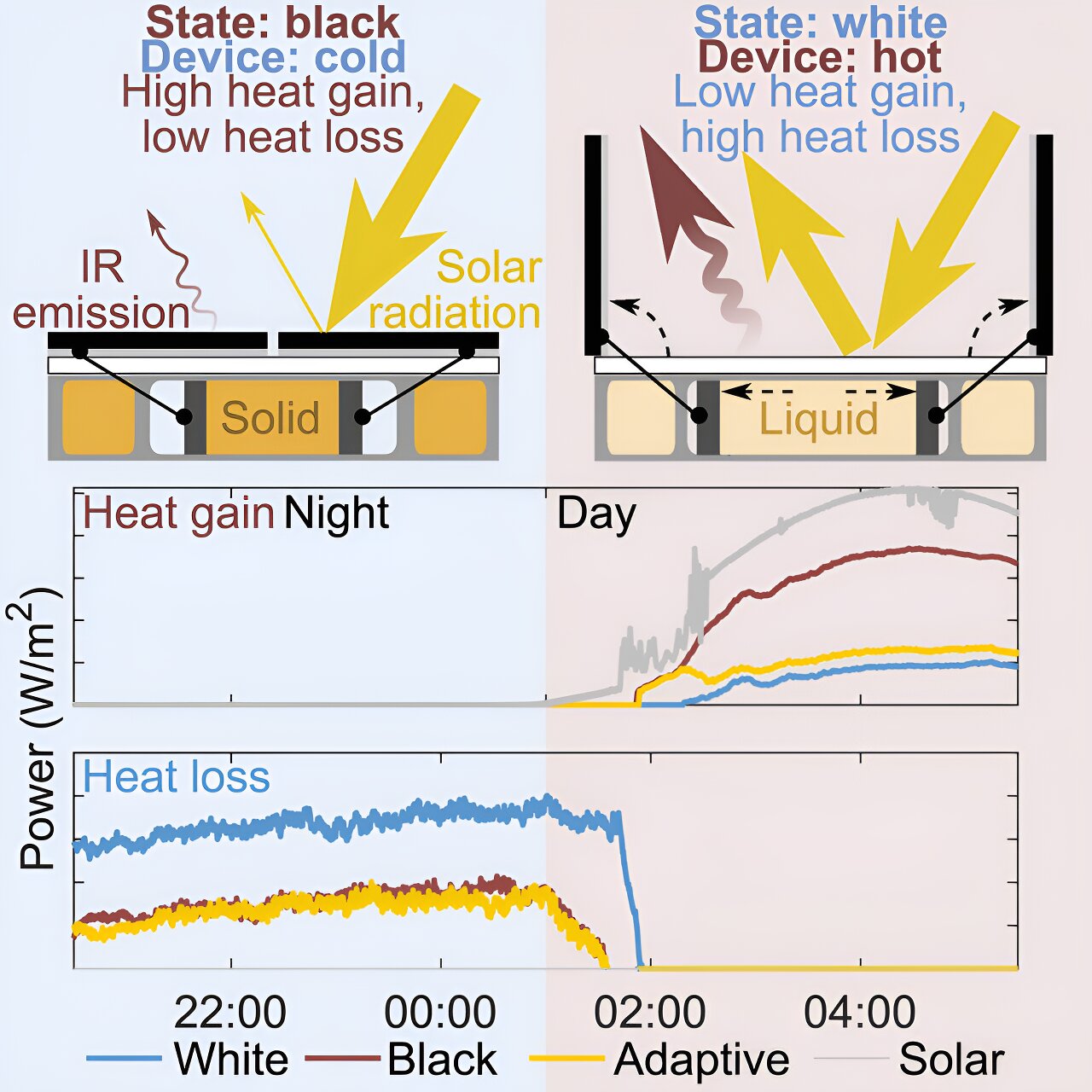
In the case of the tile, the wax motor—depending on its state—can push or retract pistons that close or open louvers on the tile’s surface. So, in cooler temperatures, while the wax is solid, the louvers are closed and lay flat, exposing a surface that absorbs sunlight and minimizes heat dissipation through radiation.
But as soon as the temperatures reach around 18° C, the wax begins to melt and expand, pushing the louvers open and exposing a surface that reflects sunlight and emits heat.
In addition, during the melting or freezing process, the wax also absorbs or releases a large amount of heat, further stabilizing the temperature of the tile and the building.
“So we have a very predictable switching behavior that works within a very tight band,” Xiao explained. According to the researchers’ paper, testing has demonstrated a reduction in energy consumption for cooling by 3.1 times and heating by 2.6 times compared with non-switching devices covered with conventional reflective or absorbing coatings. Because of the wax motor, no electronics, batteries or external power sources are required to operate the device, and unlike other similar technologies, it is responsive within a few degrees of its target range.
Additionally, the simplicity of its design lends itself to customization—different thermal coatings and various types of wax can be used to allow the device to operate at desired temperature ranges, while also lending itself toward mass manufacture.
“The device is still a proof-of-concept, but we hope it will lead to new technologies that one day could have a positive impact on energy expenditure in buildings,” said Hawkes.
More information:
Charles Xiao et al, Passively adaptive radiative switch for thermoregulation in buildings, Device (2023). DOI: 10.1016/j.device.2023.100186
University of California – Santa Barbara
Read the full article here


