


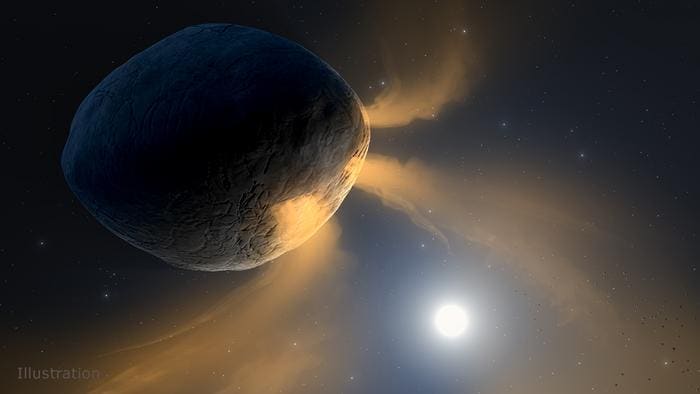
How a weird asteroid buzzing around the inner solar system causes the Geminid meteor shower is a question that has long puzzled scientists. However, researchers in Finland think it’s like a rare meteorite found only six times on Earth’s surface.
Best Time To See Geminids
The Geminid meteor shower, the northern hemisphere’s most spectacular of the year, peaks next week. As many as 150 “shooting stars” are expected to fall on the night of Wednesday, December 13 through Thursday, December 14—just when there’s a New Moon, meaning dark skies ideal for seeing “shooting stars.” According to the American Meteor Society, the Geminids provide good activity before midnight and can appear as bright white, yellow and green streaks.
‘Shooting Star’ Swarms
Swarms of shooting stars, like the Geminids, are typically the result of the warming of comets as they pass through the inner solar system to round the sun. Comets are made from ice and rock and tend to melt slightly when they get close to the sun, leaving a trail of dust and debris that sometimes move into Earth’s orbital path. When these meteoroids strike Earth’s atmosphere, they heat up and discharge photons of light that we see as “shooting stars” in the night sky.
Asteroid Origin
The Geminids are different because they appear to be caused by an asteroid called Phaethon 3200. It’s about 3.6 miles (5 km) in diameter and has been puzzling researchers for a long time. Although the Geminids is the only major meteor shower originating in an asteroid, Phaethon 3200 is comet-lie in some ways. For example, a comet-like tail is visible for a few days when the asteroid is closest to the sun.
Infrared Insight
Now, Finnish researchers have all but confirmed that Phaethon 3200—which some consider a broken bit of a comet—is indeed an asteroid. Images of Phaethon 3200 previously measured by NASA’s Spitzer space telescope—the infrared forerunner to the James Web Space Telescope—have been reanalyzed by researchers from the University of Helsinki, who compared them to infrared data on meteorites studied in laboratories. Meteorites are meteoroids that fall to Earth.
Rare Meteorite
The results, published in November in Nature Astronomy, show that Phaethon 3200 resembles a scarce kind of meteorite called a CY carbonaceous chondrite. Only six specimens are known, but only this kind of meteorite is known to decompose when heated.
When Phaethon 3200 passes close to the sun, its surface temperature rises to about 800°C, about the same temperature that CY carbonaceous chondrite meteorites produce carbon dioxide, water vapor and sulfide sulfur gas.
Comet Tail
The researchers also found that gas is released when the asteroid passes closest to the sun. At the same time, the pressure produced by carbon dioxide and water vapor is high enough to lift small dust particles from the asteroid’s surface.
Cue the comet-like tail—and the Geminids meteor shower.
“Sodium emission can explain the weak tail we observe near the Sun, and thermal decomposition can explain how dust and gravel are released from Phaethon,” said lead author Eric MacLennan, a postdoctoral researcher at the University of Helsinki, in a press release.
The research builds on a study earlier this year that indicated that Phaethon’s tail is made of sodium, not dust.
Close To The Sun
For Phaethon 3200, getting close to the sun is a frequent occurrence. While many of the comets that cause meteor showers have orbits of hundreds of years, Phaethon 3200 zips around the sun every 14 months, never getting too far from the sun or Earth (hence its classification as an “Apollo” asteroid).
Wishing you clear skies and wide eyes.
Read the full article here



