


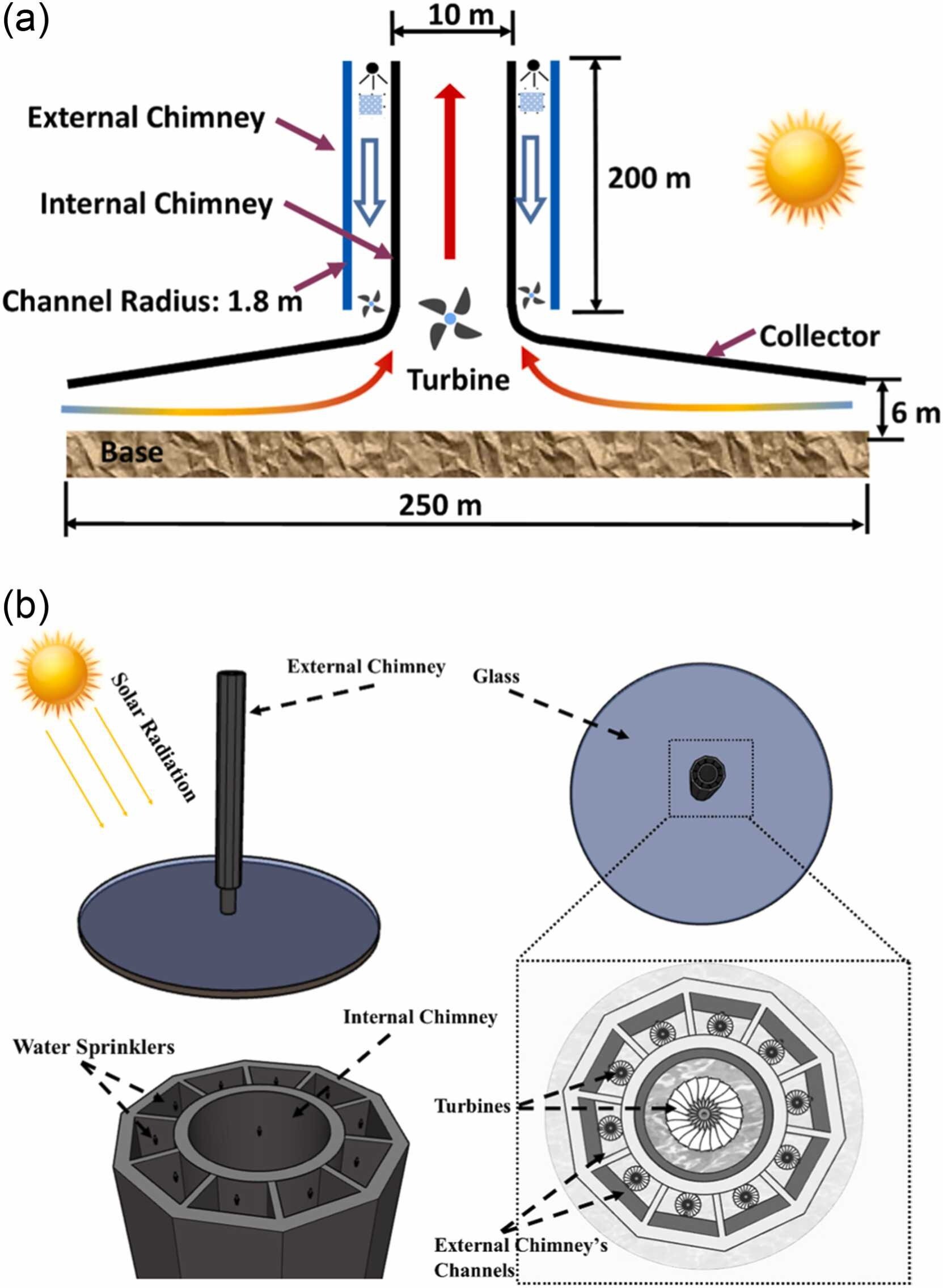
If you want to improve the output of solar energy systems, why not also run them at night? That’s the question researchers in Qatar and Jordan addressed as they successfully devised a system that promises to more than double energy output of current solar power stations.
By combining two concepts—a solar updraft system and a cooling downdraft structure—researchers designed a model that could generate 753 MWh of energy annually. That’s enough to power roughly 753 homes for about five weeks or 1,500 60-watt light bulbs nonstop for a year.
The origins of the system, referred to as Solar Tower Power Plant, go back to 1982 when Spanish engineers constructed a chimney-like tower with a mechanical turbine at its base. Air within the tower was warmed by absorbing solar radiation, similar to a greenhouse. As the air heated, it created an updraft that rose and activated wind turbines that in turn generated electricity.
That model was not widely adopted, mainly due to the enormous structural size that required massive acreage. It was also quite costly.
Changes over the following years included improvements in ventilation, altering construction materials, bolstering insulating surfaces and applying multiple turbo generators to boost output.
According to the researchers, such improvements at best resulted in “modest” improvements.
Emad Abdelsalam, of the School of Engineering Technology at Al Hussein Technical University in Jordan, and colleagues developed an improved updraft system and incorporated downdraft technology to achieve better results.
A downdraft system, like the updraft, centers on a tall tower. Pumps carry water to the top where warm air collects and cools it. The cooler air becomes more dense than the outside air and falls through the cylinder. That cooler air drives the base turbine that in turn generates electricity.
The model is referred to as a Twin Technology Solar System (TTSS).
The model TTSS updraft tower is 652 feet high with a 45-foot diameter. Ten downdraft towers encircle the updraft tower.
Power continues to be generated at night as air from daytime sunlight retains heat.
“The value-added feature of the new structure was to improve electricity production efficiency and reduce production costs compared to the original traditional solar updraft system,” Abdelsalam said. “The study results will open the door for additional improvements in the future toward addressing the issues mentioned above.”
The TTSS works out efficiently in a hot, dry climate. A simulation was devised based on weather conditions of Riyadh, the capital of Saudi Arabia, where temperatures average above 100 degrees from May through September.
Between the two processes, power generation is achieved round the clock. Weather can affect output—humidity, more common in winter, slows the process down—and researchers also note that reliance on a continuous supply of large quantities of water is an issue that needs to be addressed.
Another benefit of the system is its contribution to air quality. The TTSS system resulted in a reduction of 677 tons of carbon dioxide emissions.
The researchers’ paper, “An innovative twin-technology solar system design for electricity production,” is published in Energy Reports.
More information:
Emad Abdelsalam et al, An innovative twin-technology solar system design for electricity production, Energy Reports (2023). DOI: 10.1016/j.egyr.2023.11.027
© 2023 Science X Network
Read the full article here


