


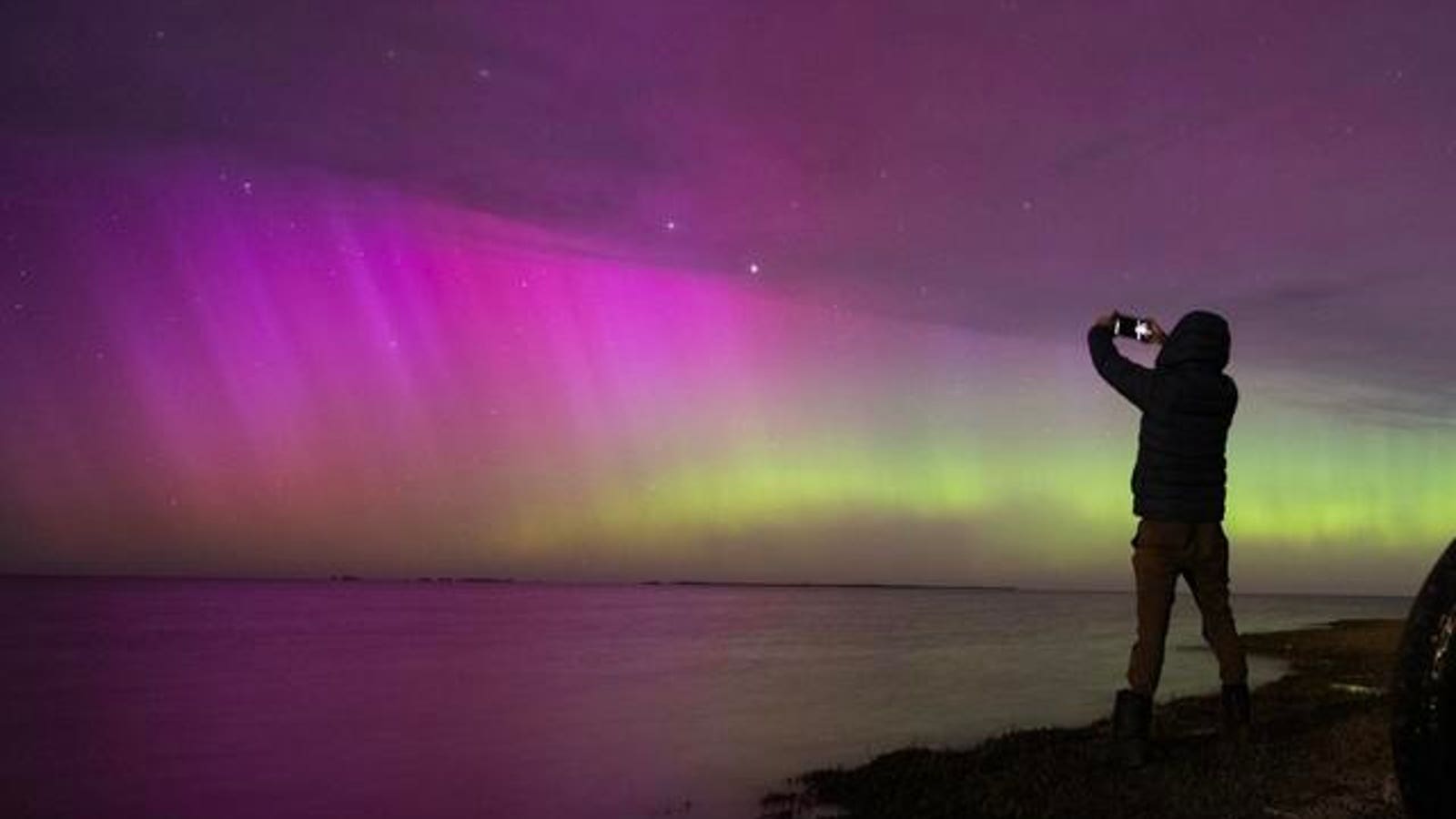
A series of three geomagnetic storms last week caused aurora displays at the most southerly latitudes in the northern hemisphere for 20 years on December 1 and 2.
According to The Japan Times, a red-colored aurora was seen with the naked eye from Hokkaido, the northernmost of Japan’s main islands, with the phenomenon visible to the naked eye for the first time since October 2003.
Last Tuesday, solar physicists predicted big displays were incoming after a solar flare caused three separate coronal mass ejections on the sun.
A CME is a cloud of magnetic fields and charged particles from the sun that streams into space at up to 1,900 miles (3,000 kilometers) per second.
All three CMEs occurred in the “Earth strike zone” and saw streams of charged particles head toward Earth in a rare “halo CME.” Although CMEs take a few days to travel to Earth from the sun as a solar wind, the charged particles accelerate down the field lines of Earth’s magnetic field when they arrive, exciting oxygen and nitrogen to cause green and red.
The result is a geomagnetic storm, with the more potent the solar wind, the more intense the displays—and the farther south they occur.
Usually, the aurora occurs in an oval roughly around the Arctic and Antarctic Circles. Still, when solar activity is intense—as it is right now—they reach closer to the equator.
As well as the Northern Lights (aurora borealis) seen as far south as the Midwest U.S. states, Scotland and Wales in the U.K and Japan, the Southern Lights (aurora Australis) were seen in New Zealand, Tasmania and southern Australia.
However, the most intense displays were still reserved for locations around the Arctic Circle, such as Alaska, northern Canada, Iceland, Norway, Sweden and Finland.
The solar wind—a stream of electrons, protons and helium nuclei—is called “space weather” and originates from coronal holes on the sun, dark regions with low-density plasma in the sun’s corona, its hotter outer atmosphere.
The sun is currently nearing the peak of Solar Cycle 25, which is proving to be much stronger than the last one. A solar cycle lasts roughly 11 years.
The SWPC recently published an update to its prediction for the current solar cycle, pinpointing the height of the sun’s activity—called solar maximum—to occur between January and October 2024.
Wishing you clear skies and wide eyes.
Read the full article here



