


There’s some sobering news from the latest edition of the World Health Organization’s flagship report on malaria. Cases of malaria are higher than they were pre-pandemic, with about 249 million cases in 2022.
Globally, the prognosis is worsened by climate change (for example, the catastrophic 2022 floods in Pakistan led to a staggering fivefold increase in malaria cases), and antimicrobial resistance (as mosquitoes, which are fiendishly resilient, are adapting to the limited slate of antimalarial drugs).
Yet only about half of the money needed to combat malaria is in place. For 2022, the WHO reported an enormous funding gap of $3.7 billion (based on the target of cutting malaria cases and deaths by 90% between 2015 and 2030).
At the same time, there are some reasons for optimism. We now have two WHO-recommended vaccines against malaria. And we have a great deal of scientific expertise arrayed against this threat. One surprising recent finding related to malaria is that there’s a connection with the color of rivers.
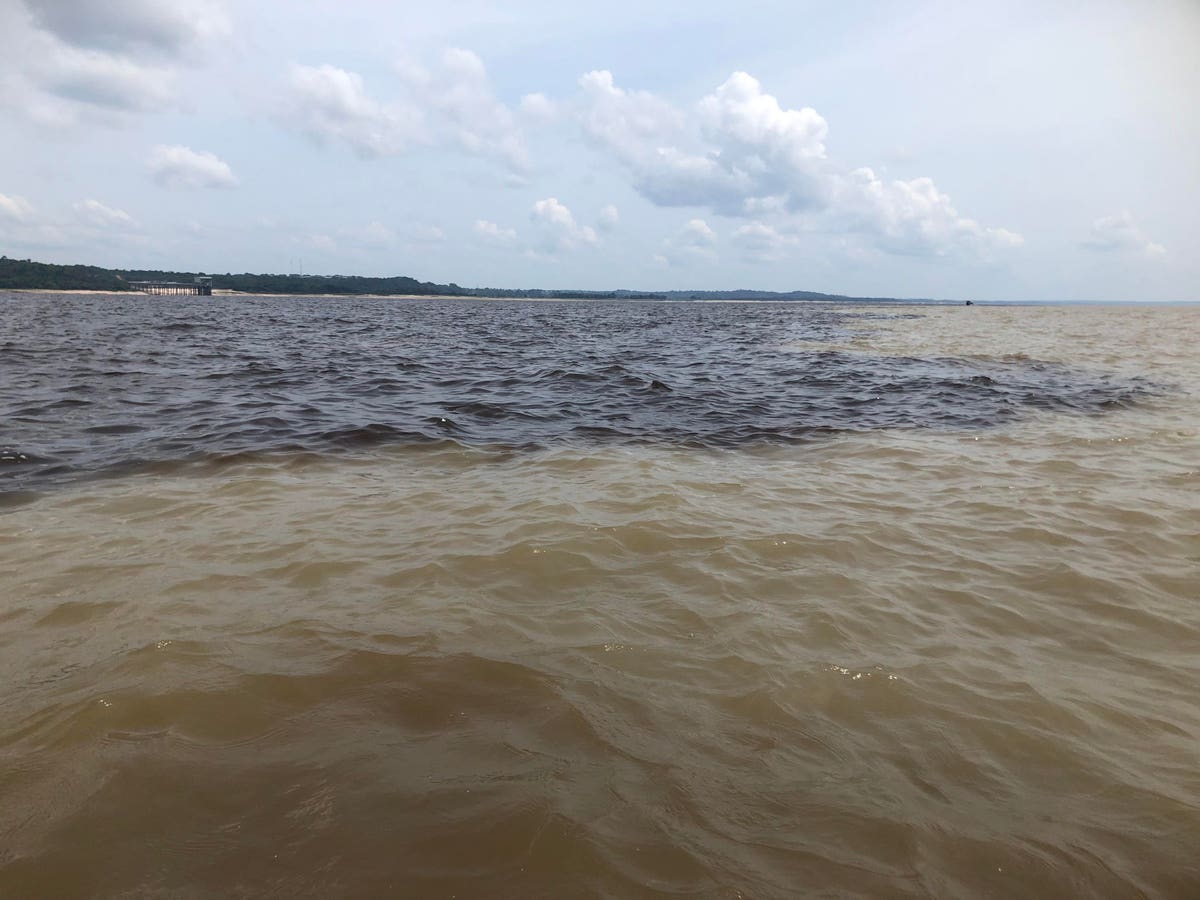
It’s a remarkable sight: a mass of dark brown water abruptly cut off by much lighter water, as distinct as a black-and-white cookie. Known as the Meeting of the Waters, this hydrological phenomenon has become a tourist sight in the part of the Brazilian Amazon where the Amazon River (classified as a white-water river) meets the Rio Negro (which, as the name suggests, is a black-water river).
The two streams of water differ not only in color, but also in temperature, place of origin, and contents. White-water rivers are almost neutral in pH and contain many suspended sediments, while black-water rivers have an acidic pH and lots of organic matter instead of suspended sediments.
Suspended sediments are essentially tiny particles in the water, which don’t sink to the bottom. In rivers these are usually sand, clay, and silt. And they’re key to this relationship between water color and malaria.
A new study, published in November in the Malaria Journal, looks at 50 municipalities in the Brazilian state of Amazonas to see whether these types of differences also affect malaria incidence. And indeed, municipalities on the banks of black-water rivers have more malaria-transmitting mosquitoes than those on the banks of white-water and mixed-water rivers.
It’s hard to translate this into case numbers, since the analysis is based on probabilities of annual parasitic incidence (API). But when looking at these levels, “the probability of malaria incidence is higher in black-water rivers, compared to white-water and mixed-water rivers,” reports Fernanda Rodrigues Fonseca, a researcher at the Instituto Leônidas e Maria Deane, part of Fiocruz Amazônia, who coauthored the paper. The probabilities of black-water rivers having higher API levels range between 96% and 99%.
White-water rivers also show more seasonal trends in malaria, whereas black-water areas fluctuate less.
The reason for the differences is that malaria is more intense in riverine areas where there are low concentrations of suspended sediments. This not only changes the color of a river, but also provides a more comfortable environment for Anopheles darlingi, the main mosquito species that transmits malaria in Brazil.
So what are the practical applications of this knowledge? Fonseca believes that it can help with health surveillance, “with the recognition of susceptible areas and identification of places with the highest risk of malaria transmission, which can contribute to more precise planning of actions aimed at controlling the disease in the region.”
It will be interesting to see if researchers looking at other rivers also find that water color is a relatively simple indicator (although just one of many) of malaria incidence. Understanding hydrological dynamics may help us to stay one step ahead of mosquitoes, whose fortunes are so dependent on water systems.
Read the full article here



