


A research team led by Prof. Yu Shuhong from the University of Science and Technology of China (USTC) of the Chinese Academy of Sciences (CAS) proposed a new strategy to prepare smart windows that dynamically regulate solar radiation, providing a more effective window for solar spectrum regulation and heat management in buildings. The work is published in Nature Communications.
Installing intelligent windows that block solar radiation and regulate indoor temperatures is essential for the construction of energy-efficient buildings. Existing smart windows mainly regulate solar radiation by switching between transparent and opaque optical states, a process that often sacrifices the transmission of some visible light in order to block more solar radiation, thus affecting indoor lighting. Furthermore, the limited stimulus response makes it difficult for these smart windows to dynamically or selectively modulate solar radiation in response to complex weather changes and individual preferences.
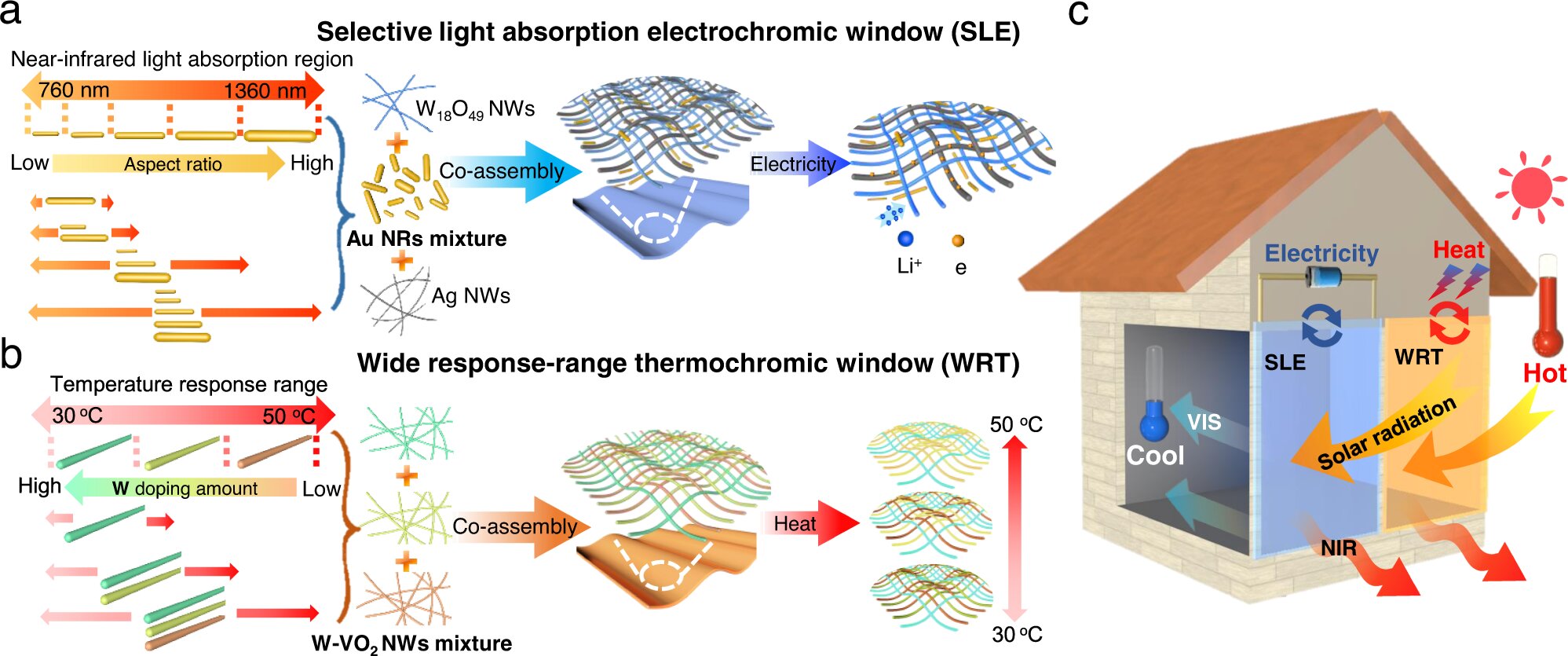
Based on the unique optical properties of one-dimensional nanomaterials, the researchers synthesized and mixed Au nanorods with different aspect ratios, which can selectively absorb near-infrared light in a certain wavelength band without overly affecting the transmission of visible light, thus ensuring light illumination in the room. Subsequently, the multi-sized Au nanorod mixtures were co-assembled with electrochromic W18O49 nanowires and conductive Ag nanowires to form an ordered mesh structure. The appearance of the smart windows is significantly altered in color by an external power supply. The synergistic effect of the two further improves the windows’ solar light-blocking performance
Using the same interfacial co-assembly strategy, the researchers prepared thermochromic smart windows (WRT) with a wide response range based on the co-assembly of W-VO2 nanowires with different W doping levels. It broadens the response temperature range and enables the number of W-VO2 nanowires in the thermochromic state to vary with the ambient temperature, thereby dynamically modulating the color change of the smart windows.
Smart windows selectively block solar radiation and dynamically adjust the room temperature according to the applied voltage or the ambient temperature. And they can save even more energy consumption during the hotter months.
This research significantly improves the optical properties of windows by modulating the composition and structure of multiple types of materials, enabling the rapid, large-scale construction of smart windows that can be used for solar spectrum modulation, thus providing new solutions for the design, preparation and application of new electrochromic and thermochromic smart windows.
More information:
Si-Zhe Sheng et al, Nanowire-based smart windows combining electro- and thermochromics for dynamic regulation of solar radiation, Nature Communications (2023). DOI: 10.1038/s41467-023-38353-4
Provided by
University of Science and Technology of China
Read the full article here


