


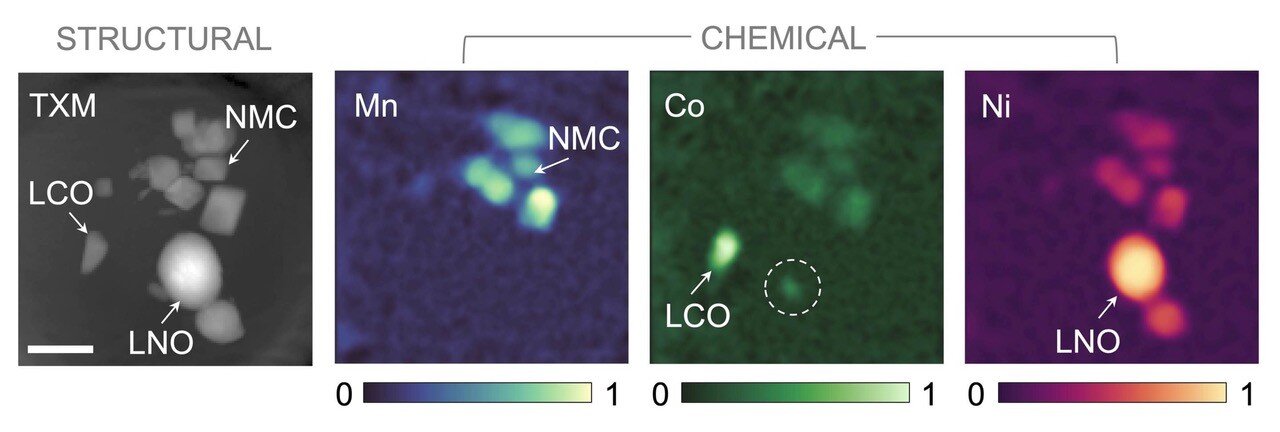
Batteries are challenging to observe and analyze. They can’t really be opened up because of their volatile nature. One way to monitor batteries is through X-ray technology. However, the equipment is very expensive and those methods struggle to balance resolution, sensitivity and speed.
One of the newest Texas Engineers has developed a low-cost method for using X-ray tech to capture images inside batteries and then deploying a software algorithm to fill in the blanks. Instead of an X-ray lens that may cost hundreds of thousands of dollars, this new research uses a couple sheets of sandpaper to structure the illumination in a sample in a way that allows for detailed mapping at the nanoscale.
“The data may look ugly to the eye, but it contains a lot of information that can be extracted by our algorithm,” said Yijin Liu, an associate professor in the Walker Department of Mechanical Engineering who joined UT this fall.
The research, published in Proceedings of the National Academy of Sciences, is a continuation of work he did at Stanford University to improve experimental techniques for monitoring structure change in batteries over time.
Using the sandpaper changes the illumination of a sample, allowing for a broader but less complete image. The algorithm pulls out information about chemical particles in the image the same way facial recognition software might be able to identify blurry faces in a group photo.
Battery components are made up of many different particles of a variety of chemicals. Over time, as the battery charges and discharges repeatedly, those particles can break off and float away, reducing the capacity of the battery.
“Your phone might say it is 100% charged and has 10 hours of battery life, but really it will only last for six hours because of changes to the internal structure,” Liu said.
Understanding what happens to these chemical particles over time can help researchers design more dependable battery materials that won’t be impacted by this phenomenon. And the applications of this technique go beyond batteries. Any situation that needs non-invasive internal imaging could benefit, including areas like biology, environmental studies and materials science.
More information:
Jizhou Li et al, Nanoscale chemical imaging with structured X-ray illumination, Proceedings of the National Academy of Sciences (2023). DOI: 10.1073/pnas.2314542120
University of Texas at Austin
Read the full article here


