


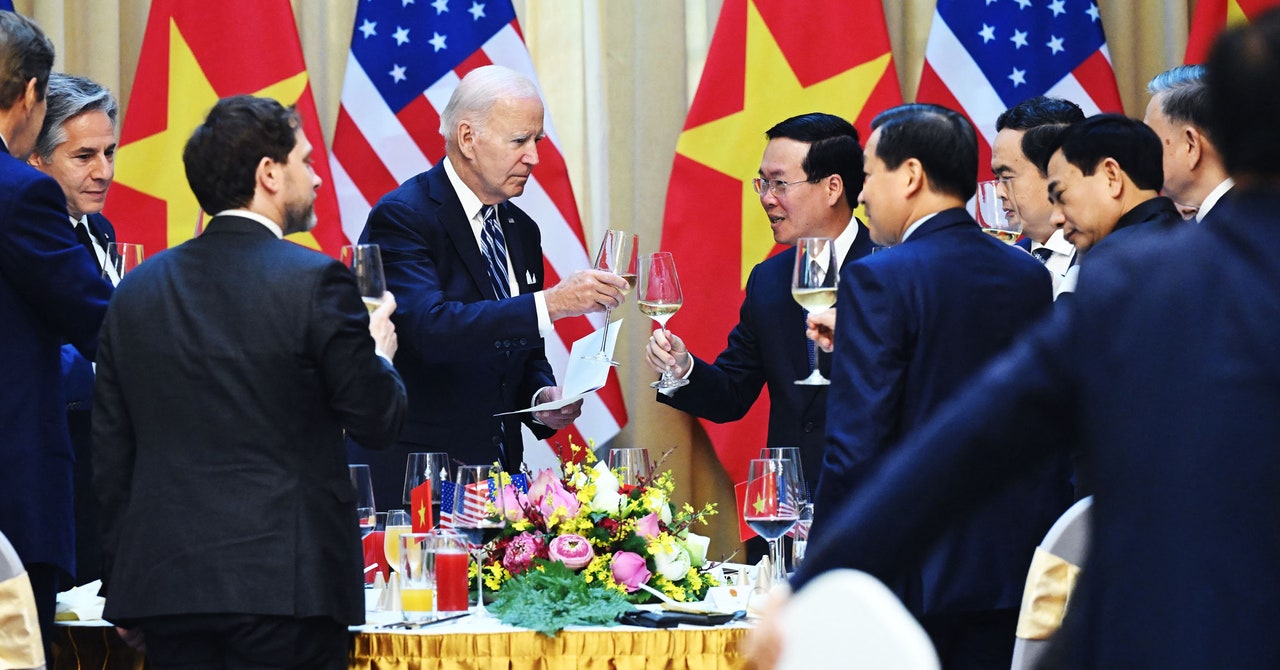
When president Joe Biden traveled to Vietnam last month, he was accompanied by a coterie of leaders from top US technology companies. He and the executives from Google, Intel, Boeing, and chipmaker GlobalFoundries were all on the same mission: to find a new partner to help produce some of America’s most prized technology.
The subtext, conspicuously absent from official statements, is reducing dependence on China. Vietnam is central to a “friend-shoring” strategy the US is hoping can line up alternatives to China to provide the raw materials and manufacturing skills needed for key components in the tech supply chain—and especially semiconductors.
As tensions between the US and China over technology and national security have grown, so has the pressure on the US to diversify. Last month, the Biden administration tightened its chip sanctions on China still further. Yet although Vietnam’s government and industries are enthusiastic about working more closely with the US, supply chain experts in both Washington and Hanoi warn that it can’t replace China’s tech manufacturing scale and skills any time soon.
The US courtship of Vietnam as a new tech ally began with treasury secretary Janet Yellen’s visit to the country in July. Hanoi responded by upgrading its relationship with Washington to its highest diplomatic status, alongside Moscow and Beijing. Biden then cemented the partnership by announcing $2 million of seed funding to help Vietnam develop its semiconductor workforce.
In Vietnam, hopes continue to run high a month after Biden’s trip to cement the new relationship. In early October, Vietnam’s prime minister, Phạm Minh Chính, met with representatives of Amkor, a US company that assembles new-made chips into working products, to unveil a $1.6 billion chip testing and assembly factory near Hanoi. Chính urged accelerated investment to help the country achieve its aim of expanding its semiconductor workforce 10-fold by 2030. The first ever batch of Vietnamese college students majoring in chip design is scheduled to commence their studies in 2024.
Both countries may need to temper their expectations. Many have been left wondering how big of a role Vietnam can really play in the US technology supply chain, and what concrete steps will be taken to increase its role. Diversification from China will not be easy, and neither the US nor Vietnam can cut ties with China entirely.
Read the full article here





