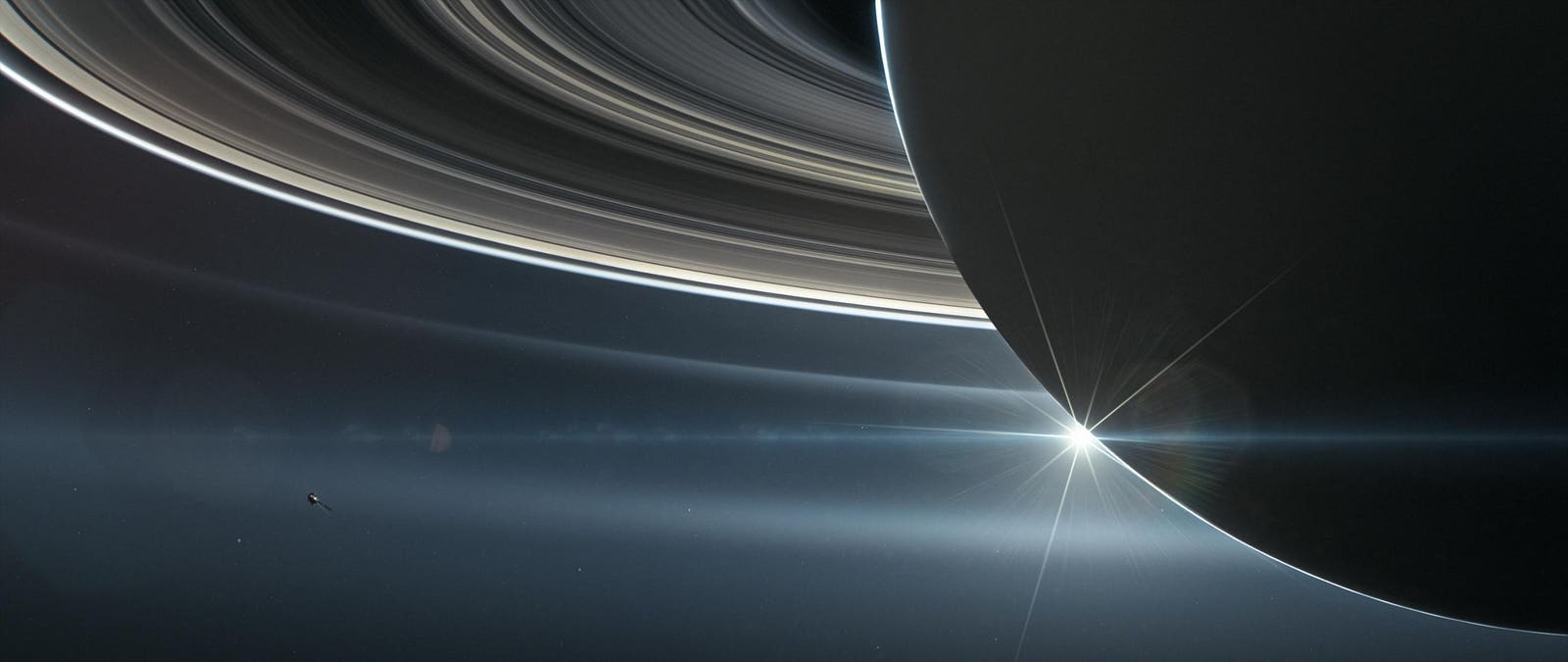
New insights about Saturn’s famous ring pattern have come from data collected during solar eclipses at the sixth planet from the sun.
Published in the journal Monthly Notices of the Royal Astronomical Society, a new paper crunches archive data from NASA’s Cassini spacecraft, which orbited Saturn from 2004 to 2017.
It reveals how much light the rings absorb. The rings are 98% ice and extend up to 87,000 miles (140,000 kilometers) from the planet, yet are less than a mile thick.
Eclipses At Saturn
While Cassini was in the shadow of the rings—and the sun was eclipsed by Saturn, from its point of view—its instruments received much less sunshine. Exactly how much it did get has enabled scientists to measure the transparency of Saturn’s rings.
Although these were “fake” eclipses caused purely by the spacecraft’s motion, it’s known that two of Saturn’s moons, Epimetheus and Pandora, can cause actual solar eclipses from the giant planet’s point of view.
Science In Saturn’s Shadow
When light hits a surface—in this case, the metal Cassini and its instruments were made of—it releases electrons. This is known as the photoelectric effect. This is what happened to Cassini’s Langmuir probe, which was on the spacecraft to measure charged particles around Saturn.
“Focusing on the data variations, we realized that they were connected with how much sunlight each ring would allow to pass,” said George Xystouris, a PhD student at Lancaster University. Knowing the properties of the Langmuir Probe and how bright the sun was in Saturn’s neighborhood, “we managed to calculate the change in the photoelectrons number for each ring, and calculate Saturn’s rings optical depth,” said Xystouris. The results, which reveal how much light the rings absorb, agreed with high-resolution images of the rings.
Disappearing Act
Saturn’s rings are no older than 400 million years, according to a study published earlier this year, and will disappear in about 100 million years, according to NASA, when they’ll be pulled into Saturn by its gravity. However, in the very short term, they will become much more challenging to see. Since Saturn orbits the sun every 29 years, Earth’s view of the planet, waxes and wanes in that time, with the rings appearing to open and close.
Our view is currently narrowing, and by 2025 the rings will be tilted edge-on to Earth, making it almost impossible to view them. They will then tilt back towards Earth and continue to become more visible and brighter until 2032.
Wishing you clear skies and wide eyes.
Read the full article here