


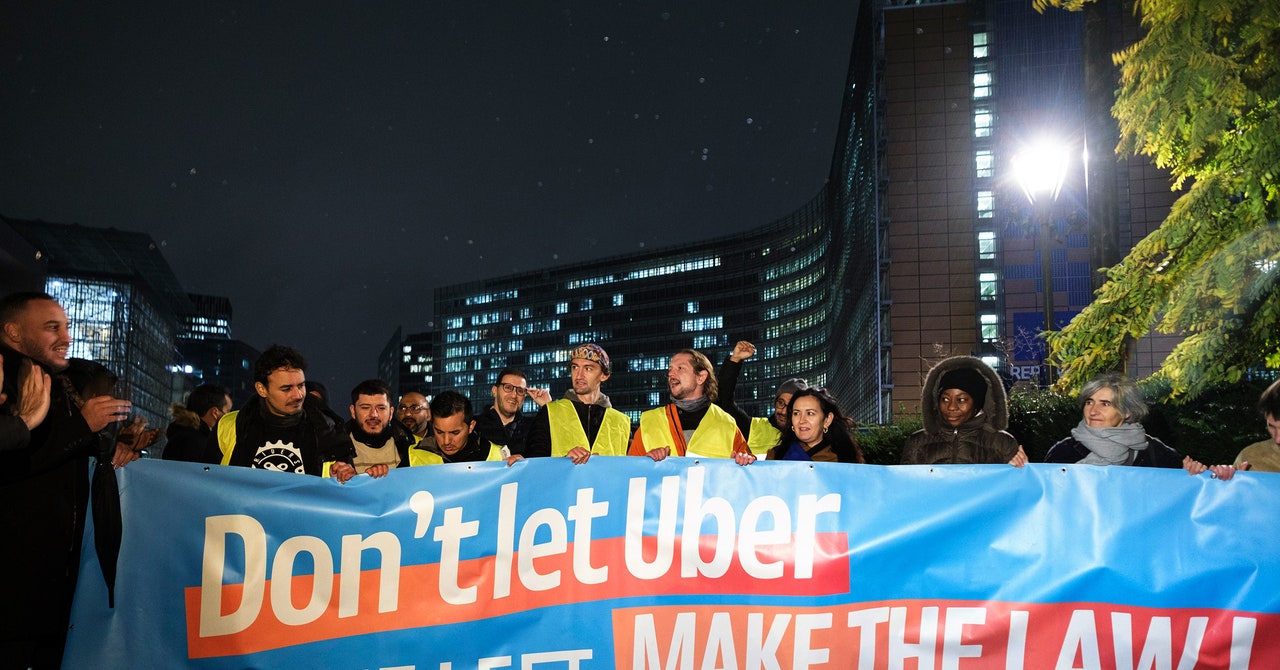
A small group of protesters stand on the side of a roundabout opposite Brussels’ oak-framed Europa building, which is glowing in the dark. Despite the heavy rain, the group is here to direct their anger at the politicians, who are inside, deciding the future of Europe’s gig economy. In case their chants can’t be heard over the noise of passing traffic, the demonstrators have also printed their message onto a banner. It reads: “Don’t Let Uber Make the Law.”
Among the crowd are Camille Peeters, Marcus Haunold, and Felipe Corredor. The three men work for different companies and live in different countries—in Belgium, Austria, and Spain, respectively. But their experiences working as couriers for some of Europe’s most popular food delivery platforms have led them to the same conclusion. Platforms are taking advantage of their workers, they claim, and now those same companies are attempting to sabotage new rules that were supposed to fix the gig economy’s problems.
“Something has to change, because the current situation is really bad for most platform workers,” says Haunold, who has spent the past five years working for Foodora in Vienna, a food delivery app owned by Berlin-based Delivery Hero. As a “free employee,” a special category of worker in Austria, he is entitled to paid sick leave only after three days of being ill, and he does not receive holiday allowance. He says he’s finding it increasingly difficult to make a living in the gig economy, and in the past year he has started working for a second platform, a delivery service called Wolt, to make ends meet. (Alexander Gaied, chief operating officer at Foodora Austria, disputes the claim that conditions on the platform are getting worse and says riders’ pay per hour has increased 10 percent since January.)
When EU officials first suggested new rules to regulate the gig economy two years ago, Haunold was hopeful that his job was about to change for the better. Negotiations between EU officials over what exactly those rules, known as the Platform Work Directive, should include have been beset by infighting. Trade unionists and labor activists say that’s because the debate has been heavily influenced by Uber.
Read the full article here





