


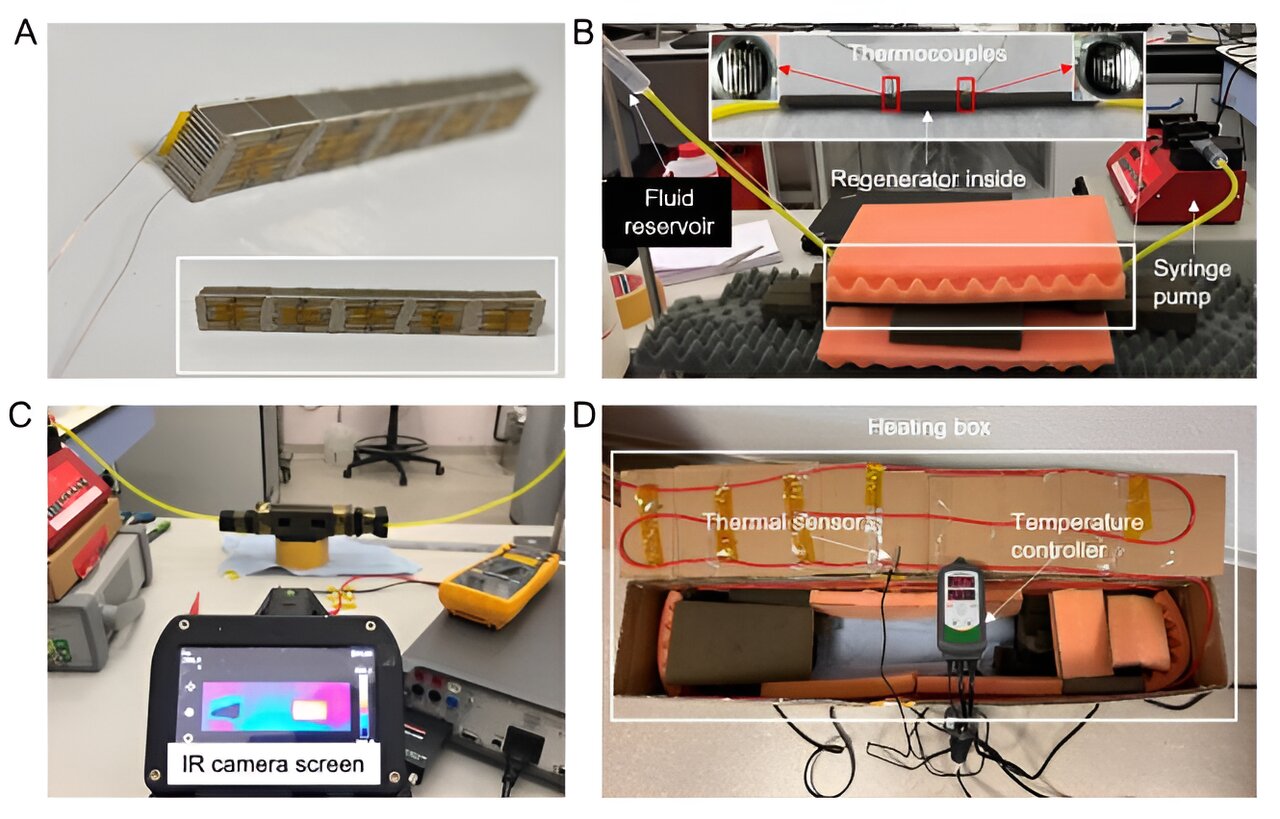
A team of engineers at the Luxembourg Institute of Science and Technology, working with a pair of colleagues from Murata Manufacturing Company, has developed a regenerative electrocaloric heat pump that is more efficient than conventional air conditioners.
In their paper published in the journal Science, the group describes the technology and how well prototypes have worked. Jaka Tušek, with the University of Ljubljana, in Slovenia, has published a Perspectives piece in the same journal issue outlining principles behind an electrocaloric heat pump and the work done by the team on this new effort.
Conventional air conditioners and refrigerators do their work by compressing vapors and allowing them to expand repeatedly, an approach that is both inefficient and environmentally unfriendly. For that reason, scientists have been working for many years to find a suitable replacement.
One approach is the development of a solid-state electronic heat pump. Such devices typically involve exposing ferroelectric material to an electric field, triggering polarization, which alters the material’s temperature. Devices using the approach can be designed to heat or cool the air around them. Unfortunately, despite much effort, a commercially viable electrocaloric heat pump has not materialized due to a variety of issues. The research team has taken a fluid-based approach and created prototype devices more efficient than conventional air conditioners.
To make their device, the researchers laid strips of lead scandium tantalate atop one another and then placed them in silicone oil selected for its heat-carrying properties. Adding electricity causes the strips to heat up, which pushes the fluid in one direction, and then pushes it the other way when it cools down—the region of difference, they found, was approximately 20°C. To use the device as a heater or an air conditioner, oil is circulated through the system. Testing showed the device capable of reaching 64% of Carnot’s efficiency—the theoretical limit of devices using such technology.
The research team acknowledges that more work is required to reach such efficiencies in a real-world environment.
More information:
Junning Li et al, High cooling performance in a double-loop electrocaloric heat pump, Science (2023). DOI: 10.1126/science.adi5477
Jaka Tušek, A highly efficient solid-state heat pump, Science (2023). DOI: 10.1126/science.adl0804
© 2023 Science X Network
Read the full article here


