


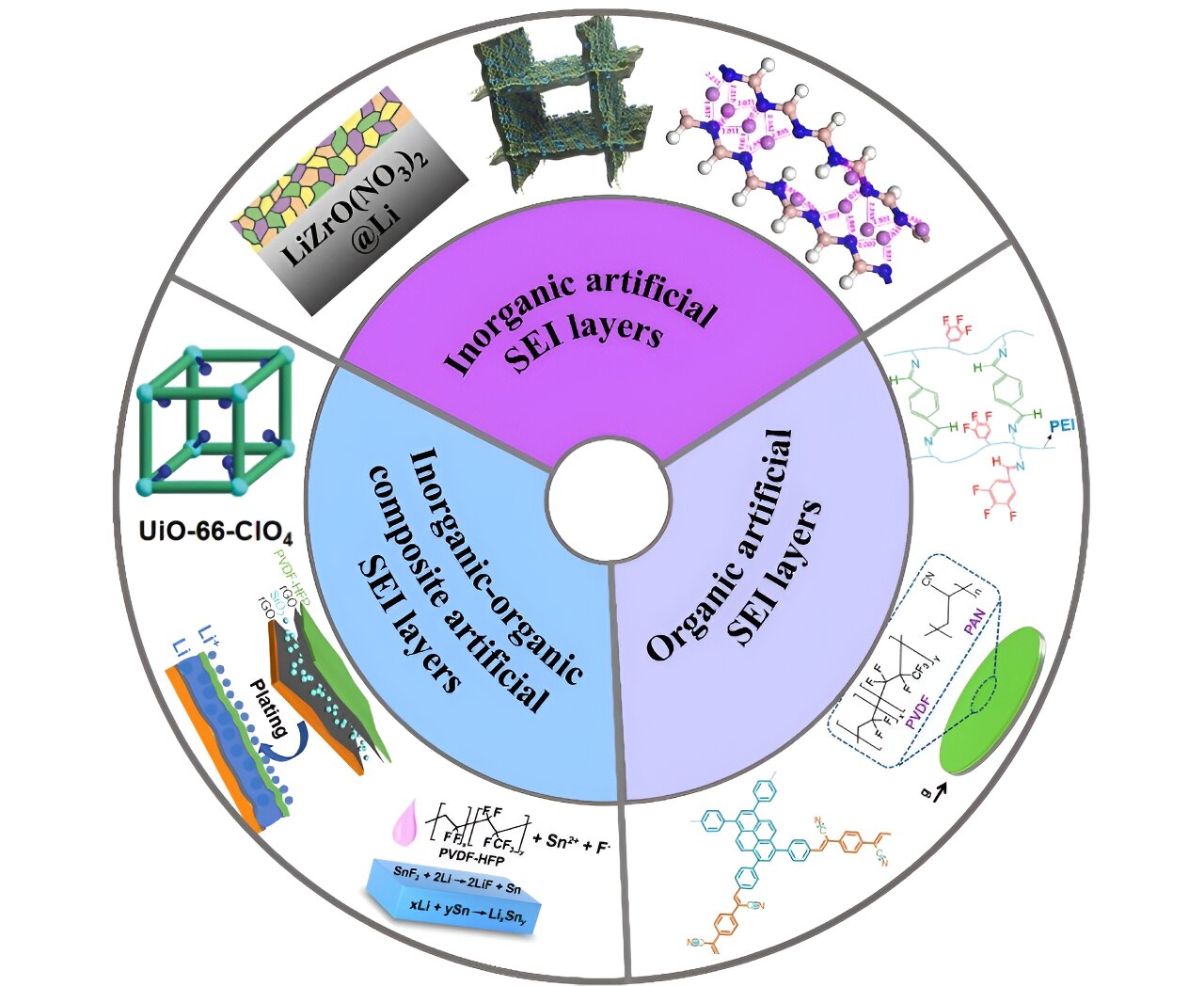
The use of lithium metal as the anode for batteries is one of the smarter options with better energy density than other materials. However, the interface between the electrode and electrolyte has quite a few issues that can be addressed for a safer and more functional outcome in the future.
Researchers are keen on replacing the graphite anode with lithium metal anode to construct a battery system with higher energy density. However, the Li metal anode is unstable and readily reacting with electrolyte to form a solid-electrolyte interphase (SEI). Unfortunately, the natural SEI is brittle and fragile, resulting in poor lifespan and performance.
Here, researchers have looked into a substitute for nature SEI, which could effectively mitigate the side reactions within the battery system. The answer is ASEI: artificial solid electrolyte interphase. ASEI corrects some of the issues plaguing the bare lithium metal anode to make a safer, more reliable, and even more powerful source of power that can be used with more confidence in electric vehicles and other similar applications.
Researchers published their findings in Energy Materials and Devices.
“Battery technologies have been revolutionizing our lifestyle and are closely related to everyone’s life. To realize a truly carbon-free economy, batteries with better performance are required to replace current Li-ion batteries,” said Yanyan Wang, author and researcher of the study.
Lithium metal batteries (LMBs) are such a candidate. However, the anode, lithium metal, is reactive with electrolyte and a passivation layer, called a solid-electrolyte interphase, forms on the surface of lithium metal during battery operation. Another issue of lithium metal anode is so called “dendrite growth”, appearing during battery charging.
Dendrites look like tree-branch structures that cause internal damage to the battery, leading to short-circuiting, poor performance, and potential safety hazards. These weaknesses altogether reduce the practicality of LMBs and pose some challenges that must be addressed.
The review introduced some strategies that can be employed to create a more effective and safer lithium metal anode. To improve upon the lithium metal anode, researchers found it is necessary to homogenize the distribution of lithium ions, which can help reduce the deposits on negatively charged areas of the batteries.
This, in turn, will reduce the dendrite formation which can prevent premature decay and short-circuiting. Additionally, creating an easier way for the lithium ions to diffuse while also ensuring the layers are electrically insulated can help retain the integrity of the structure, both physically and chemically, during battery cycling. Most importantly, reducing the strain between the interface of the electrode and electrolyte can ensure proper connectivity between the layers, which is an essential part of the functionality of the battery.
The strategies that appear to have the most potential are polymeric ASEI layers and inorganic-organic hybrid ASEI layers. The polymeric layers have sufficient adjustability in their design with the strength and elasticity being easily adjustable.
Polymeric layers also have similar functional groups as electrolytes which makes them extremely compatible; this compatibility is one of the major areas other components lack. Inorganic-organic hybrid layers are best for their reduction in layer thickness and marked improvement over the distribution of components within the layers, which improves the overall performance of the battery.
The future of the ASEI layers is bright but calls for some improvements. Researchers mainly would like to see improvement in the adhesion of the ASEI layers on the surface of the metal, which overall improves the function and longevity of the battery.
Additional areas that require some attention are stability in the structure and chemistry within the layers, as well as minimizing the thickness of the layers to improve the energy density of the metal electrodes. Once these issues are worked out, the road ahead for an improved lithium metal battery should be well-paved.
More information:
Yanyan Wang et al, Developing artificial solid-state interphase for Li metal electrodes: recent advances and perspective, Energy Materials and Devices (2023). DOI: 10.26599/EMD.2023.9370005
Provided by
Tsinghua University Press
Read the full article here


