


When purchasing a smartphone, one of your primary considerations is typically finding a durable case and a screen protector to safeguard the device from external harm. Similarly, a group of researchers from POSTECH has recently garnered attention in the academic world by introducing a tungsten coating that functions as a shield, much like these protective cases and films, for eco-friendly hydrogen fuel cell electrodes.
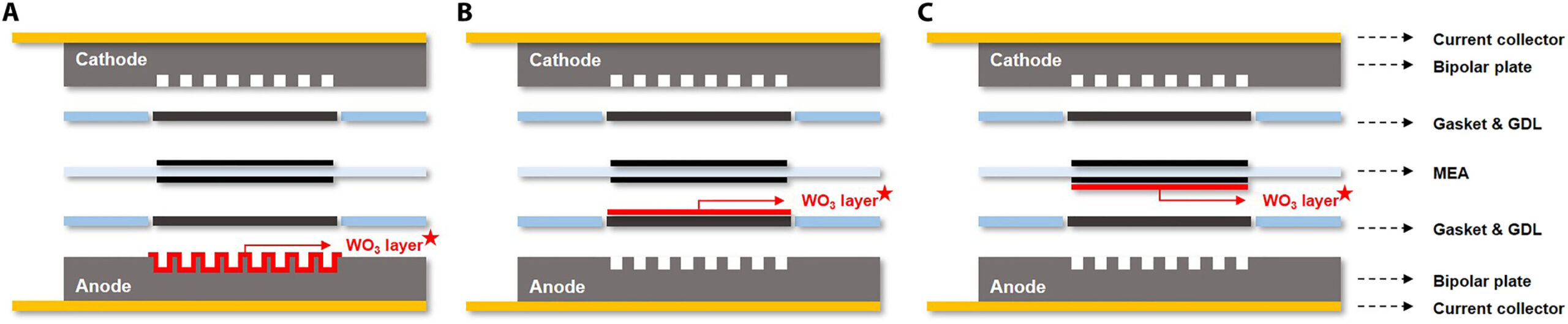
Professor Yong-Tae Kim from the Department of Materials Science and Engineering and the Graduate Institute of Ferrous & Eco Materials Technology and along with Sang-Hoon You, a doctoral candidate in the Department of Materials Science and Engineering at Pohang University of Science and Technology (POSTECH), have applied a layer of tungsten oxide (WO3) to the membrane-electrode assembly(MEA), a crucial component of hydrogen fuel cells.
This innovation aims to enhance the performance and efficiency of the electrode. Their research was published in Science Advances.
In the context of hydrogen vehicles, when they are initiated or brought to a sudden halt (start-up/shut-down, SU/SD), external air is drawn into the vehicle. The oxygen present in this air triggers an unintended electrochemical reaction within the fuel cell, expediting the deterioration of the catalyst. Given the nature of driving conditions, frequent SU/SD occurrences are inevitable, resulting in significant catalyst degradation.
The team harnessed the concept of metal-insulator transition (MIT) to tackle this challenge. MIT is a phenomenon wherein an insulator becomes capable of conducting electricity when subjected to external factors like changes in the concentration or temperature of an ambient gas. WO3 possesses the unique property of selectively conducting electricity as protons are intercalated/deintercalated by exploiting the MIT phenomenon.
To address the issue, the team applied a coating of WO3 to the catalyst layer at the anode of the MEA. Under normal operational circumstances, this coating maintains electrical conductivity. However, it selectively obstructs current flow exclusively during start-up/shut-down (SU/SD) conditions, preventing electrochemical reactions that lead to catalyst corrosion.
When the MEA coated with WO3 was incorporated into an actual fuel cell, the catalyst remained corrosion-free during SU/SD events, exhibiting an impressive performance retention rate of 94%. The team’s technology, involving the application of WO3 to the MEA, not only enhances the cell’s durability but also offers the advantage of integration into the existing mass production process for MEAs.
Professor Yong-Tae Kim said, “This innovation will directly and significantly contribute to enhancing the durability of commercial hydrogen fuel cell vehicles. What’s more, it can be readily applied to mass production processes of MEAs, simplifying its practical implementation.”
More information:
Sang-Hoon You et al, Enhancing durability of automotive fuel cells via selective electrical conductivity induced by tungsten oxide layer coated directly on membrane electrode assembly, Science Advances (2023). DOI: 10.1126/sciadv.adi5696
Pohang University of Science and Technology
Read the full article here


