


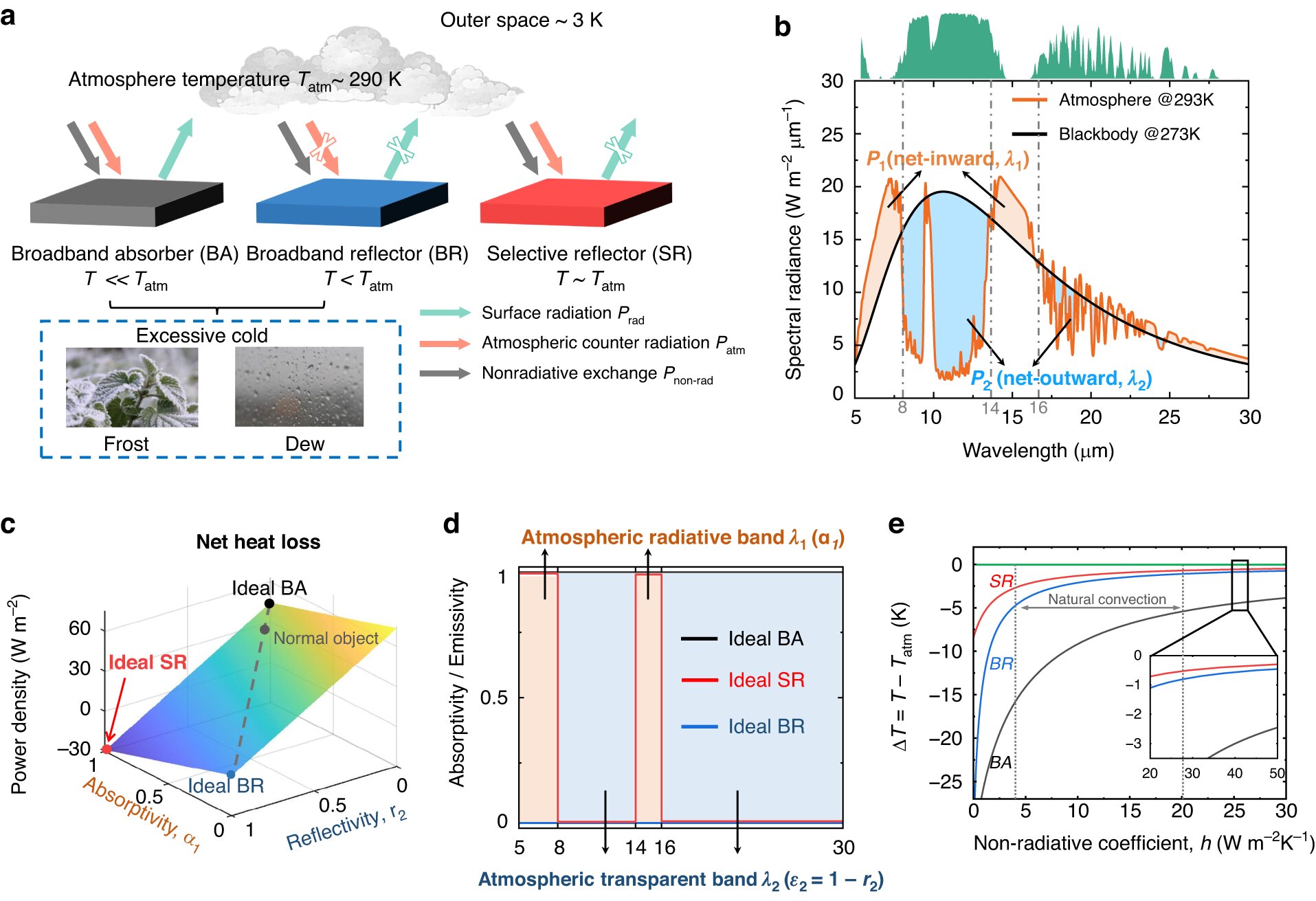
Warming has played a crucial role in various industrial and agricultural processes throughout history. Night-time warming, however, presents a distinct challenge due to the absence of solar radiation. During the night, direct radiative heat loss to outer space through the atmospheric transparent window (8–14 μm) can cause temperature to drop below freezing, posing significant threats to agriculture (crops), transportation (outdoor cables), and more.
Traditionally, achieving night-time warming relied on active electric heaters, which contribute to significant energy consumption and increased carbon emissions. Passive warming methods, including insulating blankets (reducing heat conduction) and low-emissivity films (reducing heat radiation), come with limitations, such as suboptimal effectiveness and overall positive net heat loss.
Air, known for its high heat capacity, can maintain relatively higher temperatures compared to the ground during the night, potentially serving as an external heat source. To harness energy from the entire atmosphere above the Earth’s surface, radiative methods are needed.
In a new paper published in Light: Science & Applications, a team of scientists, led by Professor Qiang Li from Zhejiang University, China, proposed a night-time radiative warming strategy based on nanophotonic control. This strategy passively suppresses the thermal radiation of objects in the atmospheric transparent window (8–14 μm) while actively utilizing energy in the atmospheric radiation bands (5–8 μm and 14–16 μm).
Achieving this strategy involves covering the target surface with a selective reflective (SR) thin film that exhibits high reflectance in the atmospheric transparent band and high absorptivity in the atmospheric radiation bands, to control radiative energy flow and effectively raising the target temperature.
Researchers designed and fabricated the device using a broadband infrared-absorbing substrate combined with germanium and zinc sulfide one-dimensional photonic crystal films. The device achieved a reflectance of 0.91 in the atmospheric transparent window and an absorptivity of 0.7 in the atmospheric radiative bands. Then, outdoor thermal testing was conducted, revealing that by covering SR film, the target’s temperature increased by 2.1°C/4.4°C compared to a broadband reflective (low-e) surface and a broadband absorptive surface, respectively.
The study also assessed the potential application of this night-time warming strategy in cities with different climates, demonstrating that the annual electricity savings could surpass 300 kWh m-2 across different climate zones.
More information:
Yining Zhu et al, Night-time radiative warming using the atmosphere, Light: Science & Applications (2023). DOI: 10.1038/s41377-023-01315-y
Chinese Academy of Sciences
Read the full article here


