


Dark matter baffles astronomers. It’s impossible to see—hence the name—and has never been measured directly, but it makes up most of the mass of galaxies. Ditto dark energy, an equally mysterious force behind the acceleration of the expanding universe.
In fact, according to NASA the current cosmological model says the universe consists of 5% visible matter, 27% dark matter and 68% dark energy. Some fundamental gaps in our knowledge of how the universe works obviously need plugging.
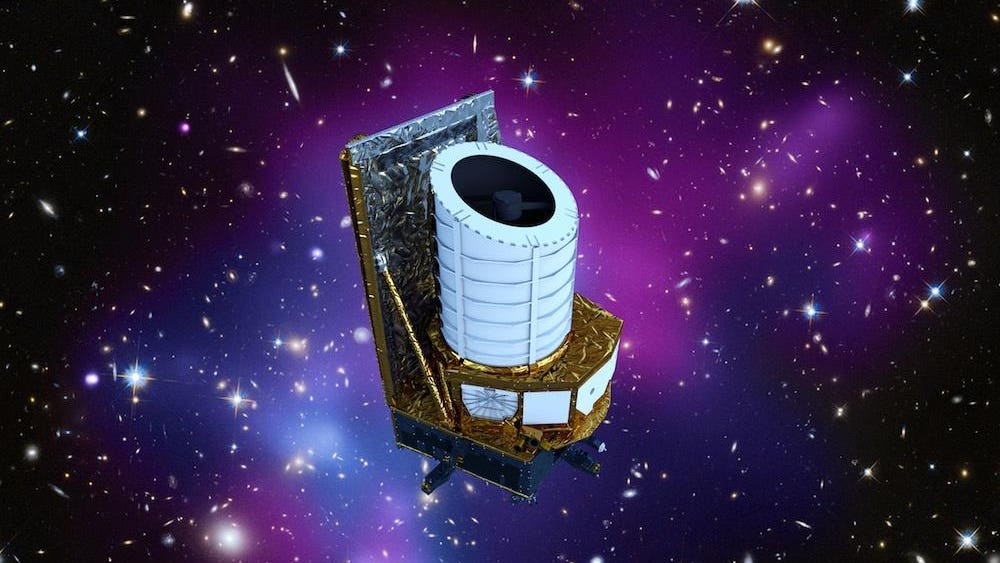
Cue Euclid, a $1.6 billion spacecraft created by the European Space Agency (ESA) that launches this weekend atop a SpaceX Falcon 9 rocket.
Here’s everything you need to know about Euclid and its unenviable task of explaining what exactly dark matter and dark energy are:
Euclid Goes Dark
A mission to map the geometry of the Universe, Euclid is named after the ancient Greek mathematician often called the father of geometry. Once in deep space a million miles from Earth, Euclid’s 1.2 m diameter telescope will study a couple of billion galaxies as they were 10 billion years ago. It will measure their velocities as they recede from it. That’s about a third of the universe, mapped in 3D and at unprecedented accuracy. Euclid’s image quality will be four times sharper than that achieved by ground-based telescopes.
How Euclid Will ‘See’ Dark Matter
Dark matter and dark energy can only be inferred by observing their influence. By mapping the Universe’s large-scale structure and precisely how it’s expanding, Euclid’s data will reveal their influence.
Its mission will last at least six years.
When to Watch Euclid Launch
Euclid was supposed to launch atop a Russian Soyuz rocket from Europe’s Spaceport in French Guiana. Those plans were canceled after Russia’s invasion of Ukraine in March 2022. Instead, Euclid will go skywards on a SpaceX Falcon 9 rocket from Cape Canaveral, Florida, no earlier than 11:11 a.m. EDT (8:11 a.m. PDT) on Saturday, July 1, 2023. It will be streamed live on NASA TV from 40 minutes before.
After launch, the satellite will travel to the Sun-Earth Lagrangian Point (L2). That’s a place 10 million miles behind Earth, as viewed from the Sun. It will join ESA’s Gaia satellite that’s currently producing a 3D map of millions of stars in our Milky Way galaxy. Euclid measures 4.7 x 3.7 meters and weights two tons.
Joint Effort
Euclid isn’t acting alone. L2 is also home to the James Webb Space Telescope, in space since late 2021, which is currently observing similarly distant galaxies. The ground-based Vera C. Rubin Observatory in Chile and NASA’s Nancy Grace Roman Space Telescope—both set to see first light in the next few years—will also survey distant galaxies to unravel the secrets behind the hidden forces in the universe.
Wishing you clear skies and wide eyes.
Read the full article here