


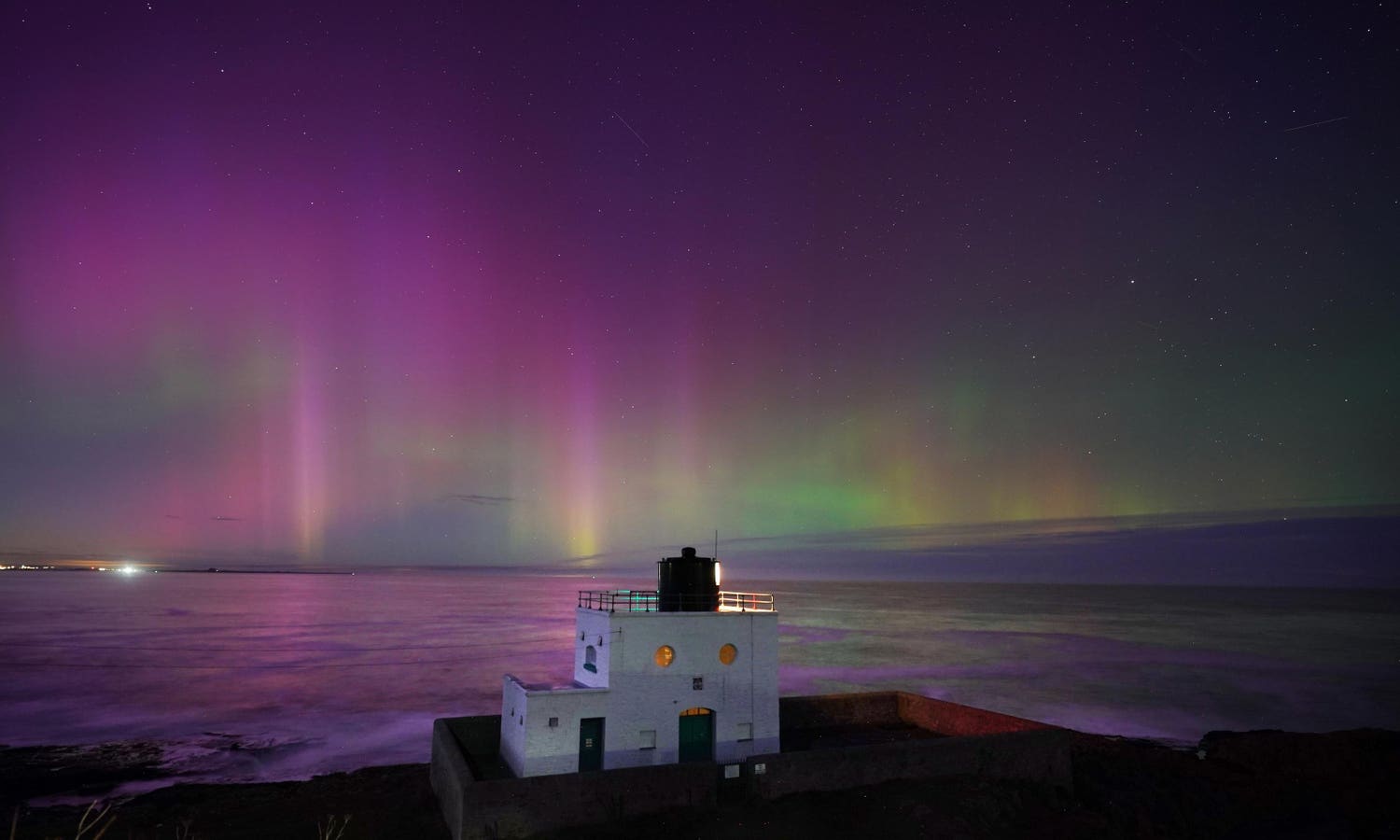
The northern lights—also called the aurora borealis—could be visible in northern U.S. states after a spike in magnetic activity on the sun on Thursday, November 9.
It comes after a correctly predicted stunning display last Sunday when a strong geomagnetic storm produced aurora in the night skies for northern U.S. states and Europe. Aurora was glimpsed as far south as Greece and Italy.
According to SpaceWeather.com, the incoming geomagnetic storm won’t be as strong as last weekend’s G3-class event, but it could still produce G2 activity levels.
That could be enough to make aurora visible in northern U.S. states from New York to Washington, said the website.
It could also mean a second scientific rocket launch by NASA in Alaska.
Saturday Night Lights
That assertion is based on space weather models produced independently by the National Oceanic and Atmospheric Administration and NASA. The former’s Space Weather Prediction Center has issued a three-day forecast that predicts for Saturday a G1 magnetic storm from 15:00 UTC (10:00 a.m. EST) with a G2 magnetic storm from 18:00-03:00 UTC (13:00-10:00 p.m. EST). A G1 is predicted to follow until -6:00 UTC (01:00 a.m. EST).
So, anyone in northern U.S. states looks set to have the possibility of aurora in the northern skies from darkness through midnight. If you can, get away from light pollution and have a manual camera on a tripod that can take long exposure images (try f2.8-4, ISO 1600, 20 seconds).
Charged Particles
The culprit is another coronal mass ejection, a cloud of magnetic fields and charged particles from the sun that streams into space at up to 1,900 miles (3,000 kilometers) per second. Crucially, this one is headed towards Earth.
Displays of the aurora are caused by events that super-charge the solar wind, a flow of charged particles from the sun. As the particles collide with Earth’s magnetic field, they accelerate down its magnetic field lines. They produce an oval of green and red around our planet’s poles.
Expanding Oval
When solar activity is high—as it is right now—that oval expands. It’s common to see the aurora from the Arctic Circle, at around 65°-70° North latitudes, in regions like Alaska, northern Canada, Iceland, Lapland (northern Norway, Sweden, and Finland) and northern Russia.
When solar activity is high—as it is right now—that oval expands, with the aurora being visible at lower latitudes.
The sun is currently nearing the peak of its present solar cycle, which is proving to be much stronger than the last one. A solar cycle lasts roughly 11 years. The SWPC recently published an update to its prediction for the current solar cycle, pinpointing the height of the sun’s activity—called solar maximum—to occur between January and October 2024.
Wishing you clear skies and wide eyes.
Read the full article here



