


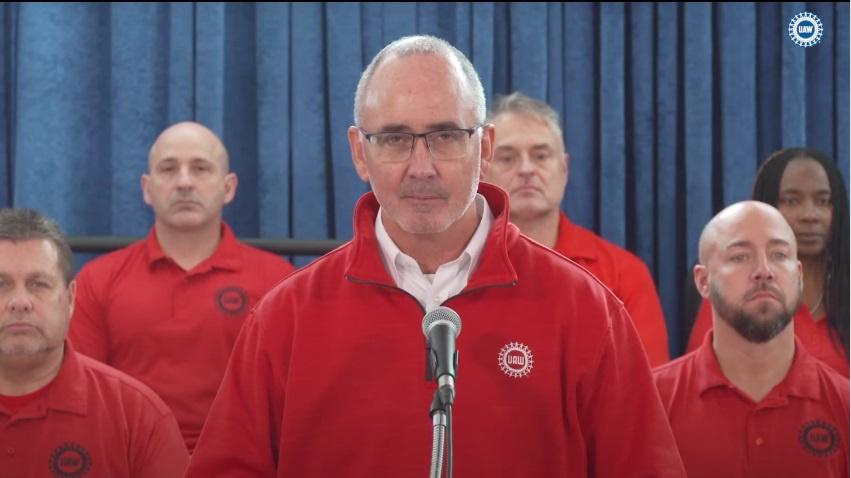
Now that he successfully negotiated to fatten members’ future paychecks and benefits, UAW president Shawn Fain’s next fight is to put some meat on the bone of the union’s membership roles.
Two features of the new four-and-a-half year contracts up for ratification by UAW members directly address Fain’s goal—its length and disposition of workers at joint venture electric vehicle battery plants.
At its peak in 1979 the UAW had 1.5 million members. That number has dwindled to just over 383,000 according to the union’s Labor Organization Annual Report filed with the U.S. Dept. of Labor on March 31. However, less than half, about 150,000, work at one of the three Detroit-based automakers.
More members means more money in the form of dues, and more money powers organizing efforts to win new members as well as funding for a strike fund from which workers on picket lines are paid.
While the last few contracts have run four years, the UAW successfully negotiated new deals that will run an extra six months.
During separate webcasts in the past week explaining the highlights of the tentative contracts to members as they vote on whether or not to ratify the contracts, Fain said the April 30, 2028 expiration dates were timed so the union could strike if necessary on May 1, May Day, otherwise known as International Worker’s Day.
The extra six months not only buys UAW members additional time at a new higher pay rate, it also buys Fain additional time to try to win a battle the union has so far lost over and over again—convincing workers at U.S. plants owned by foreign automakers to join.
“Part of our strength came from all three contracts expiring at once and taking on all three companies at once,” said Fain during Saturday’s webcast briefing General Motors Co. members on the tentative contract with that company. “But there’s a lot more than three companies that we’re looking to square up against. We need to organize like we’ve never organized before. We aren’t bashful or quiet about what our plans are. Our goal is to spend the next few years organizing auto workers across this country. The Big Three aren’t the only auto companies making record profits. Auto workers at Toyota, Volkswagen, Hyundai and Tesla, they deserve record contracts too, and we’re going to do everything we can to support them in the fight to win what they deserve.”
It’s an aggressive goal that’s completely on-brand for Fain but to date, it’s been a Sisyphean battle where the UAW has repeatedly been rebuffed by workers when foreign automakers counter the union’s organization efforts with improved wage and benefits. It’s a message there’s no need to join a union and pay dues to win bigger paychecks.
Indeed, almost immediately after the tentative contracts were announced with General Motors Co., Ford Motor Co. and Stellantis, Toyota Motor said it will raise the pay of its non-union U.S. factory workers about 9% starting January 1 and boost wages for some logistics and service parts employees according to Reuters.
The effort to pull in workers at electric vehicle leader Tesla will be formidable as well. So far, those effort haven’t gain any traction and CEO Elon Musk hasn’t been cooperative. Still, in a recent interview with Bloomberg News, Fain said he is undeterred.
“We can beat anybody,” Fain told Bloomberg. “It’s gonna come down to the people that work for him deciding if they want their fair share… or if they want him to fly himself to outer space at their expense.”
One battle to bolster the union’s membership Fain did win in these latest negotiations is to bring under the master agreement workers at the Ultium Cells factory in Lordstown, Ohio operated by the General Motors-LG Energy Solutions joint venture. Workers at GM’s closed assembly plant in Lordstown will also have a second shot at employment without having to move to find new jobs.
“The significance of this cannot be overstated,” Fain said during Saturday’s GM contract briefing webcast. “Right now the future of our industry is being defined and employers like GM have used joint ventures to drive a race to the bottom. These jobs at Ultium Cells are dangerous, difficult and pay low wages but all that comes to an end in this agreement.”
Once the contract is ratified, Ultium employees will become GM employees and covered by the national agreement. There will also be a six-month window for former Lordstown UAW members who were active employees at the assembly plant on Nov. 26, 2018 to apply to apply to return to work at Ultium Cells, retaining their current wages, benefits and seniority.
With ratification expected at all three automakers the clock will be ticking until April 30, 2028 to see if Shawn Fain makes his self-declared deadline to do what none of his predecessors have done before, or will he be similarly frustrated, and declare Mayday.
Read the full article here



