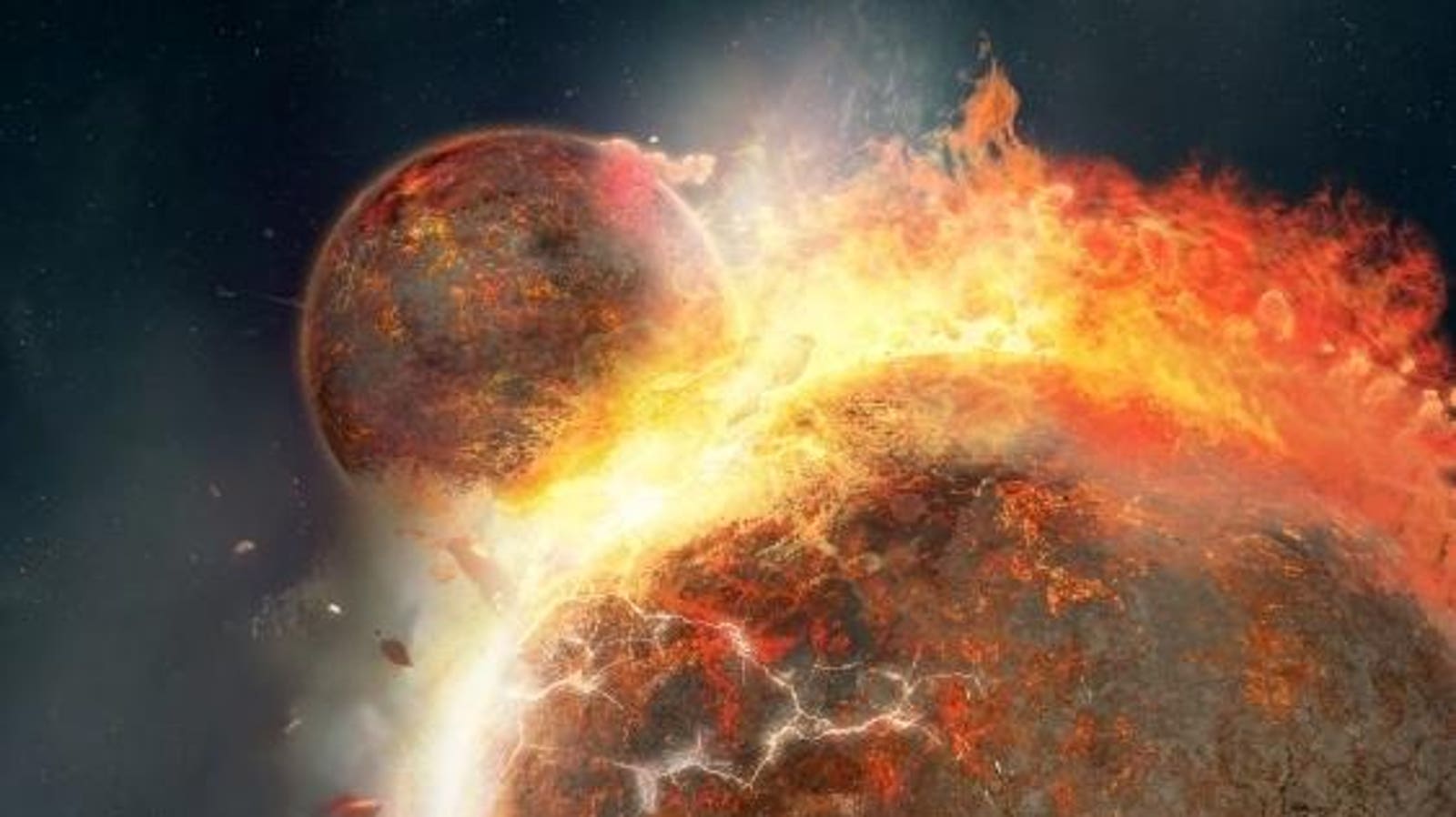
Deep inside our planet are two giant “blobs,” the leftovers of an ancient world that collided with Earth.
The blobs, which are in the mantle near the center of the Earth beneath Africa and the Pacific Ocean, have been known about since the 1980s, but a new paper published today in the journal Nature claims they have an extraterrestrial origin.
If the theory is correct then geologists have uncovered the remains of Theia, a Mars-sized planet that crashed into Earth. According to the giant-impact theory, the debris from this impact collected in an orbit around Earth to form the moon. It may have taken just hours to occur, according to NASA scientists, but no trace of Theia has ever been found in the asteroid belt or in meteorites.
“In other words, the massive blobs currently inside Earth, deep beneath our feet, are extraterrestrial,” said Ed Garnero, professor at Arizona State University’s School of Earth and Space Exploration, in a press release. “Earth not only has ‘blobs,’ Earth has extraterrestrial blobs!”
Absorbing Theory
This new theory about the blobs suggests that residual debris from the impact with Theia coalesced into the moon, but the rest of the planet was absorbed into the young Earth.
The discovery comes just weeks after new studies of moon dust returned by the Apollo 17 crew of 1972 revealed that the moon is 40 million years older than thought at 4.46 billion years.
Dense Material
The blobs, which scientists call large low-velocity provinces (LLVPs), were discovered in the 1980s by scientists measuring seismic waves traveling through Earth. Seismic waves slow down as they move through this dense material. They both have an unusually high iron content, something they have in common with the moon.
“I had a ‘eureka moment’ and realized that the iron-rich impactor could have transformed into mantle blobs,” said Qian Yuan, currently an O.K. Earl Postdoctoral Fellow at Caltech, in a press release. Simulations confirmed that the physics of the collision could have led to the formation of both the LLVPs and the moon.
The LLVPs are large, continent-sized regions within our planet. If they were on Earth’s surface they would make a layer roughly 60 miles (100 kilometers) thick around the entire planet.
Remnants Of Theia
Crucially for this discovery, Theia’s impact with Earth appears not to have been energetic enough to melt the Earth’s lower mantle. That’s the only scenario in which traces of Theia could have survived as detectable blobs rather than being mixed in with the rest of the material.
“The moon appears to have materials within it representative of both the pre-impact Earth and Theia, but it was thought that any remnants of Theia in the Earth would have been ‘erased’ and homogenized by billions of years of dynamics within the Earth,” said Steven Desch, professor at ASU’s School of Earth and Space Exploration, in a press release. “This is the first study to make the case that distinct ‘pieces’ of Theia still reside within the Earth, at its core-mantle boundary.”
Scientists now want to study how the presence of the blobs deep within Earth might have influenced its plate tectonics, the formation of the first continents and minerals.
Wishing you clear skies and wide eyes.
Read the full article here