


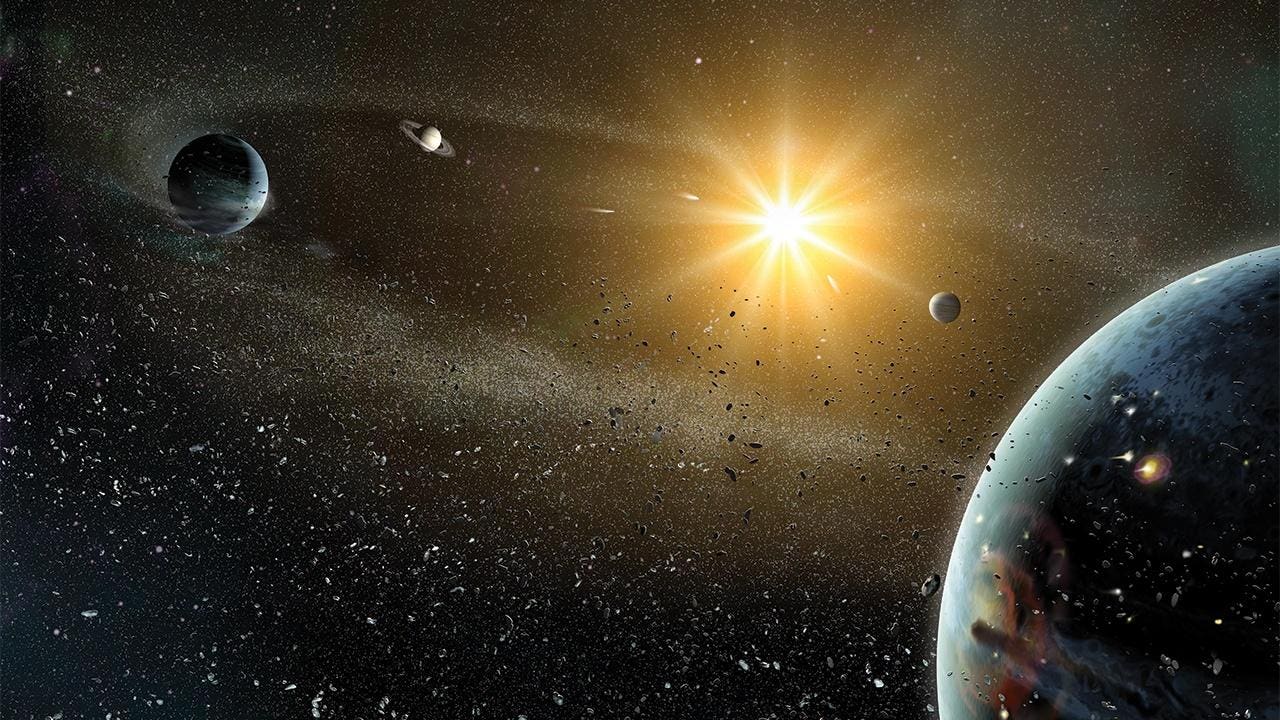
Massive planets like Jupiter—now at its brightest and best in the night sky—can prevent Earth-sized planets from becoming Earth-like by upsetting their orbits and destroying climates.
That’s the conclusion of a new paper published today in The Astronomical Journal, which details how the pull of gas giants can fundamentally change the futures of more minor planets orbiting the same star.
There are four gas giant planets in our solar system—Jupiter, Saturn, Uranus and Neptune. The largest, Jupiter, has colossal gravitational effects that deflect asteroids and comets that could otherwise threaten Earth.
Destructive role
In other star systems, gas giants can play a much more destructive role. As an example, the authors studied HD 141399, a star system also with four gas giant planets, which is 121 light-years from the solar system in the constellation Boötes. They did computer simulations to see if the four gas giant planets ejected any planets out of the star’s habitable zone.
Habitable zone
The habitable zone of a star—sometimes called a Goldilocks zone—is the distance from a star a planet needs to be for liquid water to exist on its surface. That’s thought to be a prerequisite for life. It’s bordered on either side by a “boil line” (where a world is too close to a star and where water would boil away) and an “ice line” (where water would freeze).
Chaotic place
HD 141399 is a chaotic place with “four Jupiters acting like wrecking balls, throwing everything out of whack,” said Stephen Kane, first author of the paper and an astrophysicist at the University of California – Riverside. Earth would be unlikely to stay where it is if it was in this system, the simulations showed. “There are only a select few areas where the giants’ gravitational pull would not knock a rocky planet out of its orbit and send it flying right out of the zone,” said Kane.
More evidence
A second paper, also published today by the same authors, also suggests that gas giants can cause chaos. It found that a suspected Earth-size planet in the habitable zone of a star just 30 light-years from the solar system, called GJ 357, is likely much larger. “It’s probably not terrestrial, so you couldn’t have life on it,” said Kane. Simulations suggest that the gravitational chaos caused by the planet—now thought to be 10 times the mass of Earth—is preventing other, more minor planets from orbiting in the habitable zone alongside it. It’s a warning that planets found to orbit in the habitable zone of a star shouldn’t be assumed to be capable of hosting life, said the authors.
“Our work gives us more reasons to be very grateful for the planetary configuration we have in our solar system,” said Kane.
Wishing you clear skies and wide eyes.
Read the full article here



