


by KeAi Communications Co.
The global demand for cooling energy has seen a surge in the 21st century. Notably, the use of air conditioners and electric fans accounts for nearly 20% of a building’s overall electricity consumption. Exploring eco-friendly and sustainable cooling technologies holds promising prospects for combating global warming and curbing energy usage.
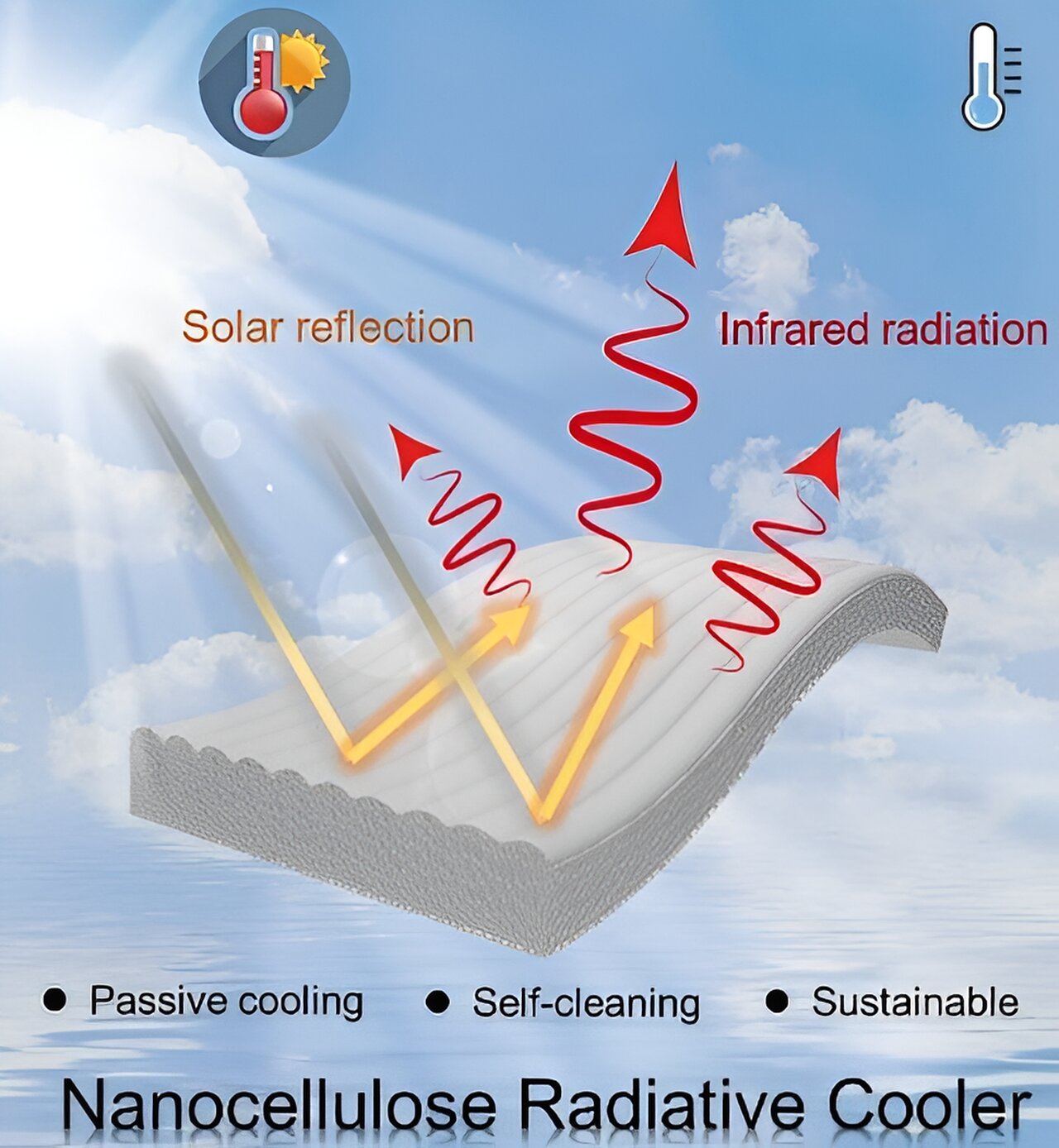
In a study published in the Journal of Bioresources and Bioproducts, a team of Chinese researchers has introduced a scalable and dust-resistant, nanocellulose-based, aerogel film radiative cooler.
“Due to its high emissivity within the atmospheric transparency window (λ≈ 8–13 µm), cellulose has been identified as a viable candidate for radiative cooling,” says first author of the study, Chenyang Cai, an associate professor in the College of Materials Science and Engineering at Nanjing Forestry University. “Nevertheless, conventional cellulose-based cooling systems often exhibit inadequate solar reflectivity and susceptibility to external dust contamination, leading to diminished daytime cooling efficiency.”
To that end, the team has developed an eco-friendly nanocellulosic passive cooling material known as nanocellulose aerogel film. This material offers robust solar scattering and infrared emissivity, making it highly effective for passive cooling during the summer.
“The scalability of the nanocellulose aerogel film is achieved through freeze-drying and hot-pressing techniques. This pioneering cellulosic cooling solution can deliver a sub-ambient temperature reduction of 6.9°C under direct sunlight in hot conditions while also exhibiting dust-repellent properties,” explains Cai.
These sustainable passive cooling materials, featuring favorable optical characteristics and hydrophobicity, provide deeper insights into the development of next-generation thermal regulation materials, contributing to the realization of carbon neutrality.
Notably, most daytime radiative coolers used petroleum and heavy metal-based materials, contributing to secondary air pollution. Moreover, their cooling performance in hot summers required enhancement.
“We hope our study opens up new avenues for scientists to further explore cellulose-based materials for thermal regulation, addressing the issue of high energy consumption.”
More information:
Chenyang Cai et al, Large scalable, ultrathin and self-cleaning cellulose aerogel film for daytime radiative cooling, Journal of Bioresources and Bioproducts (2023). DOI: 10.1016/j.jobab.2023.06.004
Provided by
KeAi Communications Co.
Read the full article here


