


A research team has proposed a new surface stabilization strategy that maximizes stability and efficiency by effectively reducing defects in the surface of perovskite quantum dots.
Advantages with perovskite quantum dots include not only good optoelectronic properties but also mass-producibility with a simple manufacturing process using a solution. This is why many studies have been conducted to apply perovskite quantum dots to next-generation optoelectronic devices. To apply perovskite quantum dots to optoelectronic devices, a ligand exchange process is required, which reduces the distance between the quantum dots and thereby improves conductivity.
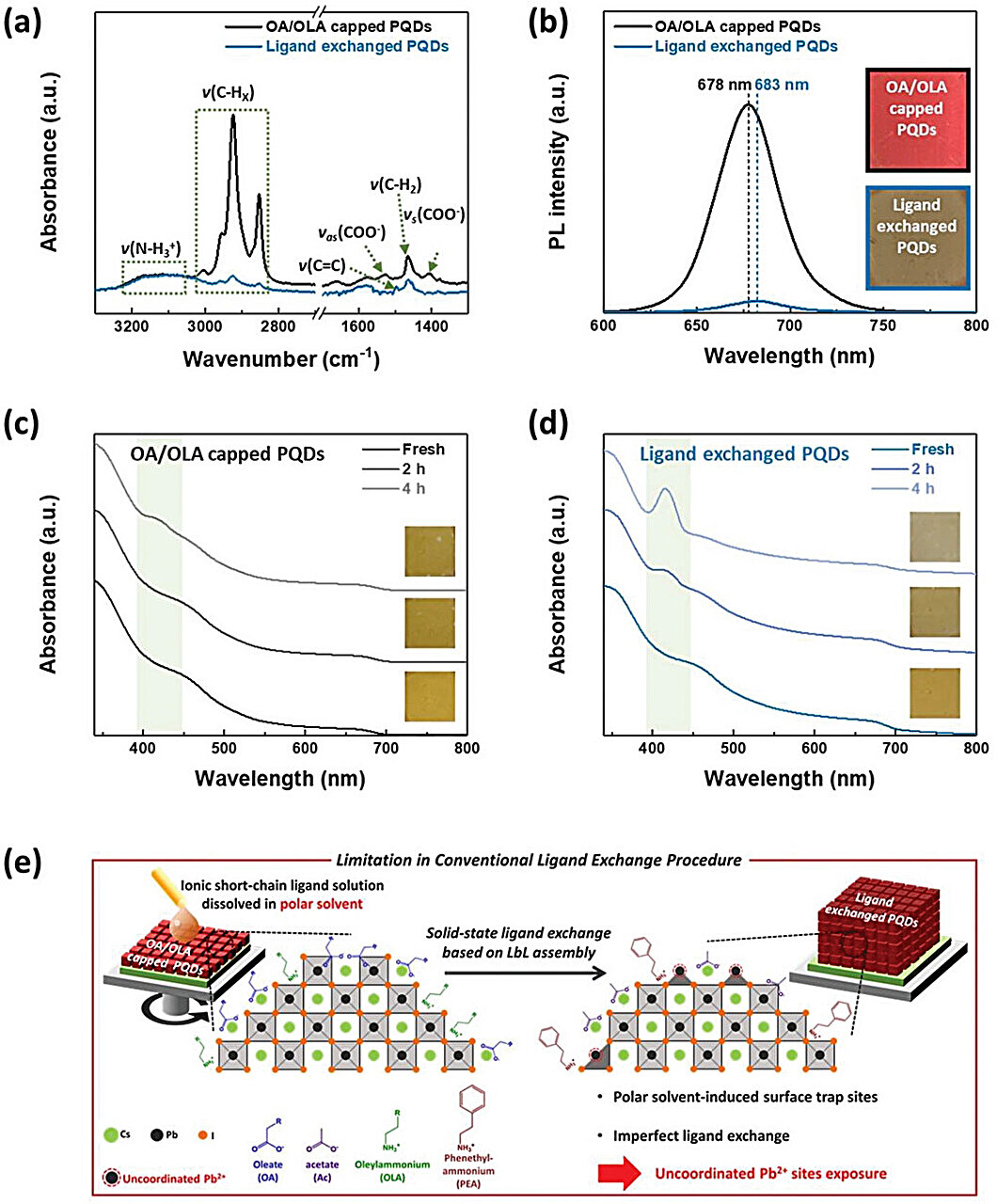
In the traditional ligand exchange process, a thin film of perovskite quantum dots is treated with ionic ligands dissolved in a polar solvent. During this process, however, the polar solvent damages the surface of the quantum dots and results in a weak bond between ionic ligands and the quantum dots, which in turn leads to many defects in the surface of the quantum dots.
Although many different ligands capable of reducing the number of defect sites during the ligand exchange process have been introduced to address this problem, all of them have not been able to move beyond the broad framework that uses ionic ligands dispersed in a polar solvent.
Against this backdrop, a research team led by Professor Jong-min Choi at the Department of Energy Science and Engineering, DGIST, has successfully developed a new approach that protects the surface of quantum dots with non-polar solvents and introduces covalent ligands to greatly reduce defects in the surface of quantum dots. It allowed the research team to develop perovskite quantum dot solar cells demonstrating high efficiency and long-term stability.
Professor Jong-min Choi at the Department of Energy Science and Engineering, DGIST, said, “Unlike traditional polar solvents, non-polar solvents protected the surface of quantum dots better, which produced fewer defects, and covalent ligands contributed greatly to reducing defects in the surface of quantum dots. Going forward, we would like to focus more on researching the control of the surface of quantum dots and contribute to the commercialization of applicable materials.”
This study was conducted in collaboration with Professor Young-hoon Kim’s research team at Kookmin University and led by Sang-hun Han and Ga-young Seo, who are students in the combined master’s and Ph.D. program at DGIST.
The study’s results were published in Advanced Science.
More information:
Sanghun Han et al, Stabilized Perovskite Quantum Dot Solids via Nonpolar Solvent Dispersible Covalent Ligands, Advanced Science (2023). DOI: 10.1002/advs.202301793
Provided by
Daegu Gyeongbuk Institute of Science and Technology
Read the full article here


