


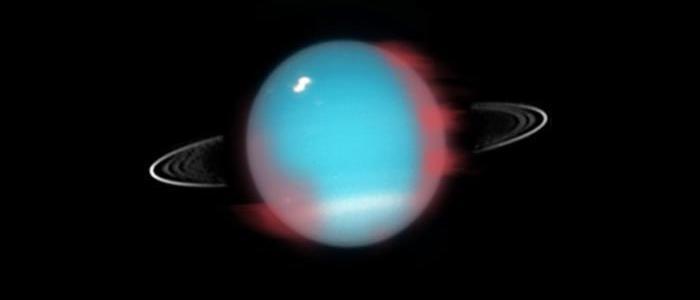
Aurora has been confirmed around the seventh planet, Uranus, after scientists studied the ice giant world in the infrared.
Although scientists found aurora around Uranus in 1986, that was only in ultraviolet light. This is the first time aurora has been seen in infrared light. Since the atmosphere at Uranus is mainly hydrogen and helium, aurora doesn’t show in the light spectrum visible to humans.
The presence of infrared aurora was confirmed by astronomers at the University of Leicester in the U.K., who this week published a paper in the journal Nature Astronomy. They used the Keck II telescope in Hawaii.
Magnetic appeal
Auroras result from the solar wind interacting with particles along magnetic field lines around planets. The existence of aurora around Uranus could help explain why its rotational axes and magnetic axes don’t align. It shares that oddness with Neptune and, to some extent, Jupiter.
However, the brightness of the aurora also depends on the temperature of the particles in the atmosphere of a planet. That could help solve one of the mysteries of the solar system.
Critical theory
Scientists do not know why the gas giants in the solar system (Jupiter, Saturn, Uranus and Neptune) are warmer than they should be. That could be down to the aurora, which generates heat and pushes it towards a planet’s magnetic equator.
It’s a critical theory because it could help scientists search for exoplanets—planets that orbit stars other than our sun—that may host life. What’s more, most exoplanets we know of are rather like Uranus.
Sub-Neptune worlds
“A majority of exoplanets discovered so far fall in the sub-Neptune category, and hence are physically similar to Neptune and Uranus in size,” said Emma Thomas, lead author and a PhD student at the University of Leicester School of Physics and Astronomy. “This may also mean similar magnetic and atmospheric characteristics too.”
The new paper begins a new age of aurora investigations at Uranus, said Thomas, and will broaden scientists’ knowledge of auroras around ice giant planets in general.
Ring pattern
As well as aurora, Uranus has rings, which were imaged last year by the James Webb Space Telescope. Before that NASA’s Voyager 2 spacecraft, in 1986, and the Keck Observatory, in 2004, also imaged the rings.
Voyager 2’s visit gave humanity its only close-up images of Uranus and discovered 10 new moons. Uranus takes 84 years to orbit the sun but rotates on its side, so for up to half a year (equal to 42 Earth-years), large parts of one hemisphere are hidden from sunlight. It has five moons that may be “ocean worlds,” which could host life.
Wishing you clear skies and wide eyes.
Read the full article here



