


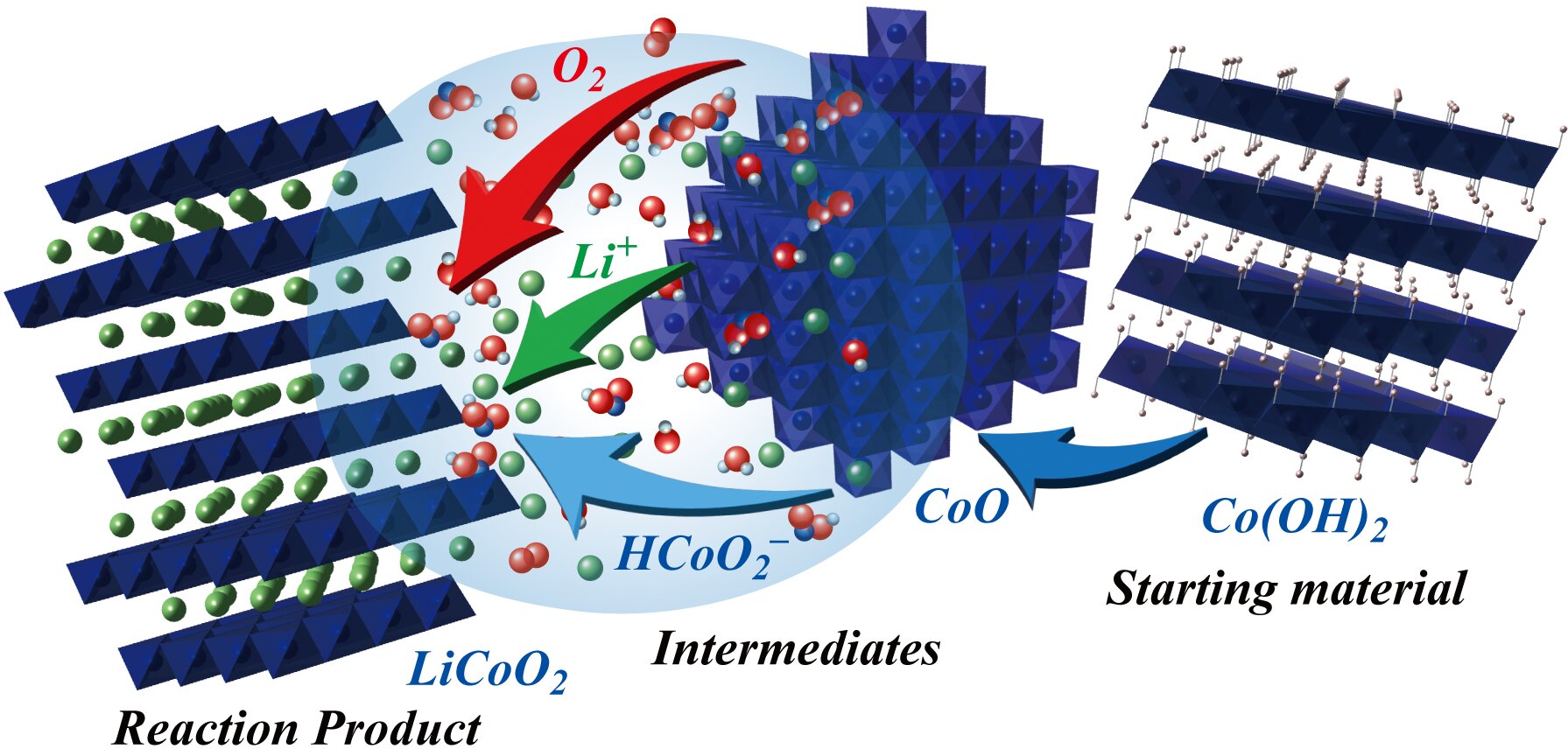
Layered lithium cobalt oxide, a key component of lithium-ion batteries, has been synthesized at temperatures as low as 300°C and durations as short as 30 minutes.
Lithium ion batteries (LIB) are the most commonly used type of battery in consumer electronics and electric vehicles. Lithium cobalt oxide (LiCoO2) is the compound used for the cathode in LIB for handheld electronics. Traditionally, the synthesis of this compound requires temperatures over 800°C and takes 10 to 20 hours to complete.
A team of researchers at Hokkaido University and Kobe University, led by Professor Masaki Matsui at Hokkaido University’s Faculty of Science, have developed a new method to synthesize lithium cobalt oxide at temperatures as low as 300°C and durations as short as 30 minutes. Their findings were published in the journal Inorganic Chemistry.
“Lithium cobalt oxide can typically be synthesized in two forms,” Matsui explains. “One form is layered rocksalt structure, called the high-temperature phase, and the other form is spinel-framework structure, called the low-temperature phase. The layered LiCoO2 is used in Li-ion batteries.”
Using cobalt hydroxide and lithium hydroxide as starting materials, with sodium or potassium hydroxide as an additive, the team conducted a series of high-precision experiments under varying conditions to synthesize layered LiCoO2 crystals. The process was called the “hydroflux process.” They were also able to determine the reaction pathway that led to the formation of the layered crystals.
“By understanding the reaction pathway, we were able to identify the factors that promoted the crystal growth of layered LiCoO2,” Matsui said. “Specifically, the presence of water molecules in the starting materials significantly improved crystallinity of the end product.”
The team also measured the electrochemical properties of the layered LiCoO2, showing that they were only marginally inferior to that of commercially available LiCoO2 synthesized by the traditional high temperature method.
“This work is the first experimental demonstration of the thermochemical stability of layered LiCoO2 at low temperatures under ambient pressure,” concludes Matsui. “Our development of this hydroflux process will enable energy saving measures in various ceramic production processes. Our immediate next steps will be the improvement of the hydroflux process based on our understanding of the reaction pathway.”
More information:
Rannosuke Maeda et al, Kinetically Enhanced Reaction Pathway to Form Highly Crystalline Layered LiCoO2 at Low Temperatures Below 300 °C, Inorganic Chemistry (2023). DOI: 10.1021/acs.inorgchem.3c01704
Hokkaido University
Read the full article here


