


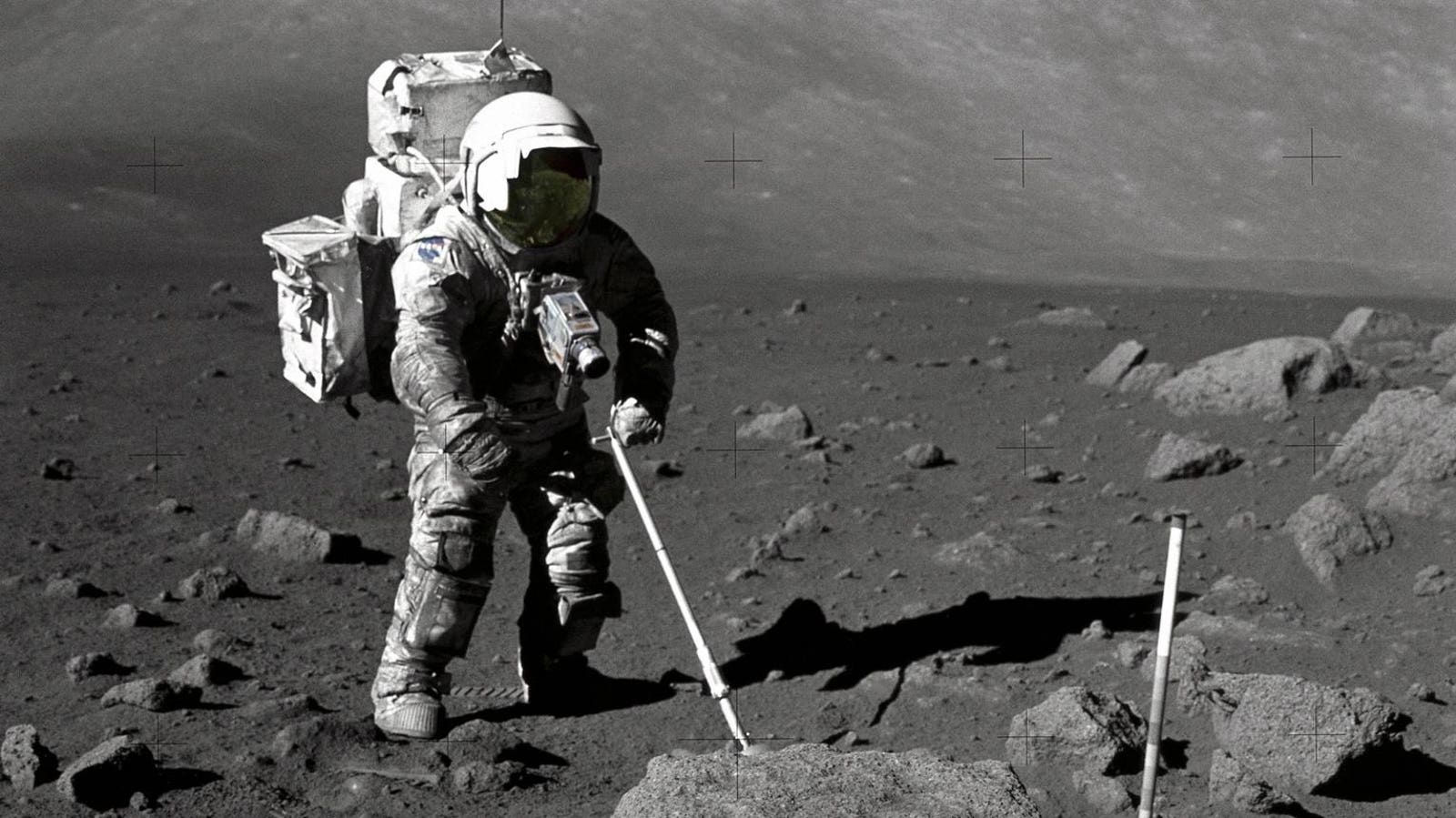
The moon is 40 million years older than scientists thought according to new evidence gleaned from crystals on moondust brought back from the lunar surface by Apollo astronauts 51 years ago.
Now said to be at least 4.46 billion years old, the crystals are, say the authors of a new study published today in Geochemical Perspectives Letters, the oldest solids on the moon.
That means they were formed when the moon itself came into being. Exactly when that happened had, until now, been a mystery. However, how the moon formed is generally accepted to be after a “great impact” between Earth and a protoplanet.
How The Moon Was Formed
The giant-impact theory proposes that a Mars-sized planet, now called Theia, crashed into Earth, with the resulting debris from this impact collecting in an orbit around Earth to form the moon.
Staggeringly, this may have happened in just a few hours, according to a supercomputer simulation devised by NASA scientists in 2022.
Crystal Clear
Tiny crystals were discovered on a sample of lunar dust brought back by NASA astronauts Gene Cernan and Jack Schmitt during Apollo 17, the final crewed mission, in 1972.
“These crystals are the oldest known solids that formed after the giant impact and because we know how old these crystals are, they serve as an anchor for the lunar chronology,” said senior author Philipp Heck, a professor at the University of Chicago and a curator at the city’s Field Museum. Their precise age was obtained by analyzing the proportion of lead isotopes within them.
Why The Age Of The Moon Is So Important
Knowing the moon’s exact age will make it easier to understand what has happened to it in its history. This new information will also help scientists answer questions about both early and modern Earth.
“The moon is an important partner in our planetary system it stabilizes the Earth’s rotational axis, it’s the reason there are 24 hours in a day, it’s the reason we have tides,” said Heck. “Without the Moon, life on Earth would look different. It’s a part of our natural system that we want to better understand, and our study provides a tiny puzzle piece in that whole picture.”
Wishing you clear skies and wide eyes.
Read the full article here



