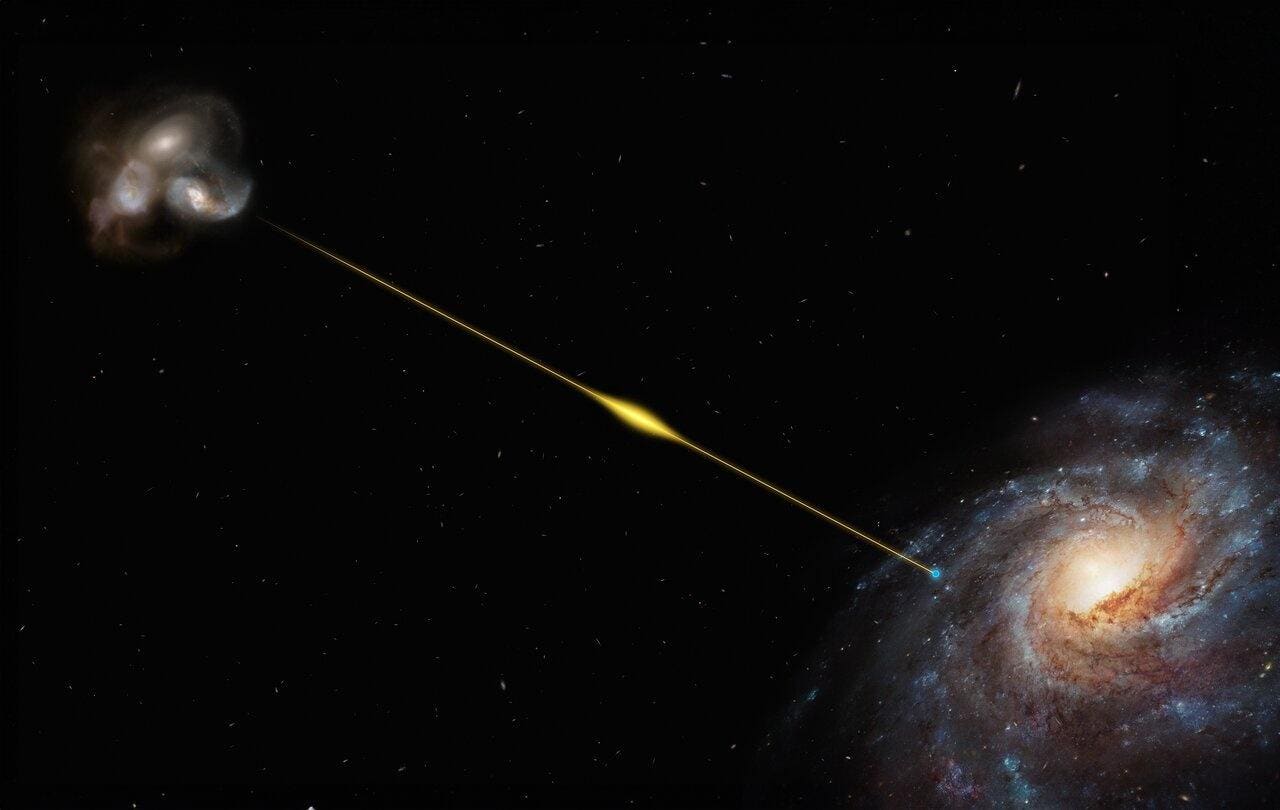
An team of astronomers have found a blast of cosmic radio waves lasting less than a millisecond about eight billion light-years from the Milky Way.
It’s the most distant fast radio burst ever detected—and one of the most energetic.
FRBs are brief and bright single radio pulses that can last for mere milliseconds. It’s thought that several thousand per day are occurring over the entire sky, but this one—dubbed FRB 20220610A after its host galaxy—is extra special.
Source Confirmed
Detected in Australia in June 2022 by the Australian Square Kilometre Array Pathfinder, it’s source was been confirmed by the European Southern Observatory’s Very Large Telescope in Chile. The discovery is published today in the journal Science.
FRB 20220610A may have lasted a fraction of a second, but during that brief time the equivalent of our sun’s total emission over 30 years was released, according to the scientists.
Vital Role
Scientists think that FRBS may come from neutron stars—the rapidly spinning remains of a collapsed core of a giant star after it’s exploded as a supernova. For now, the nature of FRBs remains a mystery, but despite that they look set to play a vital role in cosmology.
“While we still don’t know what causes these massive bursts of energy, the paper confirms that fast radio bursts are common events in the cosmos,” said Ryan Shannon, a professor at the Swinburne University of Technology in Australia, who co-led the study. “We will be able to use them to detect matter between galaxies and better understand the structure of the universe.”
Missing Matter
That’s because FRBs can be used to measure the matter between galaxies, effectively providing a new way to estimate the mass of the universe—something standard cosmology has been unable to do.
“If we count up the amount of normal matter in the Universe—the atoms that we are all made of—we find that more than half of what should be there today is missing,” said Shannon. “We think that the missing matter is hiding in the space between galaxies, but it may just be so hot and diffuse that it’s impossible to see using normal techniques.”
It’s also thought that the frequency and distance of FRBs could tell scientists about the exact rate at which the universe is expanding.
Wishing you clear skies and wide eyes.
Read the full article here