


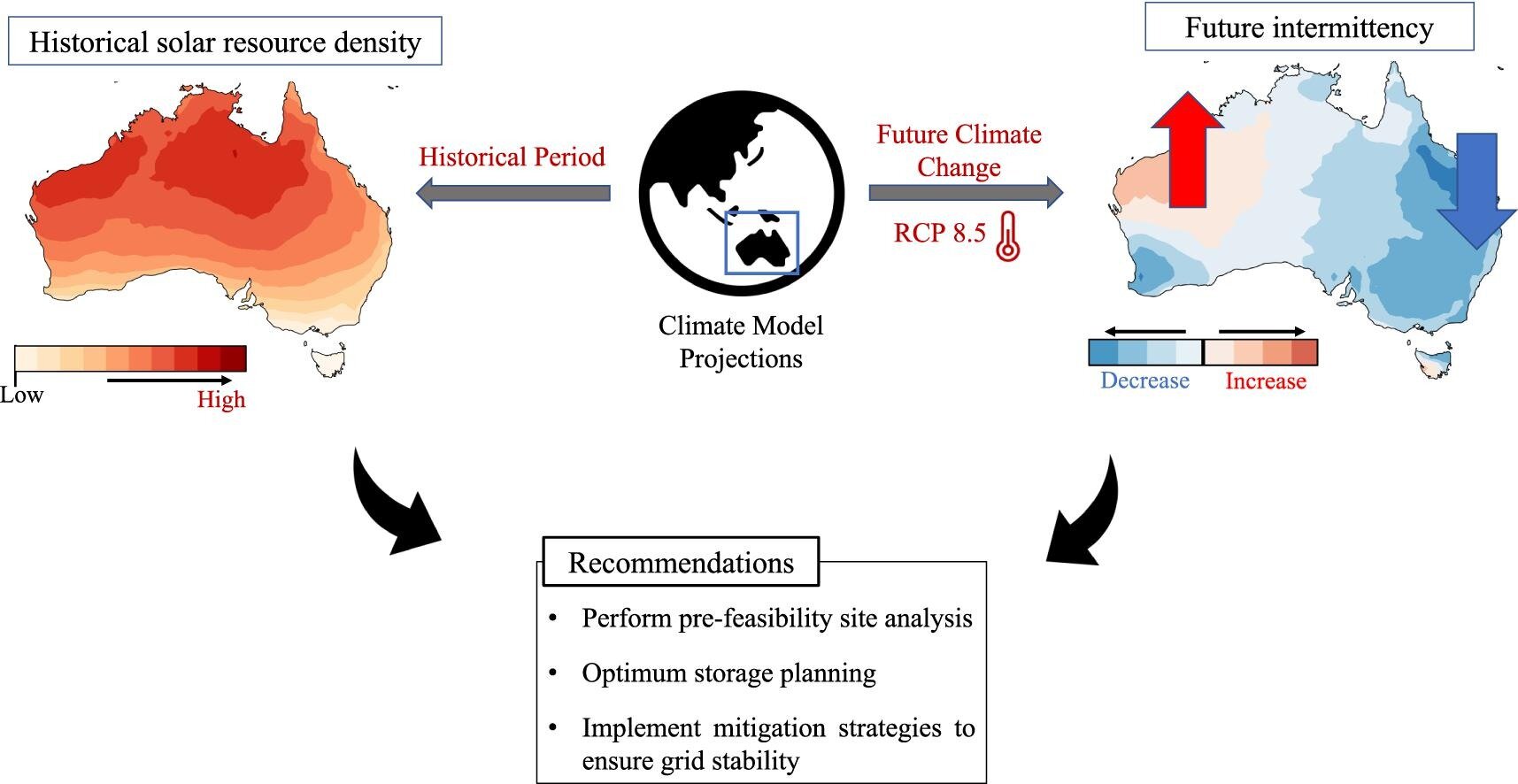
Australia’s renewable energy transition is well underway, but an impending shift in the reliability of solar due to climate change could impact generation capacity and the management of the electricity grid.
Modeling conducted by researchers from UNSW Sydney predicts changes in the availability of solar across different regions of Australia under a warmer climate. The findings, published in the journal Solar Energy, have implications for future solar power infrastructure development in Australia, including the world’s largest solar infrastructure energy network.
Australia is a prominent solar hotspot, with several notable large-scale grid-connected solar power systems—or solar photovoltaics (PV) plants—in operation or development. However, the sensitivity of solar power generation to weather-induced variability can limit its ability to deliver a consistent and dependable energy supply.
Managing grid stability due to inherent variability in solar energy generation due to factors like cloud cover, seasonal cycles, and location—all of which will be impacted by future warming—is possible with proper forecasting, power storage and load controls. But, if left unmanaged, it can lead to power deficits that can result in outages or even complete grid failures.
“Modeling future changes in solar availability is crucial for maintaining stable power generation as Australia increases its reliance on large-scale solar,” says Shukla Poddar, lead author of the study and a postdoctoral research fellow at the School of Photovoltaics and Renewable Energy Engineering. “As the climate warms, managing these weather-induced power fluctuations will be a growing challenge, so we need modeling to help better predict and prepare for these changing dynamics.”
Future solar reliability in Australia
For the study, the researchers used regional climate model simulations to map changes in Australia’s solar resource distribution and variability under a high emissions scenario—the climate trajectory Australia is currently tracking.
They found solar reliability may increase in regions of Eastern Australia by 2099. In particular, solar resource density, or irradiance, is expected to increase slightly, with fewer intermittent or lull periods (when power generation is insufficient due to unfavorable weather) and more clear sky days per year.
The findings also suggest solar reliability will decline over West Australia over the same period, with a slight decrease in availability, while intermittent periods may also increase. Episode length—the consecutive periods when solar is highly feasible for power generation—was also projected to decline, with the number of clear sky days also decreasing.
“Our study reveals Eastern Australia will experience an increase in solar resource availability and episode length in the future, indicating the probability of more stable and reliable future energy output,” Poddar says. “This region is predicted to experience a reduction in the lulls and frequency of intermittent and overcast days in the future, highlighting reduced future intermittency.
“On the contrary, some regions in Western Australia may experience increased intermittency issues, a key challenge for Australia’s future energy systems, and they will likely need to rely more heavily on energy storage solutions to ensure grid stability in the future.”
Impacts on large-scale solar PV developments
As part of the study, the researchers also completed a future solar resource assessment of the SunCable and New England solar farms in Australia.
SunCable is developing the largest solar farm in the world in the Northern Territory, which will supply renewable energy to domestic and international markets. The New England solar farm, the second largest in Australia, is also under construction and, once complete, will generate a significant amount of electricity for New South Wales.
They found the New England solar farm site will have favorable conditions in the future to generate optimum PV power, with more clear-sky days and an expected net increase in the long-term power generation capacity. However, the findings show the SunCable solar farm may experience an increase in intermittency issues in the future, suggesting the need for more energy storage systems and solar resource forecasting.
“Understanding the reliability of future solar generation can inform the design of these large-scale solar PV sites—where they should expand development and where they might need to invest more in storage technologies,” says Associate Professor Merlinde Kay, co-author of the study and lecturer in the School of Photovoltaic and Renewable Energy Engineering.
The researchers say further studies are needed to determine how to complement solar PV in Australia with other renewables, especially as more weather extremes are likely to occur.
“The next step would be to conduct a synergy study of how wind energy can complement solar in a future warmer climate, as we know hybrid systems can be advantageous for generating consistent energy supply when the sun isn’t shining or when the wind isn’t blowing,” Kay says.
“We also need to look at how disruptive extreme events, such as bushfires, will impact renewable energy generation and grid operation moving into the future, given they’re likely to increase in frequency and intensity.”
More information:
Shukla Poddar et al, Changes in solar resource intermittency and reliability under Australia’s future warmer climate, Solar Energy (2023). DOI: 10.1016/j.solener.2023.112039
University of New South Wales
Read the full article here


