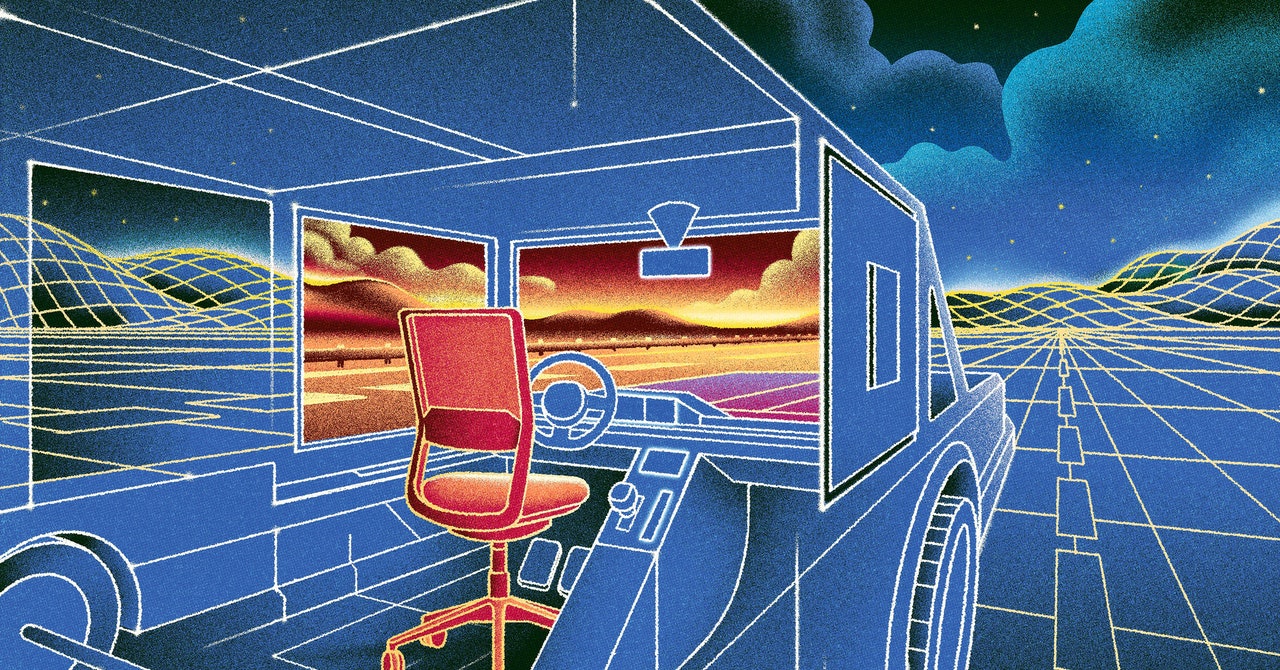
On the busy streets of suburban Berlin, just south of Tempelhofer Feld, a white Kia is skillfully navigating double-parked cars, roadworks, cyclists, and pedestrians. Dan, the driver, strikes up a conversation with his passengers, remarking on the changing traffic lights and the sound of an ambulance screaming past in the other direction. But Dan isn’t in the car.
Instead, he’s half a mile away at the offices of German startup Vay. The company kits its cars out with radar, GPS, ultrasound, and an array of other sensors to allow drivers like Dan to control the vehicles remotely from a purpose-built station equipped with a driver’s seat, steering wheel, pedals, and three monitors providing visibility in front of the car and to its side.
Vay’s approach, which it calls teledriving, is pitched as an alternative to fully autonomous driving, which is proving much harder to achieve than first thought—as the likes of Waymo, Cruise, and Tesla are discovering. Vay was cofounded by Fabrizio Scelsi, Bogdan Djukic, and Thomas von der Ohe, whose personal epiphany came while working at Zoox, one of the world’s leaders in robotaxi development.
At Zoox, remote driving was used as a failsafe for driverless cars. If a self-driving car came across an unexpected obstacle, teleguidance would allow a human operator to take control of the vehicle remotely and steer it around the obstruction.
But von der Ohe was frustrated by the industry’s slow progress. “Robotaxis, for the past 10 years or so, it always seems like they are three years out,” he says. “We actually still don’t know. So we thought about a different approach—how can we get something to market quicker that has great benefits for the customer and cities?”
Remote human assistance, von der Ohe realized, had many benefits over fully autonomous vehicles. It could prevent cars from getting stuck in tricky situations, and address safety concerns. Plus, it could be ready years, if not decades, sooner. “Why don’t we just drive ourselves?” he says.
Vay, where von der Ohe is now CEO, positions itself as an alternative approach to driverless mobility. While customers drive the vehicles like usual, Vay’s “teledrivers” take control of the vehicles once they have been used, and drive them remotely to their next destination, a Zipcar that delivers itself to your door.
Read the full article here