


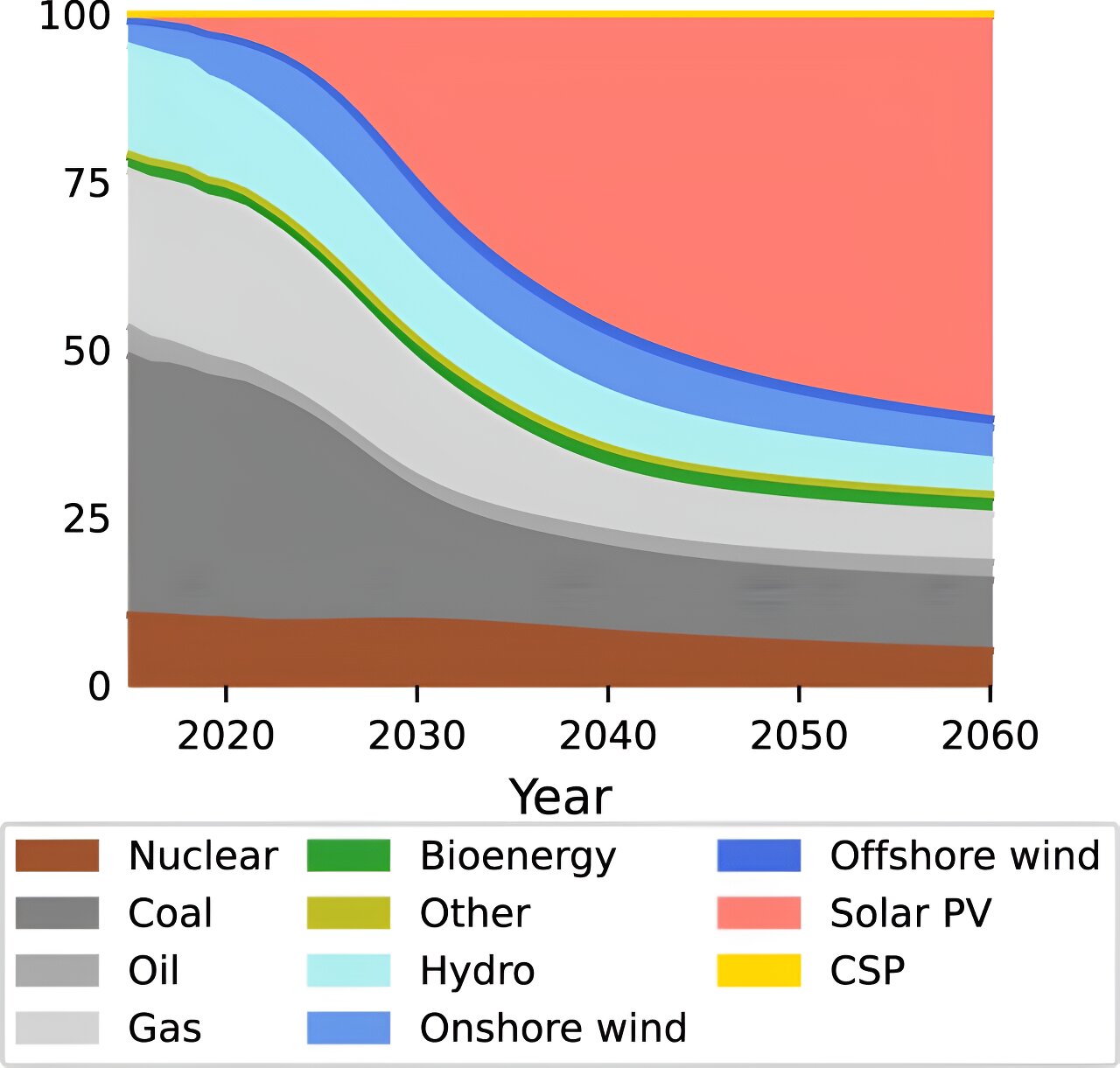
The world may have crossed a “tipping point” that will inevitably make solar power our main source of energy, new research suggests.
The study, based on a data-driven model of technology and economics, finds that solar PV (photovoltaics) is likely to become the dominant power source before 2050—even without support from more ambitious climate policies.
However, it warns four “barriers” could hamper this: creation of stable power grids, financing solar in developing economies, capacity of supply chains, and political resistance from regions that lose jobs.
The researchers say policies resolving these barriers may be more effective than price instruments such as carbon taxes in accelerating the clean energy transition.
The study, led by the University of Exeter and University College London, is part of the Economics of Energy Innovation and System Transition (EEIST) project.
“The recent progress of renewables means that fossil fuel-dominated projections are no longer realistic,” Dr. Femke Nijsse, from Exeter’s Global Systems Institute.
“In other words, we have avoided the ‘business as usual’ scenario for the power sector.”
“However, older projections often rely on models that see innovation as something happening outside of the economy.”
“In reality, there is a virtuous cycle between technologies being deployed and companies learning to do so more cheaply.”
“When you include this cycle in projections, you can represent the rapid growth of solar in the past decade and into the future.”
“Traditional models also tend to assume the ‘end of learning’ at some point in the near future—when in fact we are still seeing very rapid innovation in solar technology.”
“Using three models that track positive feedbacks, we project that solar PV will dominate the global energy mix by the middle of this century.”
However, the researchers warn that solar-dominated electricity systems could become “locked into configurations that are neither resilient nor sustainable, with a reliance on fossil fuel for dispatchable power.”
Instead of trying to bring about the solar transition in itself, governments should focus policies on overcoming the four key “barriers”:
- Grid resilience: Solar generation is variable (day/night, season, weather) so grids must be designed for this. Dr. Nijsse said, “If you don’t put the processes in place to deal with that variability, you could end up having to compensate by burning fossil fuels.” She said methods of building resilience include investing in other renewables such as wind, transmission cables linking different regions, extensive electricity storage and policy to manage demand (such as incentives to charge electric cars at non-peak times). Government subsidies and funding for R&D are important in the early stages of creating a resilient grid, she added.
- Access to finance: Solar growth will inevitably depend on the availability of finance. At present, low-carbon finance is highly concentrated in high-income countries. Even international funding largely favors middle-income countries, leaving lower-income countries—particularly those in Africa—deficient in solar finance despite the enormous investment potential.
- Supply chains: A solar-dominated future is likely to be metal- and mineral-intensive. Future demand for “critical minerals” will increase. Electrification and batteries require large-scale raw materials such as lithium and copper. As countries accelerate their decarbonization efforts, renewable technologies are projected to make up 40% of total mineral demand for copper and rare earth elements, between 60 and 70% for nickel and cobalt, and almost 90% for lithium by 2040.
- Political opposition: Resistance from declining industries may impact the transition. The pace of the transition depends not only on economic decisions by entrepreneurs, but also on how desirable policy makers consider it. A rapid solar transition may put at risk the livelihood of up to 13 million people worldwide working in fossil fuel industries and dependent industries. Regional economic and industrial development policies can resolve inequity and can mitigate risks posed by resistance from declining industries.
Commenting on the financial barrier, Dr. Nadia Ameli from UCL’s Institute for Sustainable Resources, said, “There is a growing belief that, with the dramatic decline in the global average cost of renewables, it will be much easier for the developing world to decarbonize.”
“Our study reveals persistent hurdles, especially considering the challenges these nations face in accessing capital under equitable conditions.”
“Appropriate finance remains imperative to expedite the global decarbonization agenda.”
The study is published in the journal Nature Communications.
More information:
Femke J. M. M. Nijsse et al, The momentum of the solar energy transition, Nature Communications (2023). DOI: 10.1038/s41467-023-41971-7
University of Exeter
Read the full article here


