


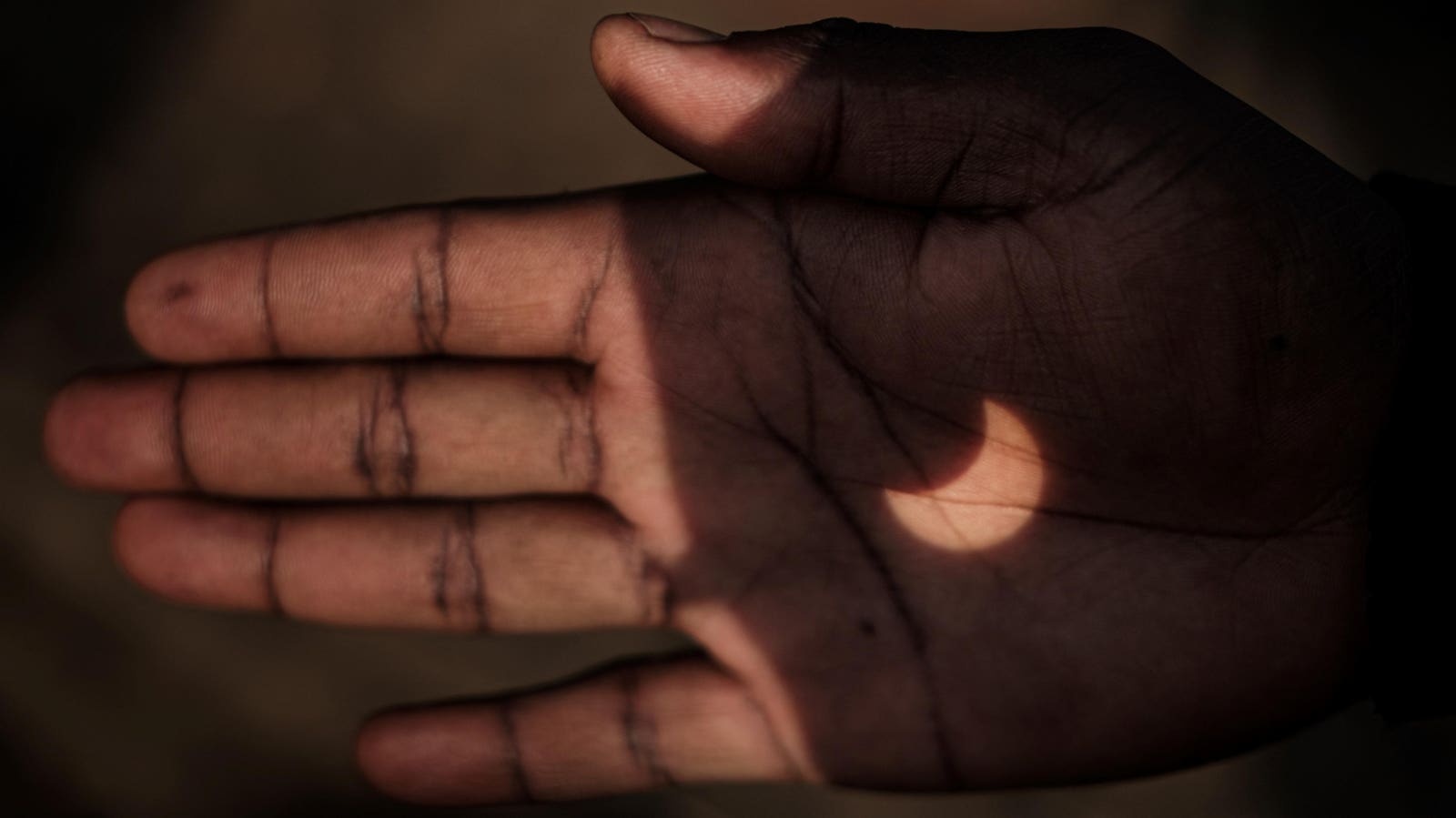
A solar eclipse will be seen from across the U.S. and beyond on Saturday, October 14—and everyone is invited.
Solar eclipse glasses are the obvious way of observing the rare event—which will be visible to everyone in the U.S and in the wider Americas as a partial solar eclipse, and to some as a “ring of fire”—but there are many more safe safe ways.
How To Safely Watch The Solar Eclipse
Is the solar eclipse safe? Solar eclipses can be dangerous and you do need to be very careful, but follow this simple advice and you’ll be safe:
- Never look at the sun with the unaided eye. You must use ISO-compliant solar filter/solar eclipse glasses—even if you’re in the path to see the “ring of fire.”
- Never look at the sun through an optical device of any kind even while wearing solar filters/solar eclipse glasses (solar filters must always be the first thing that the sunlight hits).
Here are seven ways to safely view the solar eclipse:
1. Solar Eclipse Glasses
Widely available and costing around $5 each (at most), an old pair of solar eclipse glasses may already be lurking in a cupboard at home, leftover from the last partial solar eclipse in 2021 or the total solar eclipse in 2017. If you use an old pair it’s best to check them for scratches and pin-holes, though they’re surprisingly tough and hard to damage.
To guarantee they’re safe they should show the name or logo of one of the main manufacturers—American Paper Optics, Rainbow Symphony, Thousand Oaks Optical or Baader Planetarium)—and include information about their compliance with the ISO 12312-2 international safety standard.
2. Solar Eclipse Viewer
A small piece of cardboard about the size of a smartphone, a solar eclipse viewer is essentially identical to a pair of solar eclipse glasses.
The only difference is that instead of having to hold up glasses to your eyes, you simply hold the solar eclipse viewing card in front of the sun. They slip easily into a top pocket (and hang nicely on a lanyard).
3. Project The Sun
Perhaps the best indirect way to view the progress of the moon across the sun is to create your own sun projector using a pair of binoculars on a tripod, or a telescope. It does require lining it up with the sun—and constant readjustments since the sun and moon will appear to move through the course of the eclipse—but it’s possible to project a large image of the eclipsed sun. Do not look at any point look through the binoculars or telescope at the sun—that’s incredibly dangerous.
4. Stand Near A Tree
Leaves of trees collectively act as a pinhole camera, effectively forcing eclipsed sunlight through tiny gaps in the foliage. The effect is images of the crescent-shaped partially eclipsed sun projected onto the ground below.
5. Go Fetch A Slotted Spoon
Anything with small, well-defined holes—such as a slotted spoon, a kitchen/spaghetti colander or a piece of card that you’ve attacked with a hole-punch—can be used to project crescent suns.
6. Make A Pinhole Projector
Few bother these days, but building a pinhole camera can be fun and will let you safely follow the progress of the eclipse without having to directly observe it. Just be prepared for a very small image.
7. Live Stream It On YouTube
The safest, easiest and most hassle-free way of seeing the eclipse is, of course, on your smartphone. For incredible views from across North, Central and South America—and notably of the “ring of fire” that will be visible in the U.S. Southwest, Mexico’s Yucatan Peninsula, Belize, Honduras, Nicaragua, Panama, Colombia and Brazil—visit these live streams on YouTube:
I’m an expert on eclipses—the editor of WhenIsTheNextEclipse.com and author of The Complete Guide To The Great North American Eclipse of April 8, 2024. For the very latest on the “ring of fire” solar eclipse—including travel and lodging options—check my main feed for new articles each day.
Wishing you clear skies and wide eyes.
Read the full article here



